
Last updated:
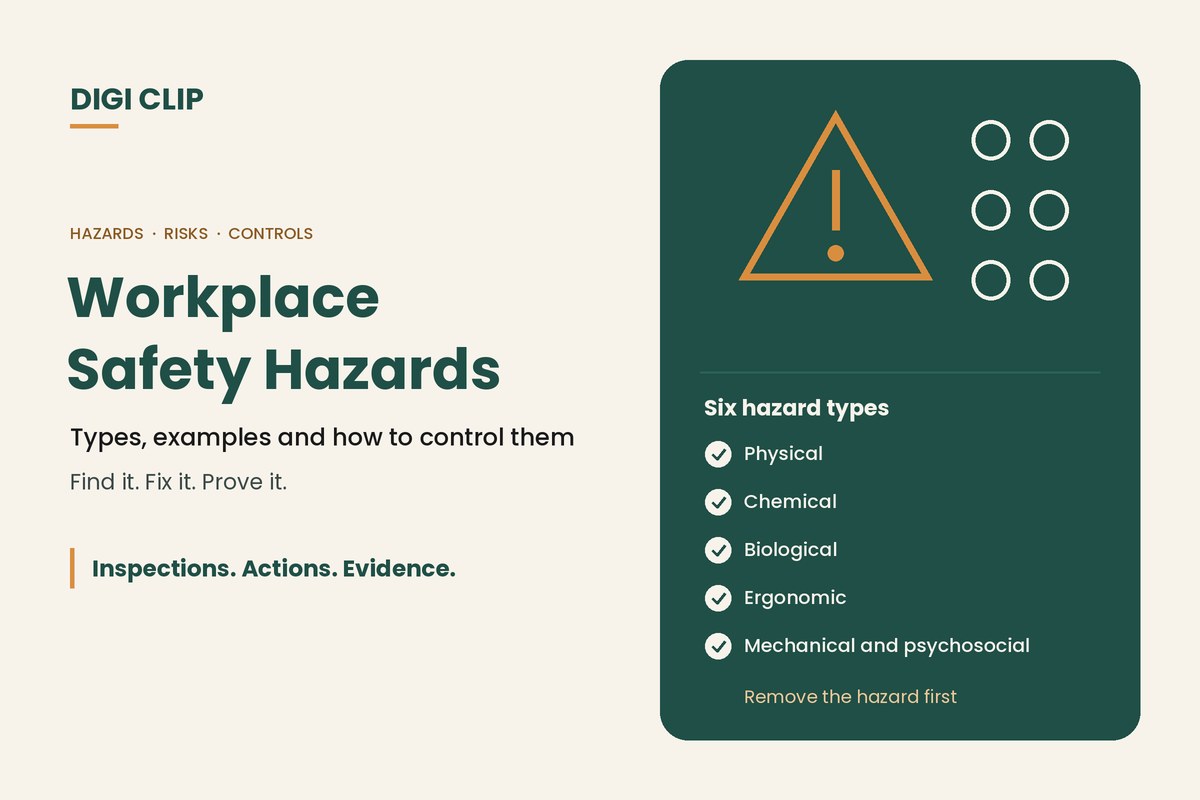
A workplace safety hazard is anything at work that could cause harm to people’s health or safety. Hazards are usually grouped as physical, chemical, biological, ergonomic, mechanical and psychosocial. Managing them means identifying the hazard, assessing the risk, putting controls in place and checking those controls keep working.
Workplace Safety Hazards: Types, Examples and How to Control Them
Every workplace has hazards, from the obvious, like moving machinery, to the less visible, like excessive workloads or poor air quality. WHS laws require businesses to identify and manage them. This guide explains the main types of workplace hazards with examples, how to identify and control them, and how regular hazard inspections keep controls in place.
Key points
- Hazards fall into physical, chemical, biological, ergonomic, mechanical and psychosocial types.
- A hazard is the source of harm. Risk is the chance and severity of that harm.
- Use the hierarchy of controls, starting by removing the hazard.
- Psychosocial hazards must be managed like any other hazard.
- Regular inspections and hazard reports keep controls working.
Types of workplace hazards
| Type | Examples | Guide |
|---|---|---|
| Physical | Noise, heat, falls, slips and trips, electricity, vibration | Noise, slips and trips |
| Chemical | Solvents, fuels, cleaning products, dusts and fumes | Chemical hazards |
| Biological | Bacteria, viruses, mould, body fluids, animal products | Biological hazards |
| Ergonomic | Manual handling, repetitive tasks, awkward postures | Hazardous manual tasks |
| Mechanical and plant | Moving parts, vehicles, forklifts, falling objects | Machine guarding, struck-by |
| Psychosocial | High job demands, poor support, bullying, harassment, fatigue | Fatigue |
Hazard vs risk
A hazard is something that could cause harm, like an unguarded machine or a wet floor. Risk is the likelihood that harm will happen and how serious it could be. A risk assessment looks at both, so controls can be prioritised. See our guide to workplace risk assessments.
Managing workplace hazards
- Identify hazards. Walk the workplace, review incidents and near misses, and talk to workers.
- Assess the risks. Consider how likely harm is and how serious it could be.
- Control the risks. Work down the hierarchy: remove the hazard, substitute, isolate, engineering controls, administrative controls, then PPE.
- Consult workers. Involve the people doing the work in choosing and reviewing controls.
- Check controls. Inspect regularly to confirm controls are in place and working.
- Review. Update controls after incidents, changes to work, or new information.
Hazard inspections
Regular workplace hazard inspections, plus an easy way for anyone to report a hazard, are the most practical way to keep controls working. Good inspections are:
- planned: set frequencies for each area, based on risk
- specific: checklists tailored to the area and its hazards
- evidence-based: photos and clear comments on anything found
- followed up: every finding assigned and closed out
See our guide to workplace safety inspections.
Hazard reporting and inspections with DIGI CLIP
With DIGI CLIP, workers report hazards and supervisors complete inspections on a phone, with photos. Each form is location- and time-stamped. Hazards become actions in the Action Log, assigned and closed out with evidence, and the Safety Tracker module supports hazard assessments with a risk matrix.
Illustrative scenario: a hazard report from the floor
A worker at a manufacturing plant notices a trailing extension lead across a walkway near a new workstation. She submits a hazard report in DIGI CLIP with a photo, which creates an action for the maintenance lead. A permanent power point is installed that week, and the action is closed out with a photo.
This scenario is illustrative. It shows how a business could use DIGI CLIP and is not an account of a specific customer.
Find and Fix Workplace Hazards
Put hazard reports and inspections on your team’s phones and see hazards land in the Action Log, ready to fix and prove.
Start Your 14-Day Free TrialNo credit card required. Set up in minutes.
Frequently asked questions
What are the main types of workplace hazards?
Physical, chemical, biological, ergonomic, mechanical and plant, and psychosocial hazards.
What is the difference between a hazard and a risk?
A hazard is something that could cause harm. Risk is the likelihood that harm will happen and how serious it could be.
What are psychosocial hazards?
Aspects of work that can cause psychological harm, such as high job demands, low support, poor workplace relationships, bullying, harassment and fatigue. They must be managed like any other hazard.
How are workplace hazards controlled?
Using the hierarchy of controls: remove the hazard where possible, then substitute, isolate, use engineering controls, administrative controls, and PPE for the remaining risk.
How often should workplace hazard inspections be done?
It depends on the risk. High-risk areas may need daily checks, while others can be inspected weekly or monthly, with extra inspections after changes or incidents.
Can hazards be reported on a phone?
Yes. In DIGI CLIP, workers report hazards on a phone with photos, and each report becomes an action in the Action Log.
About DIGI CLIP Mobile Forms
DIGI CLIP is an Australian-built mobile checklist and inspection platform. Inspections. Actions. Evidence. Teams complete checks on a phone or tablet, turn defects into assigned actions, and keep the proof that each one was fixed and verified.
See our Form Library for ready-made templates.






