Last updated:
An electrical safety inspection checklist is a structured list of checks for electrical equipment and installations at work, such as leads, plugs, power boards, switchboards and RCDs. It helps workers and supervisors spot damage and unsafe practices early, so faulty equipment is taken out of use before someone gets hurt.
Electrical Safety Inspection Checklist: A Practical Guide for Workplaces
Most electrical incidents at work start with something that could have been seen: a cracked plug, a lead with exposed wires, a power board daisy-chained behind a bench, or an RCD nobody has tested. A simple, regular electrical safety inspection catches these problems early. This guide gives you a practical checklist, explains who should do which checks, and covers how inspection and testing (“test and tag”) fits in.
Key points
- Workers can do visual checks of equipment before use. Testing and electrical work need a competent person, usually a licensed electrician or electrical inspector.
- Check leads, plugs, power boards, equipment casings, switchboards, outlets and RCDs.
- AS/NZS 3760:2022 covers in-service inspection, testing and tagging of electrical equipment and RCDs.
- Higher-risk environments need more frequent inspection and testing.
- Any faulty item should be removed from use, tagged out, reported and repaired or replaced.
Who does which electrical checks
Electrical safety at work involves three different levels of checking. Everyone has a part, but only competent people should test equipment or do electrical work.
| Check | Who does it | What it involves |
|---|---|---|
| Pre-use visual check | The person using the equipment | Looking for damage to leads, plugs, casings and power boards before use |
| Workplace electrical inspection | Supervisor, safety officer or trained staff member | A walk-through of work areas using a checklist, covering equipment, outlets, switchboard access and unsafe practices |
| Inspection and testing | A competent person, usually a licensed electrician or electrical inspector | Formal inspection, electrical testing, RCD testing and tagging, often following AS/NZS 3760 |
| Electrical repairs and installation work | A licensed electrician | Any repair, alteration or installation work on electrical equipment or wiring |
Types of electrical safety inspection
“Electrical safety inspection” can mean several different checks. Most workplaces need a mix of them:
| Inspection | What it covers | Who does it |
|---|---|---|
| Pre-use visual check | Leads, plugs, casings and power boards checked for damage before use | The person using the equipment |
| Workplace electrical inspection | A walk-through of work areas: equipment condition, outlets, power boards, switchboard access and unsafe practices | Supervisor or trained staff member |
| Test and tag | In-service inspection and electrical testing of plug-in equipment, with a tag and a record | A competent person |
| RCD testing | Push-button tests of safety switches, and operating-time tests with test equipment | Users for push-button tests; a competent person for operating-time tests |
| Installation and switchboard inspection | Fixed wiring, switchboards, circuit protection and signs of overheating | A licensed electrician |
Electrical visual inspection checklist
Use these checks for portable electrical equipment, extension leads and power boards. Anything that fails should be taken out of use straight away.
Free download: Facility Electrical Safety Checklist (PDF)
A three-page walkthrough checklist covering switchboards, portable equipment and leads, fixed installations, emergency systems and compliance records.
Prefer to run it on your phone? The same checklist is in the DIGI CLIP Form Library. Start your free 14-day trial.
Leads and cords
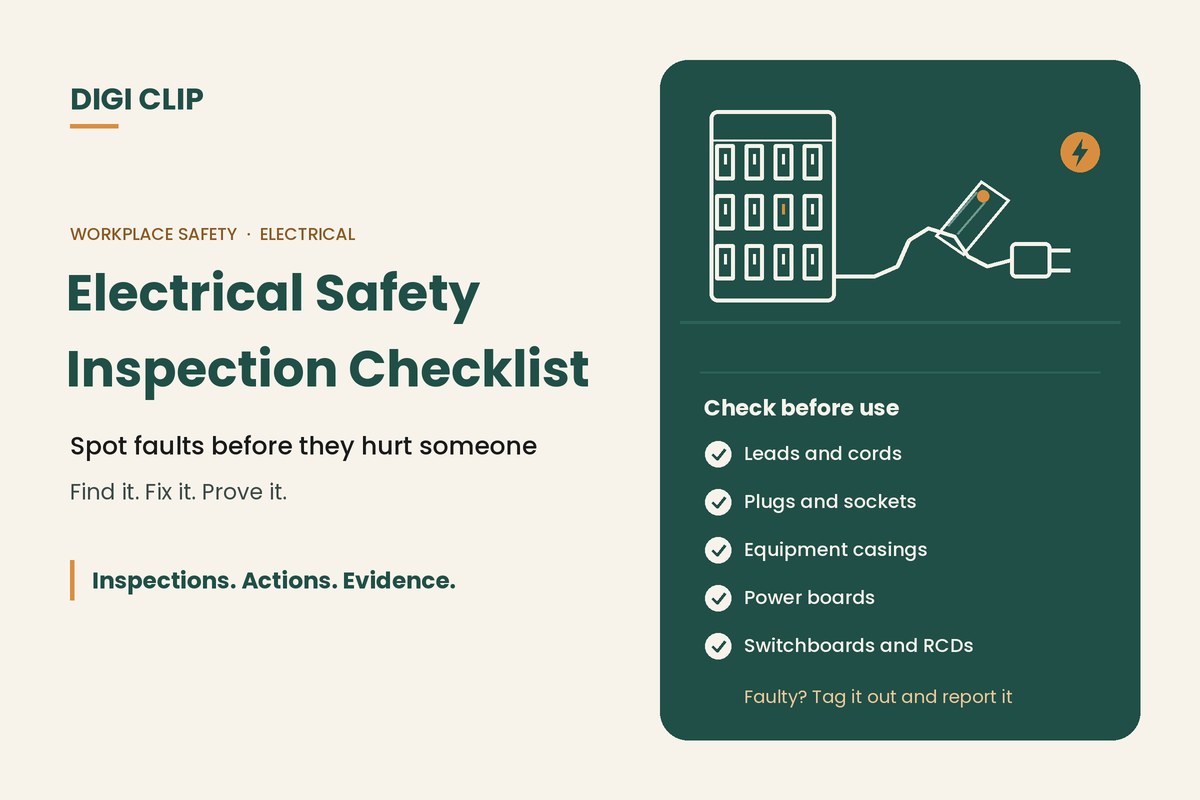
- No cuts, abrasions, burns or exposed inner wires
- Outer sheath firmly held where it enters the plug and the equipment
- No joins, tape repairs or kinks
- Not run through doorways, across walkways or where it can be crushed or driven over
Plugs and sockets
- No cracks, chips or scorch marks
- Pins straight, secure and not loose or damaged
- No signs of overheating, such as discolouration or a burning smell
Equipment
- Casing intact, with no cracks, missing screws or exposed parts
- Switches and controls working properly
- Guards and covers in place
- Current test tag in date, where your workplace uses test and tag
Power boards and extension leads
- Power boards with overload protection where required by your procedures
- No piggybacking of power boards or double adaptors
- Extension leads fully unwound when in use and suitable for the load
- Kept away from water, heat and sharp edges
Workplace electrical safety checklist
Use this list for a regular walk-through of each work area, workshop or site.
- Switchboards: doors closed and labelled, clear access kept, no signs of heat damage or water
- RCDs: fitted where required, test records current, push-button tests done as your procedure requires
- Outlets and fittings: no cracked covers, loose outlets or scorch marks
- Wet areas: electrical equipment kept away from water unless designed for it
- Portable equipment: stored properly, with damaged items tagged out and separated
- Overhead and underground services: identified before work near them, with exclusion zones where needed
- Isolation: lockout and tag-out equipment available and used for maintenance work
- Signage and emergency: isolation points marked, and staff know how to shut off power and respond to an electric shock
For isolation procedures, see our guide to lock out, tag out, try out.
Inspection and testing (test and tag)
Visual checks catch obvious damage, but some faults can only be found by testing. AS/NZS 3760:2022 is the Australian and New Zealand standard for in-service safety inspection and testing of electrical equipment and RCDs. It covers visual inspection, electrical tests, tagging, record-keeping and recommended intervals based on the type of equipment, the environment and how it is used.
Safe Work Australia’s guidance on electrical safety WHS duties explains that equipment used in higher-risk environments, where it is likely to be damaged or have its life reduced, should be inspected and tested by a competent person, and that RCDs should be tested regularly. It also notes that a competent person is usually a licensed or registered electrician or licensed electrical inspector.
Requirements differ between states and territories, so check the rules that apply to your workplace. The model Code of Practice: Managing electrical risks in the workplace has more detail.
How often: typical inspection and testing intervals
AS/NZS 3760:2022 sets out recommended intervals based on the environment and how equipment is used. Typical intervals for plug-in equipment, cords, extension leads and power boards are:
| Environment | Typical test and tag interval |
|---|---|
| Construction and demolition sites | Every 3 months (AS/NZS 3012) |
| Factories, workshops, and repair and assembly areas | Every 6 months |
| Commercial cleaning equipment | Every 6 months |
| Other hostile environments, where cords are subject to flexing, damage or harsh conditions | Every 12 months |
| Hotels, motels and other residential-type areas | Every 2 years |
| Equipment not subject to flexing, damage or hostile conditions, such as in offices | Up to every 5 years |
RCDs also need regular checks: push-button tests by users, which for portable RCDs in workshops and cleaning can be daily or before each use, and operating-time tests by a competent person, commonly every 12 months in higher-risk environments. Always check the current standard, the manufacturer’s instructions and your state or territory rules, and test more often where equipment is damaged or heavily used.
WHS requirements for electrical inspections
Under the model Work Health and Safety Regulations:
- Hostile operating environments: plug-in electrical equipment used where it is exposed to moisture, heat, vibration, mechanical damage, corrosive chemicals or dust must be regularly inspected and tested by a competent person.
- Competent person: someone with the knowledge and skills for the task, such as a licensed electrician, a licensed electrical inspector, or a person who has completed structured training in portable appliance testing, depending on your state or territory.
- RCDs: where reasonably practicable, plug-in equipment in hostile operating environments supplied through socket outlets of up to 20 amps should be protected by an RCD with a tripping current of no more than 30 milliamps.
- Construction work: AS/NZS 3012 applies to electrical installations on construction and demolition sites.
Victoria has its own OHS regulations, and other states have variations, so check the rules with your regulator. Safe Work Australia’s fact sheet on electrical risks at the workplace is a good starting point.
Records to keep
Test records should show the name of the person who did the testing, the date, the outcome, and the date the next test is due. Keep them until the equipment is next tested or permanently removed from the workplace. It also helps to record:
- workplace electrical inspections, with photos of any issues found
- faulty equipment removed from service, and whether it was repaired or disposed of
- RCD push-button test results
- who fixed each fault and when it was closed out
Common electrical hazards at work
- Damaged leads and equipment still in use because nobody reported them
- Overloaded outlets and power boards, including piggybacked boards and double adaptors
- Water and electricity together, such as equipment used in wash-down areas or outdoors in the rain
- DIY repairs by people who are not licensed to do electrical work
- Working near live parts without proper isolation
- Overhead powerlines near cranes, tippers, elevating work platforms and ladders
- Blocked switchboards that slow down isolation in an emergency
What to do when you find an electrical fault
- Stop using it. Don’t keep working with equipment that is damaged or behaving strangely.
- Isolate it safely. Switch off and unplug the equipment if it is safe to do so. Don’t touch anything that may be live.
- Tag it out. Attach a danger or out-of-service tag and move it where it can’t be used by mistake.
- Report it. Record the fault with a photo and notify your supervisor. If someone was hurt or nearly hurt, log it in Safety Tracker so it's investigated.
- Repair or replace it. Repairs must be done by a licensed electrician or competent person. Damaged cheap items are often better replaced.
- Record the close-out. Note what was done, by whom and when, before the item goes back into service.
Digital electrical safety inspections
Paper checklists make it hard to see which areas were inspected, what was found and whether faults were fixed. With a digital checklist, the inspector works through each item on a phone or tablet, photographs any fault and submits the inspection on the spot. Checklists can be completed without coverage and submitted with a tap once the device is back online. For substations, transformers and other assets, see our asset inspection checklist app guide.
In DIGI CLIP, failed items flow into the Action Log, where they are assigned, tracked and closed out with evidence. Overdue actions trigger alert emails, and records can be exported to PDF or Excel. You can run electrical checks alongside your other workplace safety inspections and equipment inspections in the same app.
Illustrative scenario: a workshop walk-through
A supervisor completes a monthly electrical walk-through of a maintenance workshop in DIGI CLIP. She finds a grinder lead with a split sheath and a power board piggybacked behind a workbench. She tags the grinder out, photographs both issues and submits the checklist. Two actions appear in the Action Log: one for the electrician to replace the lead, one for the workshop lead to remove the piggybacked board. Both are closed out with photos by the end of the week.
This scenario is illustrative. It shows how a workplace could use DIGI CLIP and is not an account of a specific customer.
Run Your Electrical Safety Checks in DIGI CLIP
Build your electrical safety checklist, complete it on your phone and turn every fault into an action you can track and prove.
Start Your 14-Day Free TrialNo credit card required. Set up in minutes.
Frequently asked questions
What is an electrical safety inspection checklist?
An electrical safety inspection checklist is a structured list of checks for electrical equipment and installations at work, such as leads, plugs, power boards, switchboards and RCDs. It helps workers and supervisors spot damage and unsafe practices early, so faulty equipment is taken out of use before someone gets hurt.
What should a visual inspection of electrical equipment include?
Check leads and cords for cuts, exposed wires and poor repairs, plugs for cracks, damaged pins or signs of overheating, equipment casings for damage and missing parts, and power boards for overloading or piggybacking. Remove anything faulty from use straight away.
Who can inspect and test electrical equipment?
Workers can do visual checks before use. Formal inspection and testing should be done by a competent person, who is usually a licensed or registered electrician or a licensed electrical inspector. Any electrical repair or installation work must be done by a licensed electrician.
What is AS/NZS 3760?
AS/NZS 3760:2022 is the Australian and New Zealand standard for in-service safety inspection and testing of electrical equipment and RCDs. It covers visual inspection, electrical testing, tagging, records and recommended intervals based on equipment type, environment and use.
How often should electrical equipment be inspected and tested?
It depends on the environment and how the equipment is used. Typical intervals under AS/NZS 3760 range from every 3 months on construction sites and 6 months in factories and workshops, to 12 months in other hostile environments and up to 5 years for equipment in offices. Check the current standard, the manufacturer’s instructions and your state or territory rules.
Can I do electrical safety inspections on a phone?
Yes. In DIGI CLIP, you complete the checklist on a phone or tablet, attach photos of any faults and submit it on the spot. Checklists can be completed without coverage, and failed items flow into the Action Log for follow-up.
What is an electrical safety inspection?
A check of electrical equipment and work areas for hazards such as damaged leads, faulty plugs, overloaded power boards and missing safety switches. It can range from a quick pre-use visual check to formal inspection and testing by a competent person.
Is test and tag a legal requirement?
Under the model WHS Regulations, plug-in electrical equipment used in hostile operating environments must be regularly inspected and tested by a competent person. Requirements differ between states and territories, so check the rules that apply to your workplace.
What records must be kept for electrical testing?
The name of the person who did the testing, the date, the outcome and the date the next test is due. Records should be kept until the equipment is next tested or permanently removed from the workplace.
About DIGI CLIP Mobile Forms
DIGI CLIP is an Australian-built mobile checklist and inspection platform. Inspections. Actions. Evidence. Teams complete checks on a phone or tablet, turn defects into assigned actions, and keep the proof that each one was fixed and verified.
Compare options in our guide to the best inspection software and mobile apps.