
Last updated:
A workplace safety inspection is a planned walk-through of a work area to find hazards, check that controls are working and record what needs fixing. Unlike an audit, which reviews the safety system as a whole, an inspection looks at the physical workplace, equipment and work practices as they are on the day.
Workplace Safety Inspections: How to Plan, Conduct and Follow Up
Regular inspections are one of the simplest ways to find hazards before someone gets hurt. The value isn’t in the walk-around itself, though. It’s in what happens afterwards: every hazard assigned, fixed and checked. This guide covers why inspections matter under Australian WHS law, how often to inspect, what to look for, a step-by-step process and how to close out what you find.
Key points
- Inspections help you identify hazards and check that control measures are still working, which WHS law expects.
- Set how often to inspect based on the level of risk, how fast conditions change and any legal or manufacturer requirements.
- Use a checklist tailored to the area, and involve the people who work there.
- Every finding needs an owner, a due date and evidence that it was fixed.
- Look for trends across inspections, not just individual findings.
Why workplace safety inspections matter
Under the model Work Health and Safety laws, a business must manage risks to health and safety: identify hazards, remove or minimise the risks so far as is reasonably practicable, and keep control measures effective. The WHS Regulations also require control measures to be reviewed and, where needed, revised in certain situations, such as when a control isn’t working, a new hazard is identified or a health and safety representative asks for a review.
The law doesn’t set one inspection schedule for every workplace, but regular inspections are one of the most practical ways to meet these duties. They also give workers a visible way to raise concerns. Elected health and safety representatives can also inspect the workplace, after giving reasonable notice, or without notice after an incident or where there is a serious risk.
Inspections vs audits
| Inspection | Audit | |
|---|---|---|
| Focus | Physical conditions, equipment and work practices | The safety management system as a whole |
| Frequency | Often: daily, weekly or monthly | Less often: typically yearly or on a set cycle |
| Who | Supervisors, workers, HSRs | Trained internal or external auditors |
| Output | Hazards and actions to fix them | Findings on how well the system works |
You need both. See our workplace safety audit checklist for the audit side.
How often should you inspect?
Base the frequency on risk. Things to consider:
- Level of risk: high-risk areas such as workshops, loading docks and construction sites need more frequent checks than offices.
- How fast conditions change: a construction site changes daily, while a storeroom may not.
- Legal and manufacturer requirements: some plant, equipment and activities have their own inspection requirements.
- History: areas with incidents, near misses or recurring findings deserve more attention.
A common pattern is daily pre-start checks on equipment, weekly supervisor walk-throughs of high-risk areas, and monthly or quarterly inspections of the whole site.
What to look for
- Housekeeping: clear walkways and exits, no slip or trip hazards, rubbish removed
- Emergency preparedness: exits and signs clear, fire extinguishers in date, first aid kits stocked, evacuation plans current
- Plant and equipment: guards in place, emergency stops working, pre-start checks completed
- Electrical: leads and plugs undamaged, testing and tagging current where required, no overloaded power boards
- Hazardous chemicals: labelled, stored correctly, safety data sheets available
- Work at height: ladders, platforms and edge protection in good condition
- Manual handling: lifting aids available and used, loads stored at sensible heights
- Traffic management: separation between people and vehicles or mobile plant
- PPE: available, in good condition and being worn where required
- Work practices: people following procedures, and whether the procedures are workable
For more on specific hazards, see our guide to workplace safety hazards.
How to conduct a workplace safety inspection
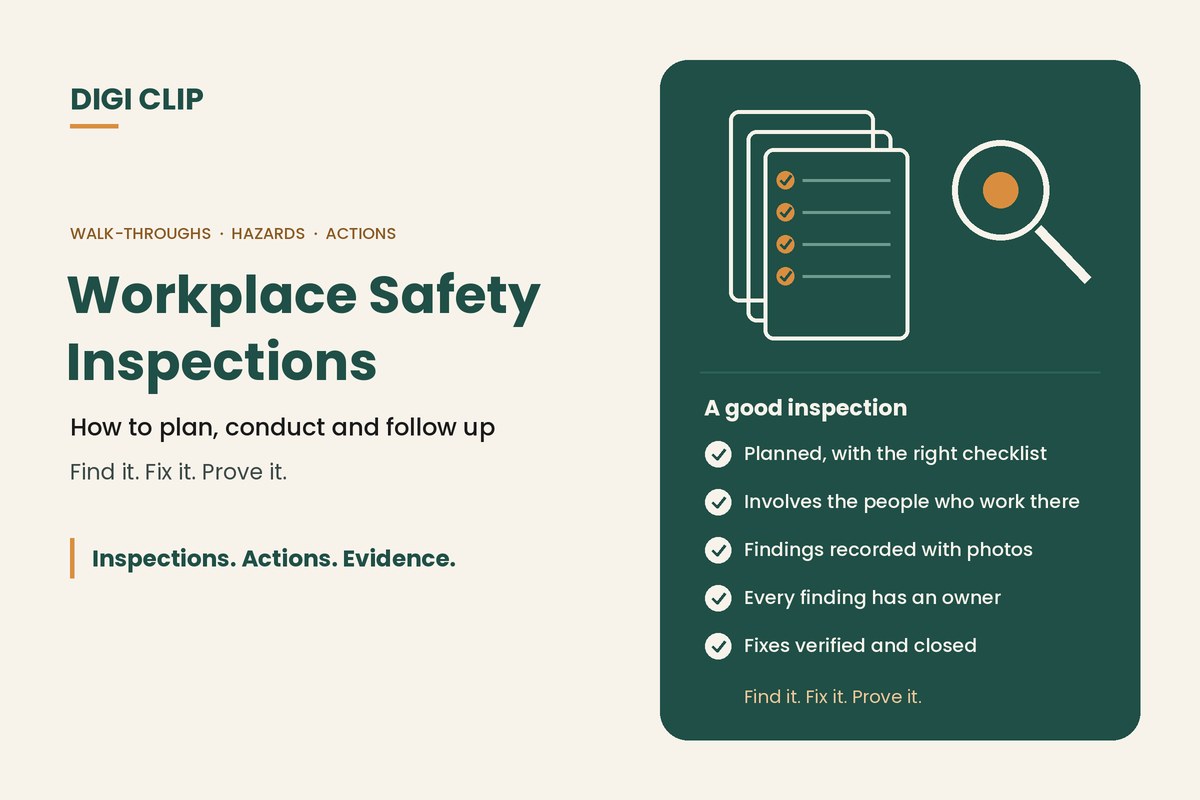
- Plan the inspection. Choose the area, pick or build a checklist for it, and review previous inspections, incidents and open actions for that area.
- Involve the right people. Include a supervisor and, where possible, a worker or health and safety representative from the area. They know where the problems are.
- Walk the area. Work through the checklist, but also look for anything the checklist doesn’t cover. Talk to workers about the hazards they see.
- Record findings with evidence. Photograph each hazard, describe where it is and rate how serious it is.
- Act on serious risks straight away. If something poses an immediate risk, stop the work or isolate the hazard before you move on.
- Assign and follow up. Give every finding an owner and a due date, and check it is fixed.
Following up on findings
Most inspection programs fail at the follow-up. A few habits make the difference:
- One owner per action: “maintenance” isn’t an owner; a named person is.
- Due dates based on risk: high-risk findings fixed in hours or days, lower-risk ones within weeks.
- Evidence of the fix: a photo or note showing the hazard has been dealt with.
- Escalation: overdue actions are flagged to a manager rather than quietly left open.
- Trends: review findings across inspections to spot recurring problems and areas that need a different kind of control.
Our guide on why reported isn’t resolved covers this gap in more detail.
Digital inspections
With DIGI CLIP, inspectors complete checklists on a phone or tablet, even without coverage, and add photos, comments and signatures to each finding. Each form is location- and time-stamped. Findings flow into the Action Log, where they are assigned, tracked and closed out with evidence, and overdue actions are escalated by email. See our guide to choosing an inspection app for a feature-by-feature checklist. Incidents, hazards and investigations can be managed alongside inspections in Safety Tracker. For electrical equipment, see our electrical safety inspection checklist and guide.
Illustrative scenario: a blocked fire exit
During a weekly walk-through at a distribution centre, a supervisor finds pallets stacked in front of a fire exit. She records it in DIGI CLIP with a photo, rates it high risk and has the pallets moved on the spot. She also raises an action for the warehouse manager to mark a no-stacking zone. The manager closes it out two days later with a photo of the new floor markings.
This scenario is illustrative. It shows how a business could use DIGI CLIP and is not an account of a specific customer.
Need a checklist to start with? See our guide to building safety checklists or browse the DIGI CLIP Form Library.
Turn Every Inspection Finding Into a Fix
Put your inspection checklists on your team’s phones and see findings land in the Action Log, ready to fix and prove.
Start Your 14-Day Free TrialNo credit card required. Set up in minutes.
Frequently asked questions
What is a workplace safety inspection?
A workplace safety inspection is a planned walk-through of a work area to find hazards, check that controls are working and record what needs fixing. Unlike an audit, which reviews the safety system as a whole, an inspection looks at the physical workplace, equipment and work practices as they are on the day.
Are workplace safety inspections a legal requirement in Australia?
WHS laws don’t set one inspection schedule for every workplace, but they require businesses to identify hazards, control risks and keep control measures effective. Regular inspections are one of the most practical ways to meet those duties, and some plant and activities have their own inspection requirements.
How often should workplace inspections be done?
Base it on risk. High-risk and fast-changing areas such as construction sites and workshops may need daily or weekly checks, while low-risk areas such as offices may only need monthly or quarterly inspections.
Who should carry out workplace safety inspections?
Usually a supervisor or manager for the area, ideally with a worker or health and safety representative who knows the work. Elected health and safety representatives can also inspect the workplace themselves.
What is the difference between a safety inspection and a safety audit?
An inspection checks physical conditions, equipment and work practices in an area, usually often. An audit reviews how well the whole safety management system is working, usually on a yearly or set cycle.
What should happen after a workplace inspection?
Deal with any immediate risks straight away, then give every finding an owner and a due date, check it has been fixed, and record the evidence. Review findings over time to spot recurring problems.
About DIGI CLIP Mobile Forms
DIGI CLIP is an Australian-built mobile checklist and inspection platform. Inspections. Actions. Evidence. Teams complete checks on a phone or tablet, turn defects into assigned actions, and keep the proof that each one was fixed and verified.
See our Form Library for ready-made templates.






