Last updated:
Quick definition: In a compliance context, "reporting" shows that an activity happened — a form was filled in, a hazard was logged. "Evidence" shows the outcome — that the issue was actually resolved and verified, with a timestamped record to support it. The two are often treated as the same thing. They aren't.
Reported Isn't Resolved: Why the Compliance Record Doesn't End With the Form
A pre-start inspection flags a brake light defect. The driver logs it, attaches a photo, and moves on. The form is complete. The box is ticked.
Three weeks later, that same defect turns up in an incident report.
Nobody skipped a step. The inspection happened. The paperwork exists. And yet, somewhere between "defect flagged" and "problem fixed," the trail went cold — because most systems are built to capture that a form was completed, not to track what happened after.
That gap is where a lot of real-world compliance risk can end up sitting.
Key takeaways
- A completed form shows an activity happened. It doesn't, by itself, show the issue was resolved.
- Under Chain of Responsibility and HVNL, regulators can ask what was done about a flagged issue — not just whether it was identified.
- A defensible record generally needs four stages: flagged, assigned, resolved, and verified.
- Digitising a form only digitises the reporting half of the process — it doesn't automatically close the loop on what happens next.
In this article
The quiet failure mode
Most operators aren't dealing with missing paperwork. They're dealing with paperwork that looks complete but doesn't tell the whole story.
A hazard gets reported. A corrective action gets assigned. And then it can sit — in an inbox, on a whiteboard, in someone's memory — with no system tracking whether it was ever actually resolved. The form says the job was logged. It doesn't say the risk was controlled.
This is easy to miss because it doesn't look like a failure. Everyone did their job. The forms are filed. It's often only when someone goes looking — an auditor, an insurer, an investigator after an incident — that the gap becomes obvious: there's evidence a problem was reported, but no evidence it was fixed.
Reporting and evidence aren't the same thing
It's worth being precise about the difference, because the two get treated as interchangeable and they're not.
Reporting shows an activity happened — a form was filled in, a check was completed, a hazard was logged.
Evidence shows an outcome — the defect was fixed, the action was verified, the risk was brought under control, and there's a timestamped, attributable record showing it.
Under Chain of Responsibility and Heavy Vehicle National Law, this distinction can carry real weight. Regulators and courts are typically not just asking whether an issue was identified. They can ask what the business did about it, who was responsible, and whether that can be demonstrated after the fact. A completed form with no closed-out action doesn't answer that question — it just shows the problem was known about.
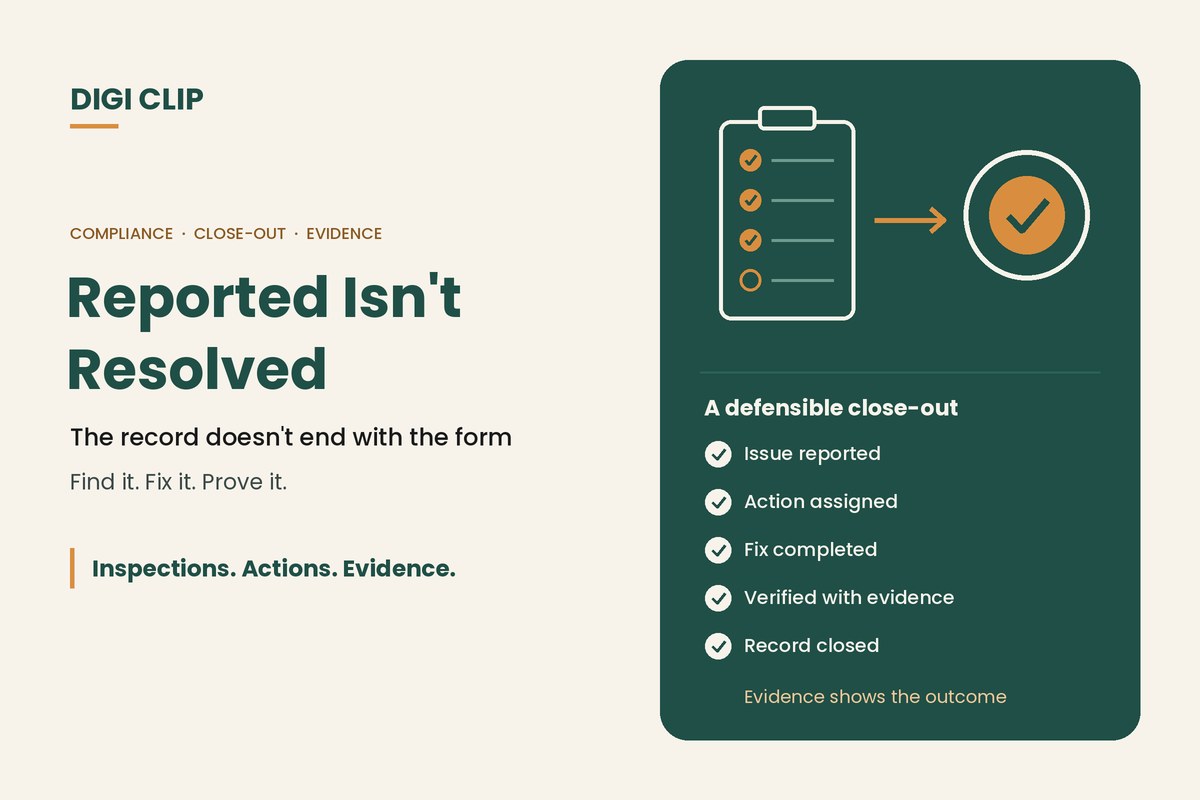
What a defensible close-out can look like
There's a useful test for whether a compliance system is producing evidence or just producing reports: can you show, for any flagged issue, exactly what happened next?
| Stage | What it means |
|---|---|
| Flagged | The hazard or defect is identified, with photo evidence at the point of discovery. |
| Assigned | A corrective action is given to a named, responsible person — not a general to-do. |
| Resolved | The action is completed, with enough detail to show what was actually done. |
| Verified | A final check confirms the resolution, retained with GPS, timestamp and photo metadata as part of the record. |
Miss the last step and the record can stop functioning as evidence. It becomes a to-do list with a paper trail — which looks fine until someone needs to rely on it.
Why this matters more than it used to
Digital forms solved a real problem: getting inspections and checklists out of notebooks and into a system that's searchable, timestamped, and harder to lose. That was a genuine improvement, and most operators have already made that shift.
But digitising the form only digitises the reporting half of the problem. It doesn't automatically close the loop on what happens after an issue is flagged — and as compliance scrutiny under CoR and HVNL has increased, that loop is often exactly where businesses can get caught out. Not because they didn't report the issue, but because they can't show what they did about it.
The businesses that tend to hold up best under scrutiny aren't necessarily the ones with the most forms. They're the ones who can produce, for any flagged issue, a complete record from discovery through to verified close-out.
The question worth asking
Next time a hazard or defect gets flagged in your business, it's worth tracing it forward: who was it assigned to, was it resolved, and is there a record proving it? If the trail runs out after the form is submitted, that's not yet a compliance system — it's a reporting system with a gap in the middle.
The form was never meant to be the finish line. It's supposed to be where the record starts.
DIGI CLIP is designed to help track corrective actions from the moment they're flagged through to verified close-out, with GPS, timestamp and photo detail to support the record.
See how the Action Log worksFrequently asked questions
What's the difference between reporting and evidence in a compliance record?
Reporting shows an activity happened, such as a form being filled in or a hazard being logged. Evidence shows the outcome — that the issue was resolved and verified, with a timestamped, attributable record to support it.
Why isn't a completed form enough under Chain of Responsibility?
CoR and HVNL scrutiny can extend beyond whether an issue was identified to what the business did about it, who was responsible, and whether that can be demonstrated after the fact. A completed form without a closed-out corrective action may not answer those questions.
What are the four stages of a defensible close-out record?
A defensible record generally needs an issue to be flagged with photo evidence, assigned to a named responsible person, resolved with detail on what was done, and verified with a final check retained alongside GPS, timestamp and photo metadata.
How can DIGI CLIP help with corrective action tracking?
DIGI CLIP's Action Log is designed to help track corrective actions from the point they're flagged through to verified close-out, with GPS, timestamp and photo detail attached to support the record when configured.
About DIGI CLIP
DIGI CLIP is a mobile forms, checklist and compliance inspection platform used by transport, warehousing, agriculture and construction businesses across Australia. Learn more at digiclip.io.