
Last updated:
Slips, trips and falls are incidents where a person loses their footing or balance. A slip happens when there isn’t enough grip between footwear and the floor. A trip happens when a foot hits an object or uneven surface. A fall can happen on the same level or from height, such as from a ladder, vehicle, dock or stairs.
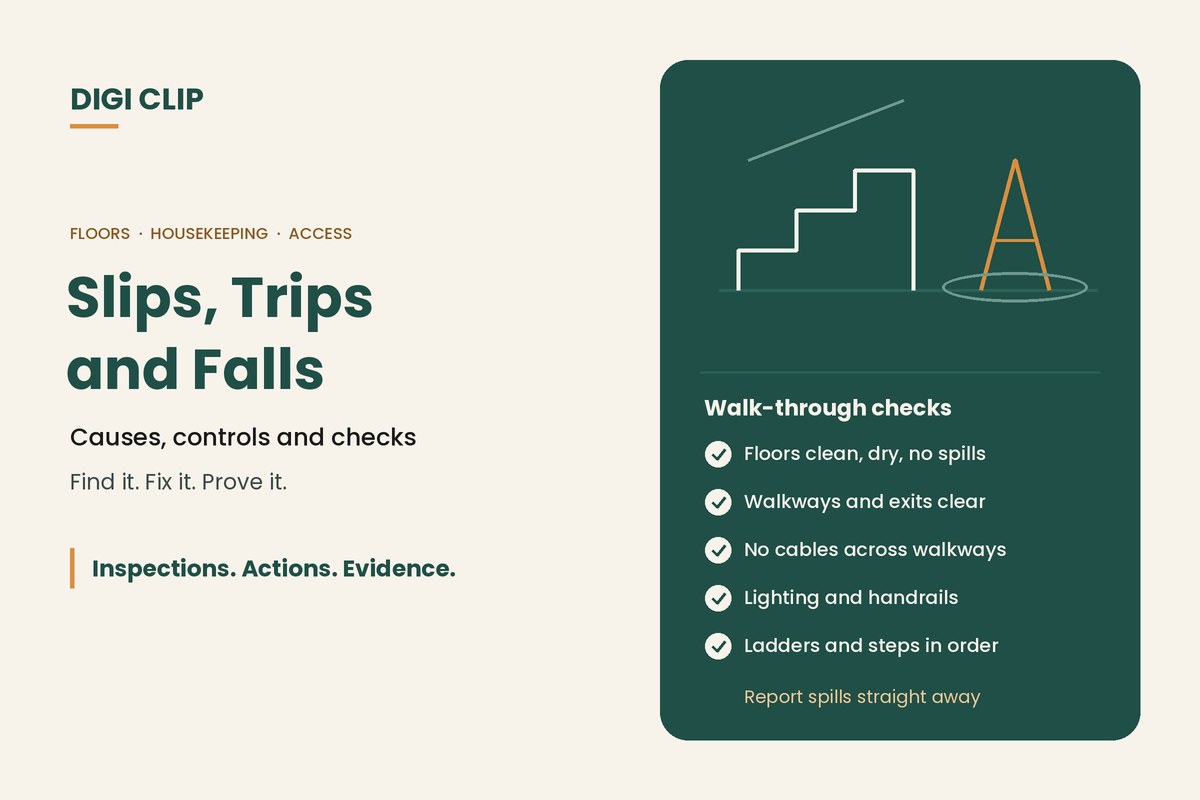
Preventing Slips, Trips and Falls at Work: Causes, Controls and Checks
Slips, trips and falls happen in every kind of workplace, from warehouses and kitchens to offices, sites and truck yards. They are often treated as minor, but they cause sprains, fractures, head injuries and lost time, and falls from height can be fatal. Most are preventable with good housekeeping, the right surfaces and footwear, and regular checks. This guide covers the causes, controls and a practical inspection routine.
Key points
- Most slips, trips and falls come from floors, housekeeping, lighting, footwear and rushing.
- Falls from height, including off vehicles, docks and ladders, need their own controls.
- Fix the environment first: surfaces, drainage, lighting and layout.
- Regular walk-through checks catch spills, clutter and damage early.
- Record and follow up near misses, not just injuries.
Common causes
| Type | Common causes |
|---|---|
| Slips | Spills, water, oil, dust, polished or wet floors, unsuitable footwear, weather tracked indoors |
| Trips | Clutter, cables and hoses, uneven or damaged floors, changes in level, poor lighting, pallets and packaging |
| Falls on the same level | A slip or trip, rushing, carrying loads that block the view |
| Falls from height | Ladders, stairs, loading docks, climbing on and off trucks and trailers, mezzanines, roofs |
What WHS law expects
Businesses must manage the risks of slips, trips and falls so far as is reasonably practicable, like any other hazard. The WHS regulations include specific requirements for managing the risk of falls, and Safe Work Australia’s model Codes of Practice on managing the work environment and facilities, and on managing the risk of falls at workplaces, give practical guidance. Check with your state or territory regulator for the rules that apply to you.
Controls that work
Floors and surfaces
- Choose slip-resistant flooring for wet or greasy areas, and fix damaged or uneven surfaces
- Improve drainage and use mats at entrances
- Mark changes in level and step edges clearly
Housekeeping
- Clean up spills straight away, with spill kits and signs close by
- Keep walkways and exits clear of stock, pallets and waste
- Route cables and hoses away from walkways, or cover them
Lighting and layout
- Provide good lighting in walkways, stairs, docks and yards
- Separate pedestrian routes from forklifts and vehicles
Working at height
- Use steps, platforms and handrails on vehicles and docks instead of climbing
- Use the right ladder for the job and check it before use. See our ladder safety tips.
- Keep three points of contact when getting on and off trucks and plant
People
- Suitable, slip-resistant footwear for the task. See our guide to PPE.
- Reduce rushing and carrying loads that block the view
A practical prevention program
- Map the hotspots. Look at incident and near miss records and walk the workplace to find where slips, trips and falls happen.
- Talk to workers. Ask where people feel unsteady or have to climb, rush or step over things.
- Fix the environment. Start with flooring, drainage, lighting, layout and access equipment.
- Set housekeeping standards. Agree who cleans what, when, and how spills are reported.
- Check regularly. Run short walk-through inspections daily or weekly, depending on the area.
- Follow up and review. Fix every finding, and review hotspots after incidents and near misses.
Walk-through checklist
- Floors clean, dry and free of spills
- Walkways and exits clear
- No trailing cables or hoses across walkways
- Flooring and stair treads undamaged, with no lifted edges
- Lighting working in walkways, stairs and yards
- Handrails secure and step edges marked
- Entrance mats in place and flat
- Ladders and steps in good condition
- Spill kits stocked and accessible
Digital walk-throughs
With DIGI CLIP, supervisors and workers complete housekeeping and walk-through checks on a phone, with photos of hazards. Each form is location- and time-stamped. A failed item or hazard report creates an action in the Action Log, so it is assigned, fixed and closed out with evidence, and repeat hotspots are easy to spot.
Illustrative scenario: a leaking roof in a warehouse
During a weekly walk-through at a warehouse, a team leader finds water pooling near a dock door after overnight rain. She fails the item in DIGI CLIP with a photo, puts out wet floor signs and a mat, and an action goes to the facilities manager. A roofer fixes a leaking gutter that week, and the action is closed out with a photo of the repair.
This scenario is illustrative. It shows how a business could use DIGI CLIP and is not an account of a specific customer.
See also our guides to warehouse safety hazards and workplace safety inspections.
Catch Slip and Trip Hazards Early
Put walk-through checks and hazard reports on your team’s phones and see hazards land in the Action Log, ready to fix and prove.
Start Your 14-Day Free TrialNo credit card required. Set up in minutes.
Frequently asked questions
What is the difference between a slip and a trip?
A slip happens when there isn’t enough grip between footwear and the floor, such as on a wet or oily surface. A trip happens when a foot hits an object or uneven surface and the person loses balance.
What are the most common causes of slips, trips and falls at work?
Spills and wet floors, clutter, cables and hoses across walkways, damaged or uneven surfaces, poor lighting, unsuitable footwear, rushing, and climbing on and off vehicles, docks and ladders.
How can slips, trips and falls be prevented?
Fix the environment first with suitable flooring, drainage, lighting and layout, then keep up housekeeping, provide suitable footwear and access equipment, and run regular walk-through checks.
How often should slip and trip hazards be checked?
High-traffic and wet areas such as kitchens, docks and entrances benefit from daily checks. Other areas can be checked weekly, with extra checks after rain, spills or changes to the layout.
What should I do after a slip, trip or fall?
Provide first aid, make the area safe, report the incident, and find out why it happened. Then fix the cause and check whether the same hazard exists elsewhere.
Can slip and trip hazards be reported on a phone?
Yes. In DIGI CLIP, workers report hazards and complete walk-through checks on a phone with photos, and each finding becomes an action in the Action Log.
About DIGI CLIP Mobile Forms
DIGI CLIP is an Australian-built mobile checklist and inspection platform. Inspections. Actions. Evidence. Teams complete checks on a phone or tablet, turn defects into assigned actions, and keep the proof that each one was fixed and verified.
See our Form Library for ready-made templates.






