
Last updated:
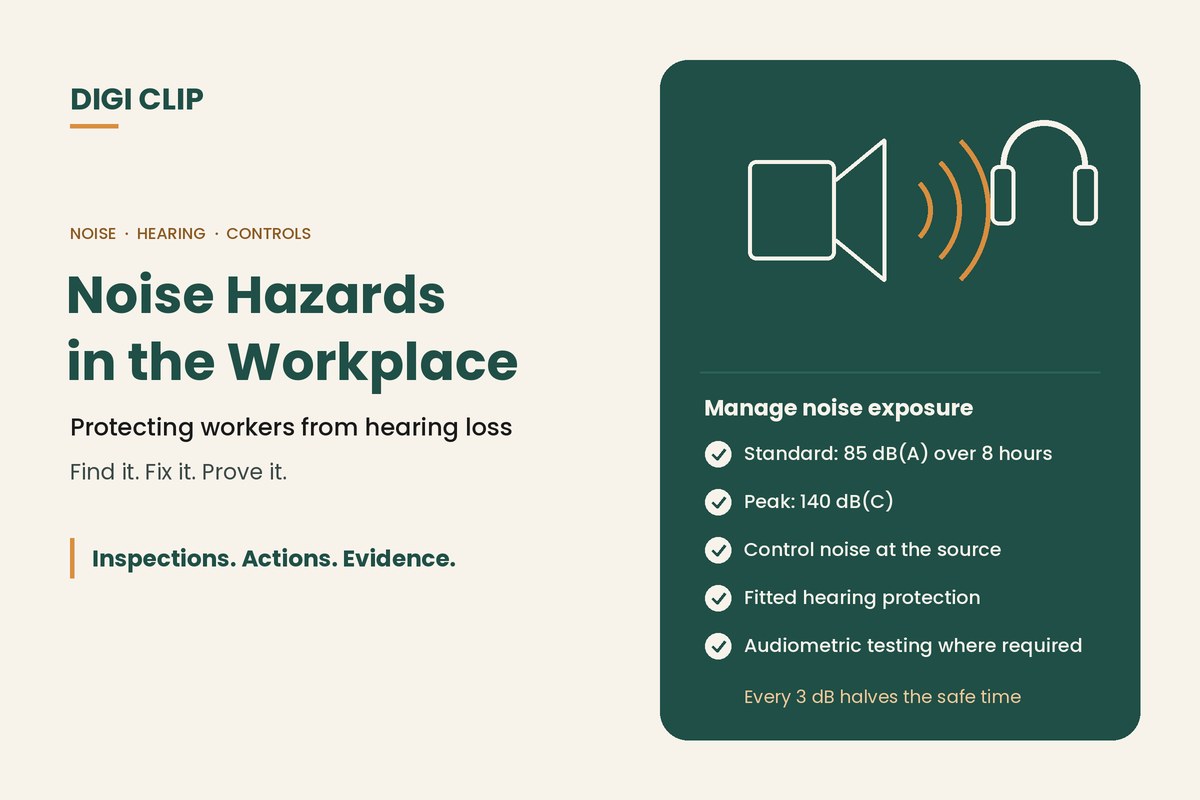
A workplace noise hazard is any sound at work loud enough, or lasting long enough, to damage hearing or affect safety. Under Australian WHS laws, the exposure standard for noise is an eight-hour average of 85 dB(A), or a peak of 140 dB(C). Noise-induced hearing loss is permanent, but it is preventable.
Noise Hazards in the Workplace: Protecting Workers From Hearing Loss
Manufacturing, construction, mining, agriculture, transport and hospitality all have loud work: grinders, compressors, saws, engines, crushers and music. Hearing damage builds up slowly and without pain, so workers often don’t notice until it’s too late. This guide covers the legal limits, common sources, how to control noise, and how to keep checks on hearing protection and testing.
Key points
- The exposure standard is LAeq,8h 85 dB(A) or a peak of 140 dB(C).
- Every 3 dB increase roughly halves the safe exposure time.
- Control noise at the source before relying on hearing protection.
- Workers who need hearing protectors because noise exceeds the standard must have audiometric testing.
- Noise can also mask warnings and alarms, so it’s a safety hazard as well as a health one.
Legal limits and duties
The WHS regulations set the exposure standard for noise as an eight-hour equivalent continuous level (LAeq,8h) of 85 dB(A), or a peak level (LC,peak) of 140 dB(C). Businesses must make sure workers aren’t exposed above the standard. Because the scale is logarithmic, every 3 dB increase roughly halves the time a worker can be exposed: 88 dB(A) for four hours carries about the same dose as 85 dB(A) for eight.
Where workers must wear hearing protectors because noise exceeds the exposure standard, audiometric testing must be provided within 3 months of the worker starting that work, and at least every 2 years after that. Queensland adopted this requirement from 29 July 2025. Safe Work Australia’s model Code of Practice on managing noise and preventing hearing loss at work gives detailed guidance. Check with your state or territory regulator for the rules that apply to you.
Common sources of noise
- Manufacturing: presses, grinders, compressors, conveyors, fans
- Construction: jackhammers, concrete saws, nail guns, piling, plant
- Mining and quarrying: crushers, screens, drills, heavy vehicles
- Agriculture: tractors, chainsaws, grain dryers, livestock sheds
- Transport and warehousing: engines, reversing alarms, air brakes, forklifts
- Hospitality and entertainment: amplified music and crowds
A useful rule of thumb: if you have to raise your voice to be heard by someone a metre away, noise may be above the exposure standard and should be assessed.
Managing noise step by step
- Identify noisy work. Walk the workplace, listen for areas where people raise their voices, and ask workers.
- Assess exposure. Have a competent person measure noise levels and work out workers’ exposure over a shift.
- Control at the source. Use quieter equipment, maintenance, enclosures and barriers before relying on hearing protection.
- Provide hearing protection. Where noise still exceeds the standard, supply suitable, fitted hearing protectors and signpost the areas.
- Test hearing. Arrange audiometric testing where required and act on the results.
- Review. Reassess when equipment, processes or layouts change, and check controls are working.
Controls that work
| Control level | Examples |
|---|---|
| Remove or substitute | Buy quieter equipment, change processes, such as bolting instead of riveting |
| Isolate | Move noisy plant away from people, use enclosures and acoustic rooms |
| Engineering | Silencers, damping, vibration mounts, barriers, regular maintenance |
| Administrative | Job rotation, limiting time in noisy areas, scheduling noisy work when fewer people are around, signage |
| PPE | Earplugs or earmuffs with the right rating, correctly fitted and worn the whole time |
Hearing protectors only work when they’re worn properly for the whole exposure. Taking them off even for short periods in loud areas greatly reduces the protection. See our guide to personal protective equipment.
Keeping noise controls in check
With DIGI CLIP, supervisors check noise controls on a phone: enclosures closed, silencers fitted, signs in place, hearing protection stocked and worn. Each form is location- and time-stamped. A failed item creates an action in the Action Log, and recurring reminders can prompt noise reassessments and audiometric testing when they’re due.
Illustrative scenario: a damaged compressor enclosure
During a weekly check at a fabrication workshop, a leading hand notices the compressor enclosure door has a broken latch and is sitting open. He fails the item in DIGI CLIP with a photo, which creates an action for maintenance. Hearing protection signs go up at the area in the meantime, the latch is replaced the next morning, and the action is closed out with a photo.
This scenario is illustrative. It shows how a business could use DIGI CLIP and is not an account of a specific customer.
See also our guide to workplace safety hazards.
Keep Noise Controls Working
Put noise and PPE checks on your team’s phones and see problems land in the Action Log, ready to fix and prove.
Start Your 14-Day Free TrialNo credit card required. Set up in minutes.
Frequently asked questions
What is the workplace noise exposure standard in Australia?
An eight-hour equivalent continuous level (LAeq,8h) of 85 dB(A), or a peak level (LC,peak) of 140 dB(C), as set by the WHS regulations.
How long can a worker be exposed to 88 dB(A)?
About four hours. Every 3 dB increase roughly halves the safe exposure time, so 88 dB(A) for four hours carries about the same noise dose as 85 dB(A) for eight hours.
When is audiometric testing required?
When workers must wear hearing protectors because noise exceeds the exposure standard. Testing must be provided within 3 months of the worker starting that work, and at least every 2 years after that.
Is hearing protection enough to manage noise?
No. Hearing protection is the last line of defence. Businesses should first remove, reduce or isolate noise at the source, and use hearing protectors for the noise that remains.
How do I know if my workplace is too noisy?
If people need to raise their voices to be heard a metre away, noise may be above the exposure standard. A competent person should measure noise levels and assess workers’ exposure.
Can noise control checks be recorded digitally?
Yes. In DIGI CLIP, supervisors complete noise and PPE checks on a phone with photos, and failed items become actions in the Action Log.
About DIGI CLIP Mobile Forms
DIGI CLIP is an Australian-built mobile checklist and inspection platform. Inspections. Actions. Evidence. Teams complete checks on a phone or tablet, turn defects into assigned actions, and keep the proof that each one was fixed and verified.
See our Form Library for ready-made templates.






