Last updated:
Logistics checklists are the standard forms a transport, freight or warehousing business uses to check vehicles, equipment, loads and workplaces, and to record incidents. They turn safety and quality requirements into consistent daily checks, with a record of what was found and fixed.
10 Essential Checklists and Forms for Your Logistics Business
Logistics businesses run on repeatable work: trucks leave the yard, forklifts load trailers, docks turn over freight and drivers log their trips. Each step has its own risks, and each needs a quick, reliable check. This guide lists the ten checklists and forms most logistics operations rely on, what each should cover, and how to keep them working in practice.
Key points
- Vehicles, forklifts, loads, docks and warehouses each need their own checks.
- Keep checklists short and specific to the equipment and task.
- Every failed item needs an owner and a fix before the equipment is relied on.
- Incident and hazard reports close the loop on what the checks miss.
- Heavy vehicle operators also have chain of responsibility duties.
The 10 essential checklists and forms
1. Truck and vehicle pre-start checklist
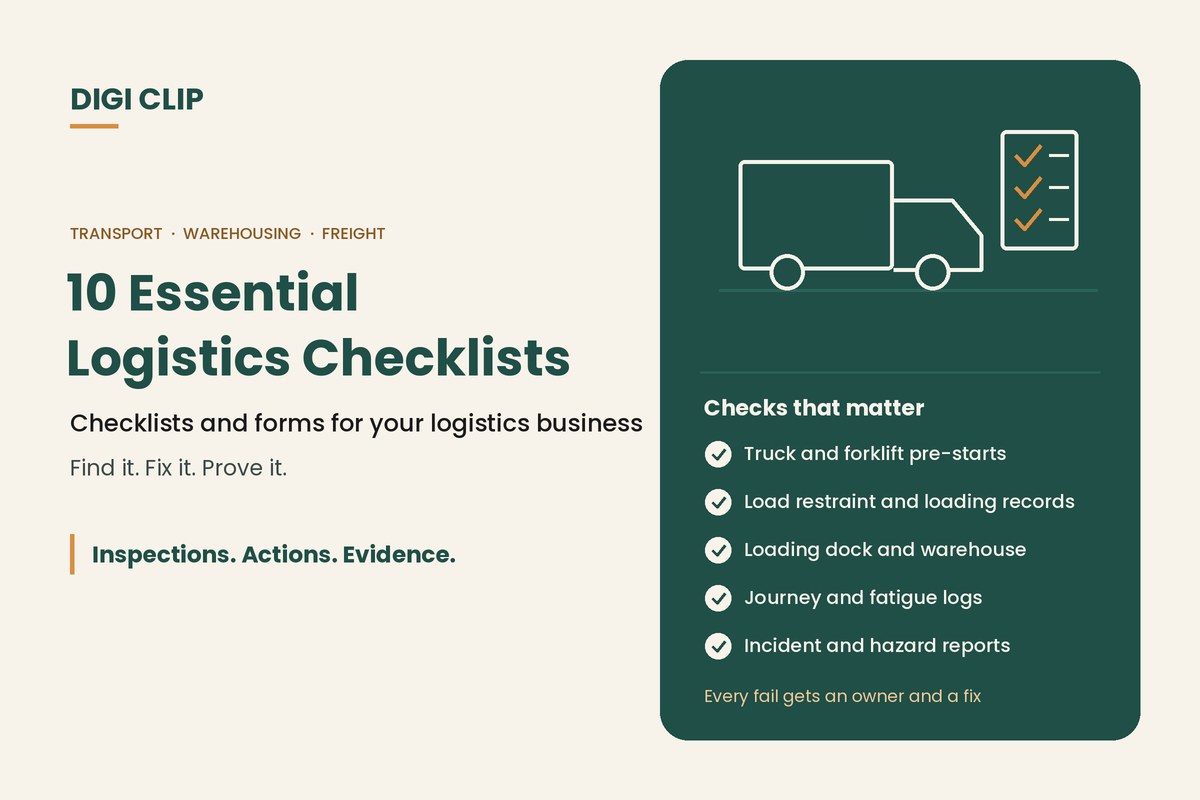
Completed before each shift or trip: tyres and wheels, brakes, lights, fluids, mirrors, cabin and safety equipment. See our commercial truck safety checklist and light vehicle pre-start checklist.
2. Forklift pre-start checklist
Forks, mast, chains, hydraulics, tyres, brakes, horn, lights, seatbelt and data plate. See our guide to forklift pre-start safety checks.
3. Load restraint checklist
Load distribution, restraint method, straps and chains in good condition, headboard and gates, and mass limits.
4. Loading and unloading record
Consignment details, condition on arrival or dispatch, discrepancies and damage, with photos.
5. Loading dock safety checklist
Dock levellers and plates, wheel chocks or vehicle restraints, lighting, edge markings, pedestrian separation and housekeeping.
6. Warehouse safety inspection
Racking condition and load signs, aisles and exits, pedestrian walkways, housekeeping, fire equipment and first aid. See our guide to warehouse safety hazards.
7. Journey and fatigue log
Trip start and end, breaks, route and any issues on the road. Drivers of fatigue-regulated heavy vehicles have specific work diary requirements under the Heavy Vehicle National Law.
8. Electrical safety checklist
Leads and plugs, test and tag status, charging stations for electric forklifts and equipment, and switchboards clear.
9. Hazardous chemicals checklist
Storage, labelling, safety data sheets, spill kits and segregation of incompatible goods.
10. Incident and hazard report
What happened or what was seen, where and when, people involved, photos, immediate actions and follow-up. Near misses matter as much as injuries.
What every good checklist includes
| Element | Why it matters |
|---|---|
| Equipment or area ID | Links the check to a specific truck, forklift, dock or zone |
| Clear pass / fail items | Makes checks quick and consistent |
| Photos and notes on fails | Shows exactly what’s wrong |
| Out-of-service rule | Tells the worker when not to use the equipment |
| Name, date and time | Shows who checked what, and when |
| Follow-up action | Makes sure faults are fixed, not just recorded |
Rolling out your checklists
- Pick your priorities. Start with the highest-risk equipment and tasks, usually vehicles, forklifts and loading.
- Keep them short. Include only items that matter and that workers can check quickly.
- Set the fail rule. Decide which faults take equipment out of service and who is told.
- Train the team. Show workers what good and bad look like for each item.
- Assign and follow up. Every failed item gets an owner and a due date.
- Review the results. Look for repeat defects and missed checks, and adjust.
Going digital
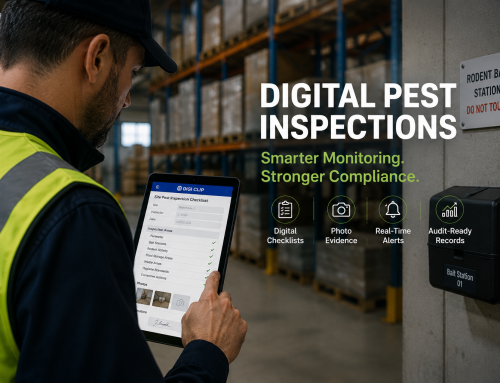
Paper forms get lost in cabs and sit in trays until someone has time to read them. With DIGI CLIP, drivers, forklift operators and warehouse staff complete checks on a phone or tablet, with photos, even without coverage. Each form is location- and time-stamped. Failed items create actions in the Action Log, so maintenance and supervisors see problems straight away and close them out with evidence.
Illustrative scenario: a dock leveller fault
During the morning dock check at a distribution centre, a leading hand finds a dock leveller lip not fully extending. He fails the item in DIGI CLIP with a photo, and the bay is closed off. The action goes to the maintenance contractor, who repairs the hydraulic ram that afternoon, and the action is closed out with a photo before the bay reopens.
This scenario is illustrative. It shows how a business could use DIGI CLIP and is not an account of a specific customer.
See also our guide to managing vehicles as a workplace.
Run Your Logistics Checklists on the Phone
Put vehicle, forklift, dock and warehouse checks on your team’s phones and see faults land in the Action Log, ready to fix and prove.
Start Your 14-Day Free TrialNo credit card required. Set up in minutes.
Frequently asked questions
What checklists does a logistics business need?
Most need truck and vehicle pre-starts, forklift pre-starts, load restraint checks, loading records, loading dock checks, warehouse inspections, journey or fatigue logs, electrical checks, hazardous chemicals checks, and incident and hazard reports.
How often should forklift and vehicle checks be done?
Before each shift or trip, and after any incident or damage. Servicing and detailed inspections should also follow the manufacturer’s schedule.
What should happen when a checklist item fails?
Follow the fail rule: take the equipment out of service if it’s unsafe, record the fault with a photo, assign it to someone with a due date, and check it has been fixed before the equipment is used again.
What is chain of responsibility in logistics?
Under the Heavy Vehicle National Law, everyone who can influence heavy vehicle transport activities, such as schedulers, loaders, consignors and managers, has a duty to make sure those activities are safe.
Should near misses be reported?
Yes. Near misses show where controls are weak before someone is hurt. Recording and following them up is one of the most useful things a logistics business can do.
Can logistics checklists be completed on a phone?
Yes. In DIGI CLIP, checklists are completed on a phone or tablet with photos, even without coverage, and failed items become actions in the Action Log.
About DIGI CLIP Mobile Forms
DIGI CLIP is an Australian-built mobile checklist and inspection platform. Inspections. Actions. Evidence. Teams complete checks on a phone or tablet, turn defects into assigned actions, and keep the proof that each one was fixed and verified.
See our Form Library for ready-made templates.