Last updated:
Warehouse safety hazards are the conditions and activities in a warehouse that can hurt people: forklifts and pedestrians sharing space, racking failures, falling stock, manual handling, loading docks, slips and trips, cold stores, chemicals and fire. Most are managed with good layout, well-maintained equipment, clear rules and regular inspections.
Warehouse Safety Hazards: Common Risks, Controls and Checks
Warehouses move fast. Pickers, forklifts, trucks and contractors all share the same floor, often under time pressure. The most serious incidents usually involve forklifts, racking or loading docks, while manual handling and slips cause the most everyday injuries. This guide covers the main warehouse hazards, the controls that work, and a practical inspection routine.
Key points
- Separating forklifts from pedestrians is one of the most effective controls.
- Racking needs regular inspection and damage needs a clear response.
- Loading docks need controls to stop trucks moving during loading.
- Manual handling and slips cause many everyday injuries.
- Daily and weekly checks catch problems before they cause harm.
Common warehouse hazards
| Hazard | Key controls |
|---|---|
| Forklifts and pedestrians | Separate walkways and barriers, exclusion zones, speed limits, pre-starts, licensed operators |
| Racking and falling stock | Load signs, regular inspections, damage reporting, safe stacking |
| Loading docks | Vehicle restraints or wheel chocks, dock levellers checked, edge markings |
| Manual handling | Mechanical aids, good storage heights, team lifts, job rotation |
| Slips and trips | Housekeeping, spill response, clear aisles, lighting |
| Cold stores | Cold-weather PPE, time limits, door release mechanisms, check-in procedures |
| Chemicals and batteries | Safe storage, SDS, ventilated charging areas, eyewash |
| Fire and emergencies | Clear exits, extinguishers, sprinklers unobstructed, drills |
See our guides to forklift pre-start checks, struck-by accidents and slips, trips and falls.
Racking safety
Racking failures can bring down tonnes of stock. The AS 4084 series of Australian Standards covers steel storage racking, including inspection. Good practice includes:
- clear load signs showing safe working loads for each bay
- regular visual checks by staff, with damage reported straight away
- periodic inspections by a competent person
- unloading and isolating damaged sections until they’re assessed and repaired
- column guards and end-of-aisle protection in forklift areas
Managing warehouse risks
- Walk the warehouse. Map where forklifts, pedestrians, trucks and stock interact.
- Separate people and plant. Use barriers, walkways, crossings and exclusion zones.
- Maintain equipment. Run forklift pre-starts, dock checks and racking inspections.
- Set clear rules. Speed limits, right of way, loading procedures and housekeeping standards.
- Inspect regularly. Daily walk-throughs and weekly detailed inspections.
- Act on findings. Assign every problem an owner and due date, and check it’s fixed.
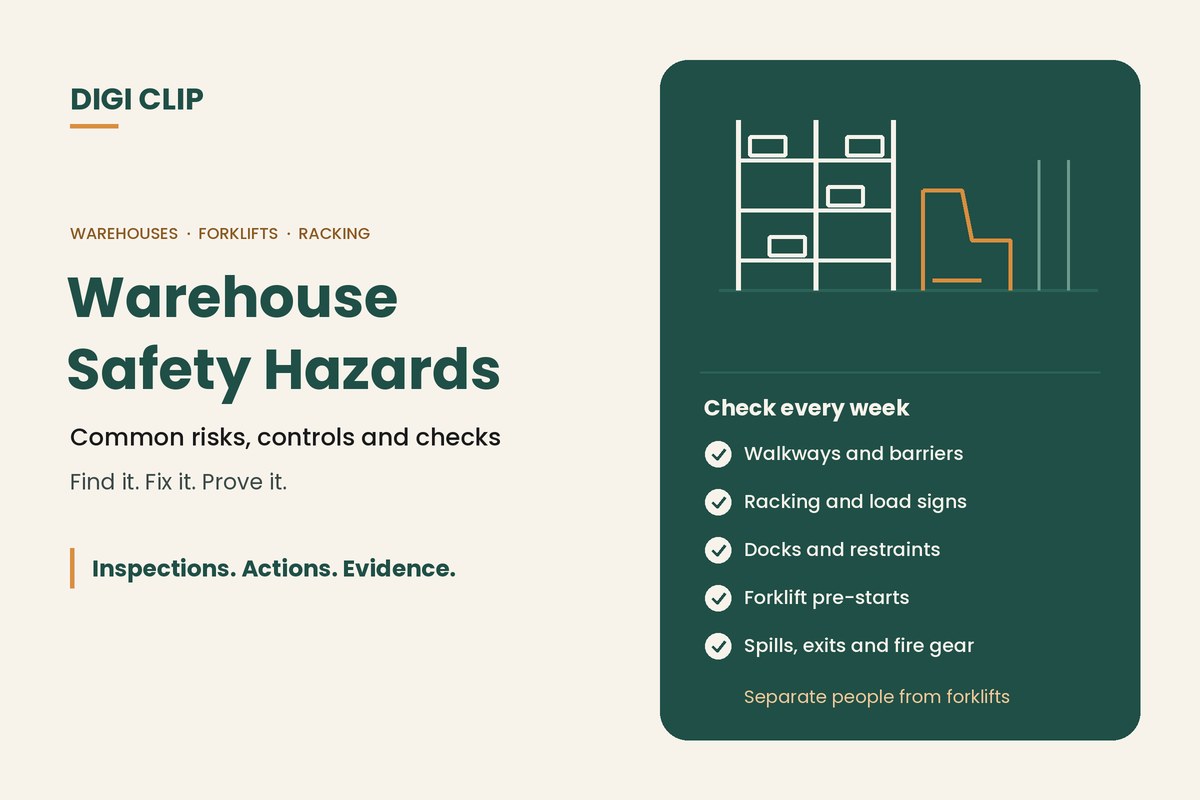
Warehouse inspection checklist
- Pedestrian walkways and barriers intact and clear
- Racking uprights and beams undamaged, load signs in place
- Stock stacked safely and within rack limits
- Aisles and exits clear, lighting working
- Dock levellers, restraints and chocks working
- Forklift pre-starts completed, charging area tidy and ventilated
- Spill kits stocked, floors clean and dry
- Fire extinguishers accessible, sprinkler heads not obstructed
Warehouse inspections on the phone
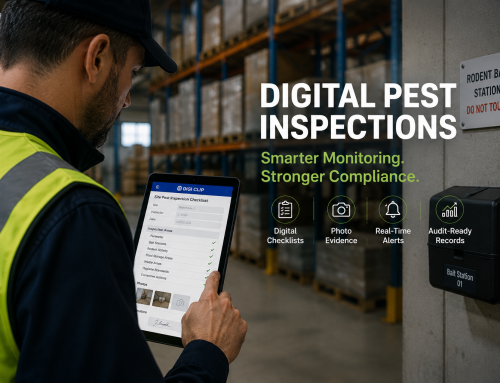
With DIGI CLIP, team leaders complete warehouse walk-throughs, racking checks and forklift pre-starts on a phone, with photos. Each form is location- and time-stamped. Findings become actions in the Action Log, so racking damage, dock faults and housekeeping issues are fixed and closed out with evidence.
Illustrative scenario: racking damage
During the morning walk-through at a distribution centre, a team leader finds a racking upright dented at forklift height. She fails the item in DIGI CLIP with a photo, and the bay is unloaded and coned off. An action goes to the facilities manager, the racking supplier replaces the upright, and the action is closed out with a photo before the bay is reloaded.
This scenario is illustrative. It shows how a business could use DIGI CLIP and is not an account of a specific customer.
See also DIGI CLIP for cold storage and warehousing and 10 essential logistics checklists.
Keep Your Warehouse Checked
Put warehouse inspections on your team’s phones and see problems land in the Action Log, ready to fix and prove.
Start Your 14-Day Free TrialNo credit card required. Set up in minutes.
Frequently asked questions
What are the most common warehouse hazards?
Forklifts and pedestrians sharing space, racking failures and falling stock, loading docks, manual handling, slips and trips, cold stores, chemicals and batteries, and fire.
How do you separate forklifts and pedestrians?
With physical barriers, marked walkways and crossings, exclusion zones, speed limits and clear right-of-way rules, supported by mirrors and lighting at blind spots.
How often should warehouse racking be inspected?
Staff should check racking regularly and report damage straight away, with periodic inspections by a competent person. The AS 4084 series of standards gives guidance.
What should happen when racking is damaged?
Unload and isolate the affected section, have it assessed by a competent person, and repair or replace the damaged parts before reloading.
What should a warehouse inspection include?
Walkways and barriers, racking and stock, aisles and exits, loading docks, forklift pre-starts and charging areas, spills and housekeeping, and fire equipment.
Can warehouse inspections be done on a phone?
Yes. In DIGI CLIP, warehouse walk-throughs, racking checks and forklift pre-starts are completed on a phone with photos, and findings become actions in the Action Log.
About DIGI CLIP Mobile Forms
DIGI CLIP is an Australian-built mobile checklist and inspection platform. Inspections. Actions. Evidence. Teams complete checks on a phone or tablet, turn defects into assigned actions, and keep the proof that each one was fixed and verified.
See our Form Library for ready-made templates.