Last updated:
Vehicles as a workplace means that any vehicle used for work, from a delivery van or ute to a truck, car or mobile plant, is a workplace under WHS laws. The business must manage the risks of driving and working in and around that vehicle, just as it would in an office, warehouse or site.
Managing the Risk of Vehicles as a Workplace: A Guide for Australian Businesses
For many workers, the vehicle is where most of the working day happens. Sales reps, tradies, couriers, community care workers and truck drivers all spend hours on the road, and road crashes are one of the biggest causes of work deaths in Australia. This guide covers who has duties, the main risks, practical controls, and how regular checks help keep vehicles and drivers safe.
Key points
- A vehicle used for work is a workplace, including a worker’s own car when it’s used for work.
- Vehicle incidents were the leading cause of worker fatalities in Australia in 2024.
- Manage the vehicle, the driver, the journey and the load.
- Heavy vehicles also come under the Heavy Vehicle National Law and chain of responsibility duties.
- Pre-start checks catch vehicle defects before they cause a crash.
Why work vehicles need managing
Safe Work Australia’s Key Work Health and Safety Statistics 2025 report that vehicle incidents were the leading cause of worker fatalities in 2024, accounting for 42% of deaths. Many of these happen on public roads, which can make them feel outside a business’s control. They aren’t. Vehicle choice, maintenance, scheduling, journey planning and fatigue are all things a business can manage.
Who has duties
- Businesses (PCBUs) must manage risks from work vehicles so far as is reasonably practicable. This includes fleet vehicles, hired vehicles and workers’ own vehicles when they’re used for work.
- Officers must exercise due diligence to make sure the business manages these risks.
- Workers must take reasonable care, follow reasonable instructions and report vehicle problems.
- Heavy vehicle operators also have duties under the Heavy Vehicle National Law, including chain of responsibility duties for everyone who influences transport activities, such as schedulers, loaders and consignors.
Road rules still apply to drivers. WHS duties sit alongside them, not instead of them.
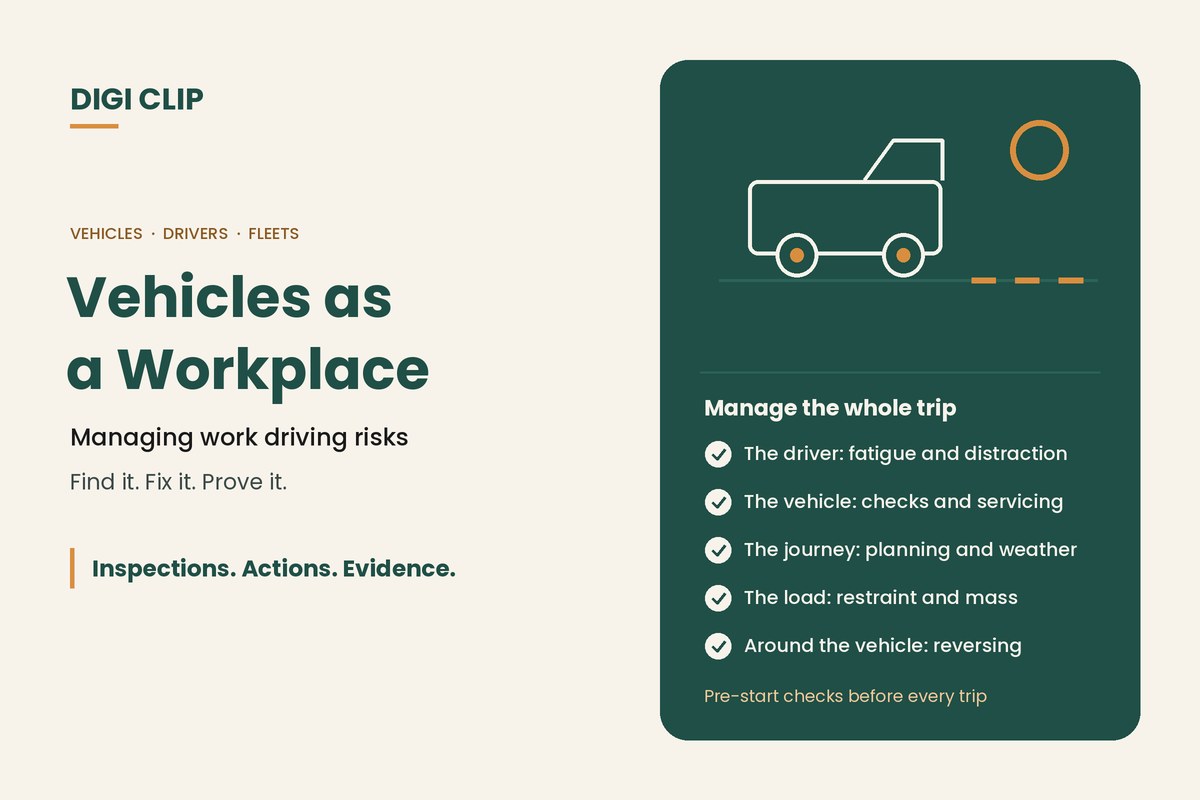
Common hazards
| Area | Hazards |
|---|---|
| The driver | Fatigue, distraction, time pressure, impairment, inexperience |
| The vehicle | Poor maintenance, worn tyres or brakes, unsuitable vehicle for the task, missing safety features |
| The journey | Long distances, night driving, remote areas, weather, unfamiliar routes |
| The load | Unrestrained loads, overloading, manual handling when loading and unloading |
| Around the vehicle | Reversing, pedestrians at depots and sites, working at height on trays and trailers |
Managing the risks
- List your work driving. Identify who drives for work, in which vehicles, how far and how often, including workers using their own cars.
- Identify the hazards. Consult drivers about the vehicle, the journey, the load and time pressures.
- Assess the risks. Consider how likely a crash or injury is and how serious it could be.
- Put controls in place. Start with removing unnecessary travel, then safer vehicles, scheduling, procedures and training.
- Check vehicles and drivers. Use pre-starts, servicing schedules and licence checks.
- Monitor and review. Look at incidents, near misses, defects and driver feedback, and adjust controls.
Controls to consider
- Remove unnecessary travel: use video calls, combine trips and plan routes to cut driving time.
- Choose safer vehicles: high safety ratings, suitable for the task, with features such as reversing cameras and cargo barriers.
- Maintain vehicles: regular servicing and daily or pre-trip checks, with defects fixed before the vehicle is used.
- Manage fatigue: realistic schedules, rest breaks and limits on driving after long shifts. See our guide to fatigue management.
- Set clear rules: no phone use while driving, seatbelts, speed and alcohol and drug policies.
- Restrain loads: secure loads correctly and don’t overload vehicles.
- Plan for emergencies: breakdown procedures, check-in arrangements and first aid kits, especially for remote travel.
Vehicle checks on the phone
With DIGI CLIP, drivers complete pre-start checks on a phone before each trip, with photos of any defects. Each form is location- and time-stamped. A failed item creates an action in the Action Log, so the defect is assigned, repaired and closed out with evidence, and fleet managers can see every vehicle’s check history in one place.
Illustrative scenario: a sales fleet ute
A field sales rep completes her morning pre-start in DIGI CLIP and notices the front tyre tread is close to the wear indicator. She fails the item with a photo, which creates an action for the fleet coordinator. A tyre fitting is booked for that afternoon, she uses a pool car for the morning run, and the action is closed out with a photo of the new tyre.
This scenario is illustrative. It shows how a business could use DIGI CLIP and is not an account of a specific customer.
For vehicle checklists, see our light vehicle pre-start checklist and commercial truck safety checklist.
Put Vehicle Checks on Every Driver’s Phone
Run pre-start checks across your fleet and see defects land in the Action Log, ready to fix and prove.
Start Your 14-Day Free TrialNo credit card required. Set up in minutes.
Frequently asked questions
Is a vehicle a workplace under WHS law?
Yes. A vehicle used for work is a workplace, so the business must manage the risks of driving and working in and around it so far as is reasonably practicable.
Do WHS duties apply when workers use their own car for work?
Yes. When a worker’s own vehicle is used for work, the business still has duties to manage the risks, such as checking the vehicle is suitable and roadworthy and managing fatigue and scheduling.
What is the leading cause of work-related deaths in Australia?
Vehicle incidents. Safe Work Australia’s Key Work Health and Safety Statistics 2025 report they were the leading cause of worker fatalities in 2024, accounting for 42% of deaths.
What is chain of responsibility?
Under the Heavy Vehicle National Law, everyone in the heavy vehicle supply chain who can influence transport activities, such as schedulers, loaders, consignors and managers, has a duty to make sure those activities are safe.
How can businesses reduce work vehicle risks?
Cut unnecessary travel, choose safer vehicles, maintain them and run pre-start checks, manage fatigue and schedules, set clear driving rules, restrain loads, and plan for breakdowns and emergencies.
Can vehicle pre-start checks be done on a phone?
Yes. In DIGI CLIP, drivers complete pre-start checks on a phone with photos, and failed items become actions in the Action Log.
About DIGI CLIP Mobile Forms
DIGI CLIP is an Australian-built mobile checklist and inspection platform. Inspections. Actions. Evidence. Teams complete checks on a phone or tablet, turn defects into assigned actions, and keep the proof that each one was fixed and verified.
See our Form Library for ready-made templates.