Last updated:
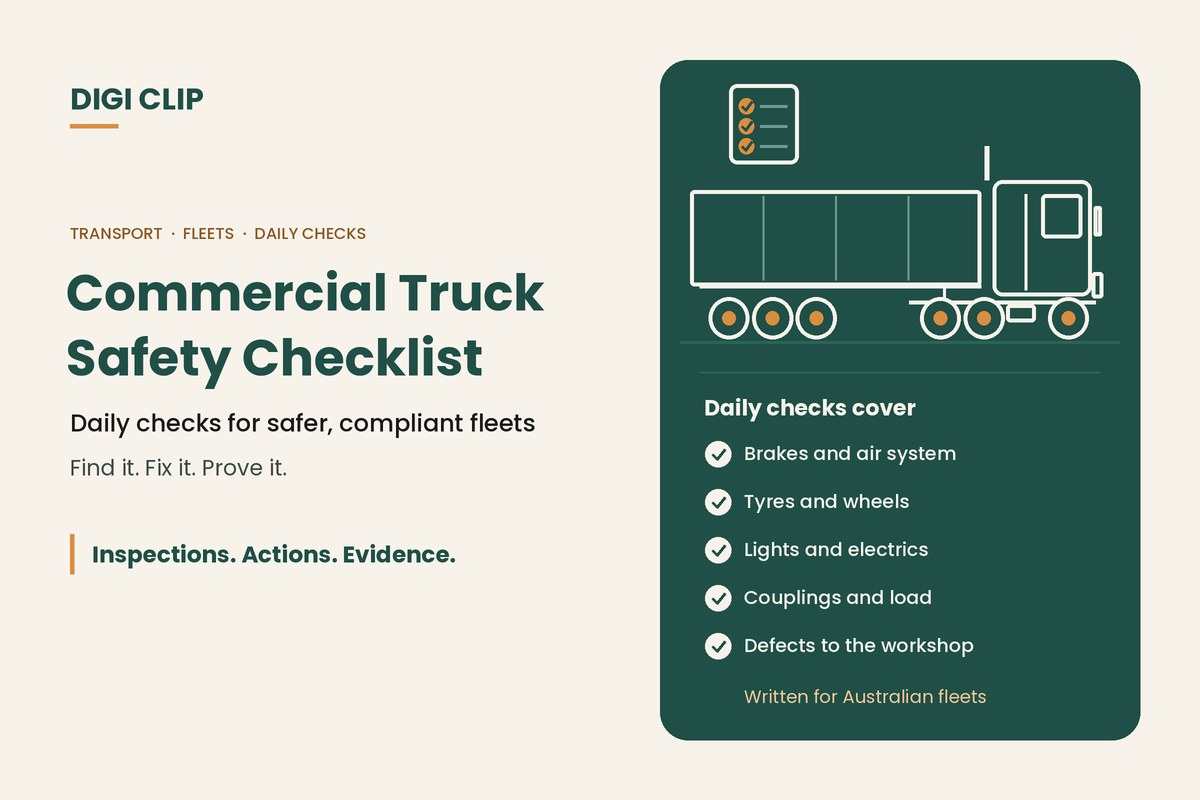
A commercial truck safety checklist is the set of checks a fleet uses to keep heavy vehicles safe and roadworthy: the driver’s daily check before leaving the yard, weekly checks, and periodic inspections and servicing. Together with a clear defect process and good records, it shows each truck is being kept safe to use.
Truck Safety Checklist for Drivers and Fleets: Daily Checks, Inspections and Records
For most Australian fleets, truck safety rests on three layers: the driver’s daily check, regular weekly checks, and scheduled inspections and servicing. Each catches different faults, and together they give you a record you can stand behind if a vehicle is inspected at the roadside or a question comes up after an incident. This guide covers what to check at each layer, what to do when you find a defect, and the records worth keeping.
Key points
- Drivers should do a daily check before leaving the yard, depot or rest area.
- The NHVR’s daily check guidance covers 10 areas, from brakes and couplings to high voltage and gas systems.
- Weekly checks and scheduled servicing pick up wear that a quick daily check can miss.
- Every defect needs a clear path: report, assess, repair or tag out, and sign off.
- Under the Chain of Responsibility, keeping trucks safe isn’t only the driver’s job.
Why truck safety checks matter
Under the Heavy Vehicle National Law (HVNL), heavy vehicles must meet the heavy vehicle standards when they are used on the road, and every party in the Chain of Responsibility has a primary duty to keep their transport activities safe, so far as is reasonably practicable. Work health and safety laws add a duty to manage the risks of vehicles used for work.
The HVNL doesn’t prescribe one daily check form, but the National Heavy Vehicle Regulator (NHVR) publishes guidance on creating heavy vehicle daily checks. A consistent checklist, with defects recorded and fixed, is one of the most practical ways to show that reasonable steps are being taken. See our guide to Chain of Responsibility compliance.
Daily check: the 10 NHVR areas
The NHVR’s guide to creating heavy vehicle daily checks describes a quick visual inspection before operating, done before leaving the yard, depot or rest area. It groups the check into these areas:
- Brakes: warning indicators and gauges working, air pressure builds normally, drain valves checked
- Couplings: fifth wheel, kingpin, towbar and connections secure and undamaged
- Wheels, tyres and hubs: inflation, tread depth, damage, and wheel nuts secure
- Structure and body: no loose or damaged panels, horn working
- Lights and reflectors: all present, clean and working
- Mirrors: present, secure and adjusted
- Windscreen and windows: no damage in the driver’s vision area, wipers and washers working
- Engine, driveline and exhaust: no fluid leaks, nothing loose or damaged
- High voltage systems: on electric and hybrid trucks, wiring, labels and battery components undamaged
- Gas systems: on gas-fuelled trucks, containers, restraints and labels in good condition
Add the items your fleet needs on top of these, such as load restraint equipment, safety gear and anything the manufacturer specifies. For a driver-focused version, see our truck pre-start checklist. You can also download our free daily heavy vehicle pre-start checklist (PDF).
How to run the daily check
- Walk around the outside. Start at the driver’s door and walk the same route every time, checking tyres, wheels, lights, mirrors, body and couplings.
- Check under the bonnet and underneath. With the engine cold, check fluid levels and look for leaks, damaged hoses and loose components.
- Check in the cab. Start the engine, check the gauges and warning lights, let air pressure build and test the brakes, horn, wipers and controls.
- Check the trailer and load. Confirm the coupling is locked, the lines are connected and the load is restrained.
- Record and report. Complete the checklist, photograph any defect and report it before you leave. A safety-critical fault means the truck stays put.
For a detailed walk-around, see our truck pre-operational checklist guide.
Weekly checks
A daily check is quick and visual. A weekly check, done by the driver or a workshop, gives time to look more closely. Typical weekly items include:
- Tyre pressures measured with a gauge, not just a visual check
- Tread depth measured across all tyres, including inner duals
- Fluid levels topped up and any slow leaks followed up
- Battery terminals, mounts and cables
- Load restraint equipment such as straps, chains, ratchets and gates
- Fire extinguisher, first aid kit, warning triangles and other safety equipment
- Cab cleanliness, seat and seatbelt condition
Periodic inspections and servicing
Some faults only show up when a trained person looks properly, often with the vehicle on a hoist. Build these into a schedule based on the manufacturer’s recommendations and how hard the vehicle works:
- Scheduled servicing at the intervals the manufacturer specifies
- Brake inspections, including linings, drums, discs, adjusters and air system components
- Steering and suspension, including play, bushes, springs and airbags
- Couplings, including fifth wheel and kingpin wear
- Roadworthiness inspections, using the National Heavy Vehicle Inspection Manual as a reference for what inspectors look for
A maintenance schedule only works if someone tracks it, so record due dates and completed work against each vehicle.
Truck driver safety checklist
Vehicle checks are only half the picture. A truck driver safety checklist covers the driver and the trip as well, so problems like fatigue, an unsecured load or a missing work diary are caught before the truck leaves the yard.
| When | What the driver checks |
|---|---|
| Before the shift | Fit for work: rested, not affected by alcohol, drugs or medication, and within work and rest limits |
| Before the trip | Vehicle daily check completed, defects reported, work diary on hand where required, licence and permits current |
| Load | Load secured and within mass and dimension limits, restraint equipment in good condition, paperwork matches the load |
| Cab and personal safety | Seatbelt worn, phone set up hands-free or away, hi-vis and PPE on board, cab tidy with no loose items |
| Emergency equipment | Fire extinguisher, first aid kit, warning triangles, torch and spill kit where required |
| Journey plan | Route, rest stops, known hazards, weather and who to call in an emergency |
| During the trip | Rest breaks taken, load re-checked after the first stop and after rough roads, fatigue warning signs acted on |
| After the trip | New defects reported, work diary completed, incidents or near misses recorded |
Fatigue is one of the biggest risks for heavy vehicle drivers. See our guide to fatigue management for the work and rest rules, and our guide to chain of responsibility evidence for what operators should keep on record.
What to do when you find a defect
A checklist is only as good as what happens after a box is marked as failed. A simple defect process looks like this:
- Report it straight away, with a photo and a clear description of where the fault is.
- Assess it. Is it safety-critical? Brake faults, tyres below the legal minimum, missing wheel nuts, faulty brake lights, windscreen damage in the driver’s view or an unlocked coupling mean the truck shouldn’t move.
- Tag it out if needed, so no one else takes the vehicle.
- Repair it and record what was done and by whom.
- Sign it off before the truck goes back into service.
Records worth keeping
If a vehicle is inspected, or questions come up after an incident, good records show what was checked and what was done about it. Keep:
- Completed daily and weekly checks, with the driver, vehicle, date and time
- Defect reports, with photos
- Repairs and sign-offs, linked to the defect they fixed
- Service and inspection history for each vehicle
- Any defect notices and how they were cleared
Records are most useful when they can be found quickly by vehicle, date or defect, which is where paper books tend to fall down. Our guide on why reporting isn’t the same as resolving explains the gap between a completed form and a verified fix.
Who is responsible?
The driver does the daily check, but under the Chain of Responsibility, safety duties extend to every party who can influence transport safety. For vehicle safety that typically includes:
- Drivers, who check the vehicle and report defects
- Operators and employers, who provide a checking system, act on defects and maintain the fleet
- Schedulers, who shouldn’t pressure drivers to skip checks or leave with known faults
- Maintenance providers, who repair and service vehicles properly
- Managers and executives, who make sure the business has the resources and systems to do all of this
Rolling out a checking program
A checklist only works if drivers use it properly every day and defects are acted on. When you set up or reset a program across a fleet:
- Match checklists to vehicles: build separate checks for rigids, prime movers, trailers and light vehicles, based on the NHVR daily check areas and the manufacturer’s instructions.
- Agree the no-go list: decide which faults stop a vehicle leaving, and make that clear on the checklist.
- Train drivers: show them how to do the check, what a fail looks like and how to report it, and supervise their first few checks.
- Make reporting easy: agree who receives defects, how quickly they are assessed and how the driver hears back.
- Review regularly: spot-check completed checks, look for “tick and flick” patterns and recurring defects, and feed what you find into the maintenance schedule.
- Keep it current: update checklists when vehicles, equipment or requirements change.
Taking truck safety checks digital
With the DIGI CLIP truck pre-start checklist app, drivers complete daily and weekly checks on a phone, add photos to failed items and submit from the yard. Checks can be completed without coverage and submitted with a tap once the device is back online. Failed items flow into the Action Log, where they are assigned to the workshop, tracked and closed out with evidence, building a history for each vehicle.
Illustrative scenario: a slow air leak
During a weekly check, a driver notices the air pressure takes longer than usual to build and hears a faint leak near the rear axle. He fails the item in DIGI CLIP with a short video and a note. The fleet manager sees the action, books the truck into the workshop that afternoon and swaps the run to another vehicle. The workshop replaces a leaking fitting and closes out the action with a photo, so the truck’s record shows the defect, the repair and the sign-off.
This scenario is illustrative. It shows how a fleet could use DIGI CLIP and is not an account of a specific customer.
Ready to build your own? Start with our truck pre-start checklist template.
Take Your Truck Safety Checks Digital
Put daily and weekly checks on every driver’s phone and see defects land in the Action Log, ready to fix and prove.
Start Your 14-Day Free TrialNo credit card required. Set up in minutes.
Frequently asked questions
What is a commercial truck safety checklist?
A commercial truck safety checklist is the set of checks a fleet uses to keep heavy vehicles safe and roadworthy: the driver’s daily check before leaving the yard, weekly checks, and periodic inspections and servicing. Together with a clear defect process and good records, it shows each truck is being kept safe to use.
Are daily checks a legal requirement for heavy vehicles in Australia?
The Heavy Vehicle National Law doesn’t prescribe a single daily check form, but heavy vehicles must meet the heavy vehicle standards when used on the road, and every party in the Chain of Responsibility has a primary duty to keep their transport activities safe. A documented daily check is one of the most practical ways to meet those duties, and the NHVR publishes guidance on creating one.
What does the NHVR suggest checking each day?
The NHVR’s daily check guidance covers brakes, couplings, wheels, tyres and hubs, structure and body, lights and reflectors, mirrors, windscreen and windows, engine, driveline and exhaust, and, where fitted, high voltage and gas systems.
Who is responsible for truck safety checks?
Drivers usually complete the daily check, but under the Chain of Responsibility, operators, employers, schedulers, maintenance providers and managers all have duties. The business needs a system that makes checks easy to do, acts on defects and keeps vehicles maintained.
What should happen when a driver finds a defect?
Report it straight away with a photo, assess whether it is safety-critical, tag the truck out if it is, repair it, and record and sign off the repair before the truck goes back into service.
How do you roll out a truck safety check program?
Build a checklist for each vehicle type, agree which faults stop a vehicle leaving, train drivers and supervise their first checks, make defect reporting simple, and review completed checks regularly for gaps and recurring faults.
Can truck safety checks be done on a phone?
Yes. Many fleets use digital checklists. The important thing is that records are accurate, secure and can be produced when asked. In DIGI CLIP, drivers complete checks on a phone or tablet, attach photos and failed items flow to the Action Log.
What should a truck driver safety checklist include?
Fitness for work, the vehicle daily check, the work diary, licence and permits, load restraint, seatbelt and phone use, PPE, emergency equipment, a journey plan, rest breaks, and reporting defects and incidents after the trip.
How often should truck drivers complete a safety checklist?
Before every shift or trip, with the load re-checked during the journey and any new defects or incidents reported at the end of the trip.
Can a driver safety checklist be combined with the pre-start?
Yes. Many fleets add fitness-for-work, load and journey questions to the daily pre-start so drivers complete one form. In DIGI CLIP, a failed answer creates an action in the Action Log.
About DIGI CLIP Mobile Forms
DIGI CLIP is an Australian-built mobile checklist and inspection platform. Inspections. Actions. Evidence. Teams complete checks on a phone or tablet, turn defects into assigned actions, and keep the proof that each one was fixed and verified.
See how it works for transport and logistics teams.