
Last updated:
Ladder safety is choosing the right ladder for the task, checking it’s in good condition, setting it up correctly and using it safely, so people don’t fall. Because falls from even low heights cause serious injuries, ladders should only be used for short, light tasks where a safer option such as a platform ladder, scaffold or elevating work platform isn’t reasonably practicable.
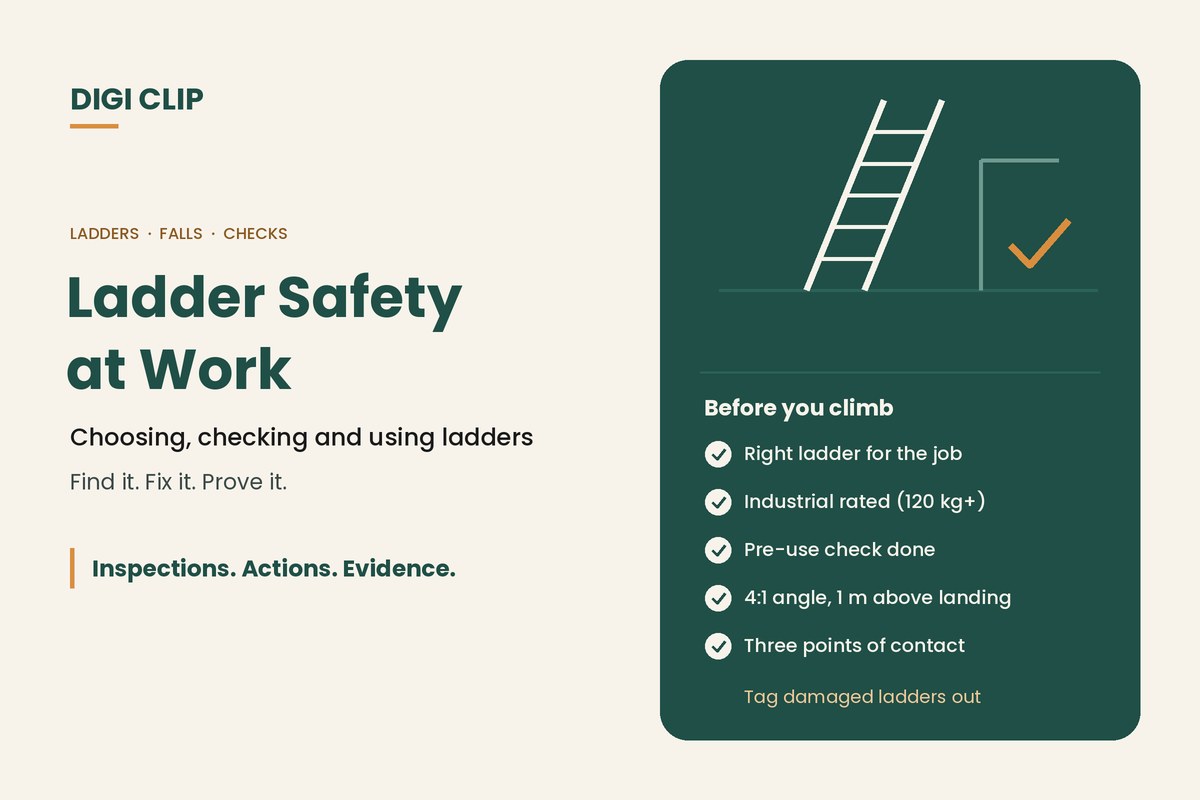
Ladder Safety at Work: Choosing, Checking and Using Ladders
Ladders are in every workshop, warehouse, site and service van, which makes them easy to take for granted. Falls from ladders happen at home and at work, often from low heights, and can cause head injuries, fractures and worse. This guide covers when a ladder is the right choice, how to pick one, what to check before use, and the setup and climbing rules that prevent falls.
Key points
- Use a ladder only for short, light work when a safer option isn’t reasonably practicable.
- Choose an industrial-rated ladder that meets the Australian Standard.
- Check ladders before each use and remove damaged ones from service.
- Set extension ladders at about 4:1 and extend them 1 metre above the landing.
- Keep three points of contact and don’t overreach.
When to use a ladder
Under the WHS regulations, businesses must manage the risk of falls, working through a hierarchy: do the work on the ground where possible, then use a fall prevention device such as a scaffold, platform or elevating work platform, and only then consider ladders and fall arrest. Ladders suit short-duration, light work, such as inspections or changing a light, where the worker can keep three points of contact. Safe Work Australia’s model Code of Practice on managing the risk of falls at workplaces gives guidance.
Choosing the right ladder
| Type | Best for |
|---|---|
| Step ladder | Short tasks at low height on firm, level ground |
| Platform ladder | Longer tasks, with a platform, handrails and more stability |
| Extension ladder | Access to a higher level, such as a roof, rather than working from it |
| Fibreglass ladder | Work near electricity, as it doesn’t conduct like aluminium |
For work, choose industrial ladders that meet the AS/NZS 1892 series of standards and are rated for the combined weight of the worker, tools and materials. Industrial ladders are rated to carry at least 120 kg.
Pre-use ladder check
- Rails not bent, cracked or split
- Rungs or steps secure, undamaged and free of grease or mud
- Feet and non-slip pads in place and in good condition
- Locks, spreaders and hinges working on step ladders
- Extension ladder locks, ropes and pulleys working
- Rating and standard labels present and readable
Tag damaged ladders out of service straight away, and repair or replace them.
Setting up and using a ladder
- Check the ladder. Complete the pre-use check and tag out anything damaged.
- Check the area. Look for overhead power lines, doorways, vehicles and people, and set up barriers if needed.
- Set up on firm, level ground. Fully open step ladders and lock the spreaders.
- Angle and secure extension ladders. Set them at about 4:1 (one metre out for every four up), extend 1 metre above the landing, and tie off or have the base footed.
- Climb with three points of contact. Face the ladder, keep both feet and one hand on it, and carry tools in a belt or haul them up.
- Work within reach. Keep your belt buckle between the rails, don’t stand above the second-top step of a step ladder, and move the ladder rather than overreaching.
Ladder checks on the phone
With DIGI CLIP, workers complete pre-use ladder checks and regular ladder inspections on a phone, with photos. Each form is location- and time-stamped. A damaged ladder creates an action in the Action Log, so it’s tagged out, replaced and closed out with evidence.
Illustrative scenario: a damaged step ladder
During a monthly equipment check at a warehouse, a team leader finds a step ladder with a cracked spreader. She fails the item in DIGI CLIP with a photo and tags the ladder out of service. An action goes to the warehouse manager, a replacement platform ladder is ordered, and the action is closed out with a photo once it arrives.
This scenario is illustrative. It shows how a business could use DIGI CLIP and is not an account of a specific customer.
See also our guide to preventing slips, trips and falls.
Keep Ladders Checked and Safe
Put ladder and equipment checks on your team’s phones and see damage land in the Action Log, ready to fix and prove.
Start Your 14-Day Free TrialNo credit card required. Set up in minutes.
Frequently asked questions
When should a ladder be used at work?
For short-duration, light work where the worker can keep three points of contact, and only when safer options such as a scaffold, platform or elevating work platform aren’t reasonably practicable.
What is the correct angle for an extension ladder?
About 4:1, which means the base is one metre out from the wall for every four metres of height. The ladder should also extend 1 metre above the landing.
What load rating should a work ladder have?
Use an industrial ladder that meets the AS/NZS 1892 series and is rated for the combined weight of the worker, tools and materials. Industrial ladders are rated to at least 120 kg.
What should be checked on a ladder before use?
Rails, rungs or steps, feet and non-slip pads, locks and spreaders, extension ropes and pulleys, and the rating and standard labels. Damaged ladders should be tagged out of service.
What is the three points of contact rule?
Keep two feet and one hand, or two hands and one foot, on the ladder at all times while climbing and working, facing the ladder.
Can ladder inspections be recorded on a phone?
Yes. In DIGI CLIP, ladder checks are completed on a phone with photos, and damaged ladders become actions in the Action Log.
About DIGI CLIP Mobile Forms
DIGI CLIP is an Australian-built mobile checklist and inspection platform. Inspections. Actions. Evidence. Teams complete checks on a phone or tablet, turn defects into assigned actions, and keep the proof that each one was fixed and verified.
See our Form Library for ready-made templates.






