Last updated:
Heavy equipment failures are breakdowns of machines such as excavators, loaders, dozers, graders and cranes. Most start small, with contamination, wear, poor lubrication or overheating, and give warning signs that daily pre-start checks and planned maintenance can pick up before the machine stops.
The Top Ten Most Common Failures in Heavy Equipment and How to Prevent Them
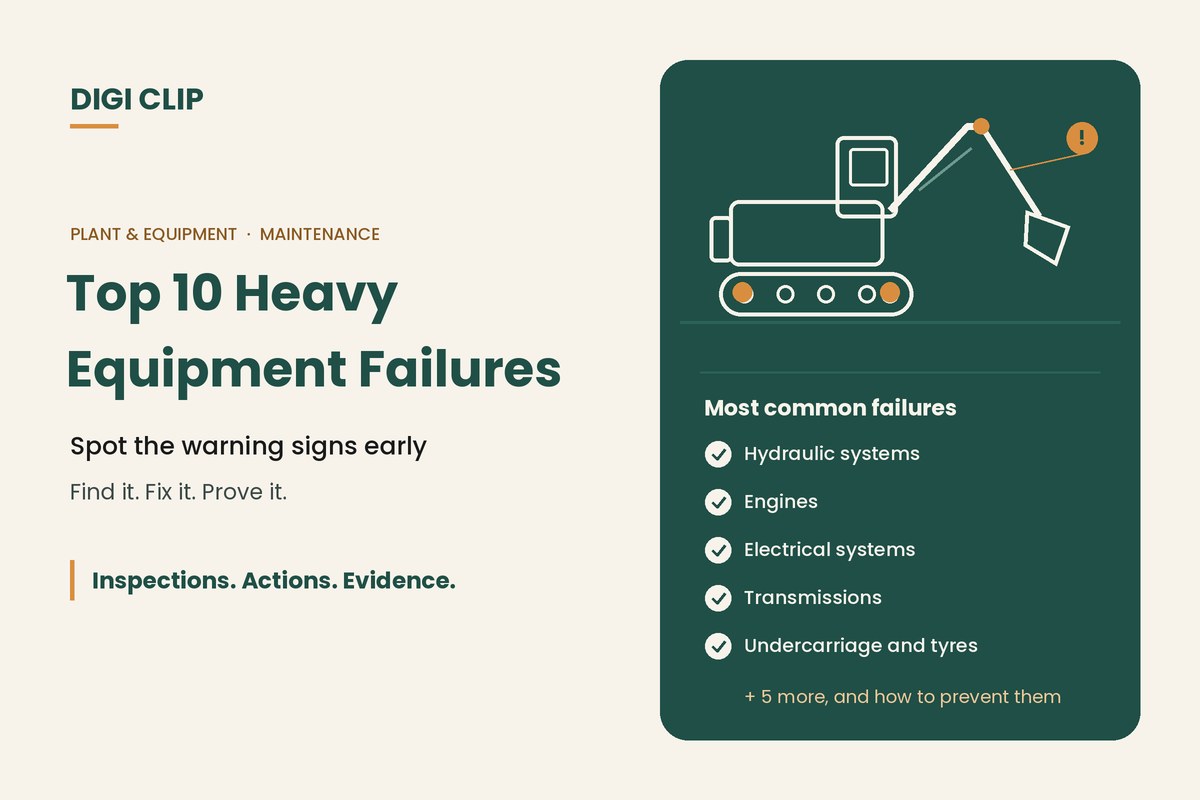
Heavy equipment works hard in dust, mud, heat and heavy loads, so wear is expected. Breakdowns are a different matter. Most major failures can be traced back to something that was visible earlier: a weeping hydraulic fitting, a coolant level that kept dropping, a warning light that was ignored. This guide covers the ten most common failure types, the warning signs to look for, and how to prevent them with daily checks and good maintenance habits.
Key points
- Hydraulics, engines, electrics, transmissions, undercarriage, brakes, cooling, lubrication, fuel and structure account for most failures.
- Contamination, missed servicing, overheating and operator misuse are the most common root causes.
- Operators are best placed to spot early warning signs during the daily pre-start.
- Every defect found should be assigned, fixed and signed off before the machine goes back to work.
- Analysing repeat failures helps you fix the cause, not just the symptom.
The ten most common heavy equipment failures
1. Hydraulic system failures
Hydraulics power the boom, bucket, blade and steering on most machines, so a failure can stop work immediately. Common causes are contaminated oil, worn seals, damaged hoses and overheating. Watch for leaks, slow or jerky movement, whining pumps and oil that looks milky or dark.
2. Engine failures
Engine damage usually follows poor air filtration, low or contaminated oil, overheating or missed servicing. Warning signs include low oil pressure, excessive smoke, loss of power, knocking and rising oil consumption.
3. Electrical failures
Corroded terminals, chafed wiring, loose connections and tired batteries cause many no-start and intermittent faults. Check battery terminals, wiring looms near moving parts, and warning lights at every start-up.
4. Transmission and drivetrain failures
Degraded fluid, overloading and harsh operation wear clutches, gears and bearings. Look for slipping, delayed or rough shifts, unusual noises and fluid that smells burnt.
5. Undercarriage, track and tyre wear
Tracks, rollers, idlers and tyres take a beating on rough ground. Incorrect track tension, misalignment and underinflation speed up wear. Check tension, look for cracked or missing parts, and inspect tyres for cuts, bulges and uneven wear.
6. Brake failures
Worn pads or discs, contaminated fluid and air in the system reduce braking. Test the service and park brakes at every pre-start, and report any pulling, soft pedal or noise straight away.
7. Cooling system failures
Blocked radiators, low coolant, failed fans and leaking hoses lead to overheating, which then damages engines and hydraulics. Keep radiators and coolers clean, especially in dusty conditions, and treat a dropping coolant level as a defect.
8. Lubrication failures
Missed greasing and the wrong lubricant cause pins, bushes and bearings to wear quickly. Follow the greasing schedule, watch for dry or squeaking joints, and look for excessive play in pins and bushes.
9. Fuel system failures
Water and dirt in fuel damage injectors and pumps. Use clean storage and refuelling practices, drain water separators as required, and change fuel filters on schedule. Watch for hard starting, misfiring and loss of power.
10. Structural failures
Booms, arms, frames and attachments can crack from fatigue, overloading or misuse. Look for cracks, especially around welds and pin bosses, bent components and loose or missing fasteners. Structural cracks should always be assessed by a competent person before the machine is used again.
Warning signs at a glance
| Failure type | Common causes | Warning signs to check daily |
|---|---|---|
| Hydraulic | Contaminated oil, worn seals, damaged hoses | Leaks, slow or jerky movement, pump noise |
| Engine | Dirty air or oil, overheating, missed servicing | Low oil pressure, smoke, power loss |
| Electrical | Corrosion, chafed wiring, weak batteries | Hard starting, warning lights, flickering |
| Transmission | Degraded fluid, overloading | Slipping, rough shifts, burnt smell |
| Undercarriage and tyres | Wrong tension, misalignment, underinflation | Uneven wear, cracked parts, cuts and bulges |
| Brakes | Worn components, contaminated fluid | Pulling, soft pedal, noise |
| Cooling | Blocked radiators, leaks, fan faults | Rising temperature, dropping coolant |
| Lubrication | Missed greasing, wrong lubricant | Dry or noisy joints, pin play |
| Fuel | Water or dirt in fuel, old filters | Hard starting, misfiring, power loss |
| Structural | Fatigue, overloading, misuse | Cracks near welds, bent parts, loose fasteners |
How to prevent heavy equipment failures
- Run a daily pre-start on every machine. Use a checklist written for that type of machine, covering fluids, leaks, hydraulics, brakes, undercarriage, structure and warning lights. Our plant pre-start checklist is a good starting point.
- Follow the manufacturer’s service schedule. Stick to service intervals, fluid specifications and genuine or equivalent parts.
- Keep fluids clean. Store and transfer oil, fuel and coolant properly, and use sampling where it suits your fleet to spot contamination and wear early.
- Train operators. Operators should know the machine’s limits, how to warm it up and shut it down properly, and which warning signs to report.
- Close the loop on every defect. Each defect needs an owner, a due date and a record that it was fixed before the machine goes back to work.
- Review repeat faults. If the same failure keeps coming back, investigate the cause rather than repeating the same repair.
For more on servicing and scheduling, see our guides to plant machinery maintenance checklists and preventative maintenance.
Heavy equipment failure analysis
When a machine fails, the repair fixes the symptom. Failure analysis finds out why it happened, so it doesn’t happen again. A simple approach works for most fleets:
- Record the facts: the machine, hours, operating conditions, what failed and what the operator noticed beforehand.
- Check the history: recent pre-starts, defects, services and repairs for that machine.
- Find the root cause: ask why the failure happened, then why that happened, until you reach something you can control. Our guides to the 5 Whys and root cause analysis explain how.
- Act on it: update the pre-start checklist, service schedule, training or operating procedure, and track the change to completion.
Good pre-start and defect records make this far easier, because the warning signs and past repairs are already written down.
Digital inspections for heavy equipment
With DIGI CLIP, operators complete pre-starts on a phone or tablet, photograph any defect and submit the check on site. Checklists can be completed without coverage and submitted with a tap once the device is back online. Failed items flow into the Action Log, where they are assigned to maintenance, tracked, and closed out with evidence. Overdue actions trigger alert emails, and inspection and defect history can be exported to PDF or Excel when you need to review a machine. If you're choosing software, our guide to inspection checklist apps covers offline use, audit trails and evaluation criteria.
See our heavy equipment inspection app guide and equipment inspection checklist template for more.
Illustrative scenario: a coolant level that kept dropping
An excavator operator notes a low coolant level on two pre-starts in a week and adds a photo of a damp hose clamp each time. Both defects land in the Action Log. Instead of topping up again, the maintenance supervisor reviews the history, finds a split hose under the clamp and replaces it. The close-out records the fix, and the checklist is updated to include a hose check around the radiator.
This scenario is illustrative. It shows how a fleet could use DIGI CLIP and is not an account of a specific customer.
Catch Equipment Faults Before They Stop Work
Put your plant pre-starts on every operator’s phone and see defects land in the Action Log, ready to fix and prove.
Start Your 14-Day Free TrialNo credit card required. Set up in minutes.
Frequently asked questions
What are the most common heavy equipment failures?
The most common failures are in hydraulics, engines, electrical systems, transmissions, undercarriage and tyres, brakes, cooling systems, lubrication, fuel systems and structural components such as booms and frames.
What causes most heavy equipment failures?
Contaminated fluids, missed or late servicing, overheating, poor lubrication, overloading and operator misuse are among the most common root causes.
How often should heavy equipment be inspected?
Operators should complete a pre-start check before each shift, and machines should be serviced and inspected according to the manufacturer’s schedule. More frequent checks may be needed in harsh conditions.
What is heavy equipment failure analysis?
Failure analysis looks at why a machine failed, not just what failed. It uses the facts of the failure, the machine’s inspection and repair history, and a root cause method such as the 5 Whys to find changes that stop the failure happening again.
What should an operator do if they find a defect?
Record the defect, add a photo if possible and report it straight away. If the defect affects safety, the machine should be tagged out and not used until it has been repaired and signed off.
Can heavy equipment inspections be done on a phone?
Yes. In DIGI CLIP, operators complete inspections on a phone or tablet, attach photos and submit them on site. Checklists can be completed without coverage, and failed items flow into the Action Log for follow-up.
About DIGI CLIP Mobile Forms
DIGI CLIP is an Australian-built mobile checklist and inspection platform. Inspections. Actions. Evidence. Teams complete checks on a phone or tablet, turn defects into assigned actions, and keep the proof that each one was fixed and verified.
Learn more about the DIGI CLIP checklist and inspection app.
If you liked this post? Why not share it!