Last updated:
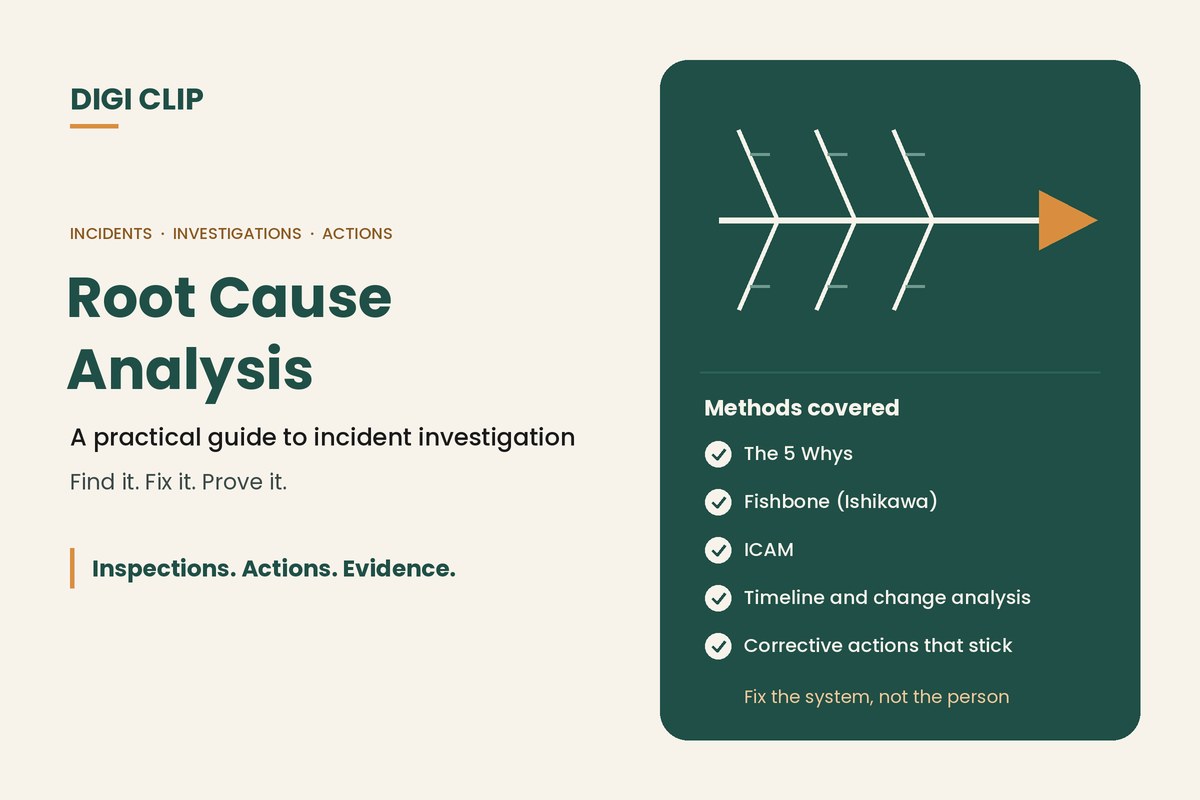
A root cause analysis (RCA) is a structured way of investigating an incident, near miss or recurring problem to find the underlying reasons it happened, not just the immediate trigger. The aim is to fix those underlying causes so the same thing doesn’t happen again.
Root Cause Analysis: A Practical Guide to Effective Incident Investigation
When something goes wrong at work, it’s tempting to stop at the obvious answer: the worker didn’t follow the procedure. Root cause analysis asks why, and keeps asking until it reaches causes you can actually fix, such as unclear procedures, poor equipment design, time pressure or gaps in training. This guide covers the levels of cause, the steps of an investigation, the most useful RCA methods, and how to make sure corrective actions stick.
Key points
- Look past the immediate cause to the underlying and systemic causes.
- Focus on systems and conditions, not blame.
- Choose a method that suits the incident: 5 Whys for simpler problems, fishbone or ICAM for more complex ones.
- Corrective actions should target root causes and use the hierarchy of controls.
- Check that actions were completed and worked.
The three levels of cause
- Immediate cause: the event that directly led to the incident, such as a forklift reversing into a pedestrian.
- Underlying cause: the conditions that allowed it, such as no separation between the walkway and the forklift route, or a reversing alarm that didn’t work.
- Root or systemic cause: the gaps in the system behind those conditions, such as no traffic management plan, or pre-start checks that don’t lead to repairs.
Fixing only the immediate cause usually means the problem comes back in a different form.
How to conduct a root cause analysis
- Make the scene safe and preserve it. Provide first aid, control ongoing risks and, for notifiable incidents, preserve the site and notify the WHS regulator as required.
- Gather the facts. Collect photos, witness accounts, records, maintenance history, rosters and procedures while details are fresh.
- Build the sequence of events. Put together a timeline of what happened, before, during and after.
- Analyse the causes. Use an RCA method to work back from what happened to why it happened, at each level.
- Agree corrective actions. Set actions that address the root causes, with owners and due dates.
- Follow up and share lessons. Check actions are completed and effective, and share what was learned.
Root cause analysis methods
The 5 Whys
Ask “why?” repeatedly, usually around five times, until you reach a cause you can fix. It is quick and works well for simpler incidents. See our step-by-step guide to the 5 Whys.
Fishbone (Ishikawa) diagram
Groups possible causes into categories, such as people, equipment, methods, materials, environment and management. It helps teams think broadly and avoid fixating on one cause.
ICAM
The Incident Cause Analysis Method is widely used in Australian mining, aviation and other high-risk industries. It looks at absent or failed defences, individual and team actions, task and environmental conditions, and organisational factors.
Timeline and change analysis
Compares what happened with what normally happens, to find what changed: a new crew member, a different machine, a rushed job or a changed procedure.
| Method | Best for | Effort |
|---|---|---|
| 5 Whys | Simpler incidents and recurring faults | Low |
| Fishbone | Problems with several possible causes | Medium |
| ICAM | Serious incidents and high-risk industries | Higher |
| Timeline and change analysis | Incidents where something was different from normal | Medium |
Corrective actions that stick
- Target the root cause: retraining one worker rarely fixes a system problem.
- Use the hierarchy of controls: prefer removing the hazard, isolation and engineering controls over signs and reminders. See our guide to workplace risk assessments.
- Be specific: each action needs a named owner, a due date and a clear description of done.
- Verify: check the action was completed and that it worked, for example through a follow-up inspection.
- Update: revise risk assessments, procedures and checklists so the fix becomes part of how work is done.
Common mistakes
- Stopping at human error: “worker didn’t follow the procedure” is a starting point, not a root cause.
- Blame: people stop reporting when investigations are about finding someone to blame.
- Too slow: evidence and memories fade quickly.
- Weak actions: “remind staff to be careful” won’t prevent a repeat.
- No follow-up: actions stay open or are closed without checking they worked.
Investigations in DIGI CLIP
Safety Tracker, included in the DIGI CLIP Compliant plan, has an investigation template that links to our 5 Whys guide for root cause analysis. Investigators select the severity level and investigation type, and corrective actions added in the investigation flow into the Action Log, where they are assigned, tracked and closed out with evidence. Each form is location- and time-stamped.
Illustrative scenario: a repeat hand injury
After a second hand injury on the same packing machine in three months, a site investigates using a fishbone diagram. They find a guard is removed to clear jams because jams are frequent, and jams are frequent because a worn feed roller was never replaced. Actions are raised to replace the roller, fit an interlocked guard and add the roller to the maintenance schedule. Each is closed out with evidence, and a follow-up inspection a month later confirms jams have dropped.
This scenario is illustrative. It shows how a business could use DIGI CLIP and is not an account of a specific customer.
Close the Loop on Every Investigation
Record investigations on any device and see corrective actions land in the Action Log, ready to fix and prove.
Start Your 14-Day Free TrialNo credit card required. Set up in minutes.
Frequently asked questions
What is a root cause analysis?
Root cause analysis is a structured way of investigating an incident, near miss or recurring problem to find the underlying reasons it happened, not just the immediate trigger. The aim is to fix those underlying causes so the same thing doesn’t happen again.
What are the main root cause analysis methods?
Common methods include the 5 Whys, the fishbone (Ishikawa) diagram, ICAM (Incident Cause Analysis Method) and timeline or change analysis. The right one depends on how complex and serious the incident is.
What is the difference between the 5 Whys and root cause analysis?
Root cause analysis is the overall process of finding underlying causes. The 5 Whys is one technique used within it, best suited to simpler incidents and recurring problems.
What are the three levels of cause?
The immediate cause (what directly led to the incident), the underlying cause (the conditions that allowed it) and the root or systemic cause (the gaps in the system behind those conditions).
Who should be involved in a root cause analysis?
Someone trained in investigation, the supervisor of the area, workers involved or familiar with the task, a health and safety representative where there is one, and specialists such as maintenance technicians when needed.
How do you make sure corrective actions work?
Target the root causes, use the hierarchy of controls, give each action an owner and due date, verify it was completed and effective, and update risk assessments, procedures and checklists.
About DIGI CLIP Mobile Forms
DIGI CLIP is an Australian-built mobile checklist and inspection platform. Inspections. Actions. Evidence. Teams complete checks on a phone or tablet, turn defects into assigned actions, and keep the proof that each one was fixed and verified.
See our Form Library for ready-made templates.