
Last updated:
A safety checklist is a structured list of items a worker or supervisor checks to confirm that equipment, a work area or a task is safe. In industrial settings, checklists turn safety procedures into consistent, repeatable checks, and create a record of what was checked and what was found.
Safety Checklists in Industrial Settings: Why They Matter and How to Build One
Factories, warehouses, workshops and sites run on routines, and routines are where things get missed. A well-built safety checklist keeps the important checks from being skipped, even on a busy shift or when someone new is doing the job. This guide covers why checklists matter, the most useful types, how to build one step by step, a starter list for small businesses, and how to make sure the checks lead to action.
Key points
- Checklists make safety checks consistent across people, shifts and sites.
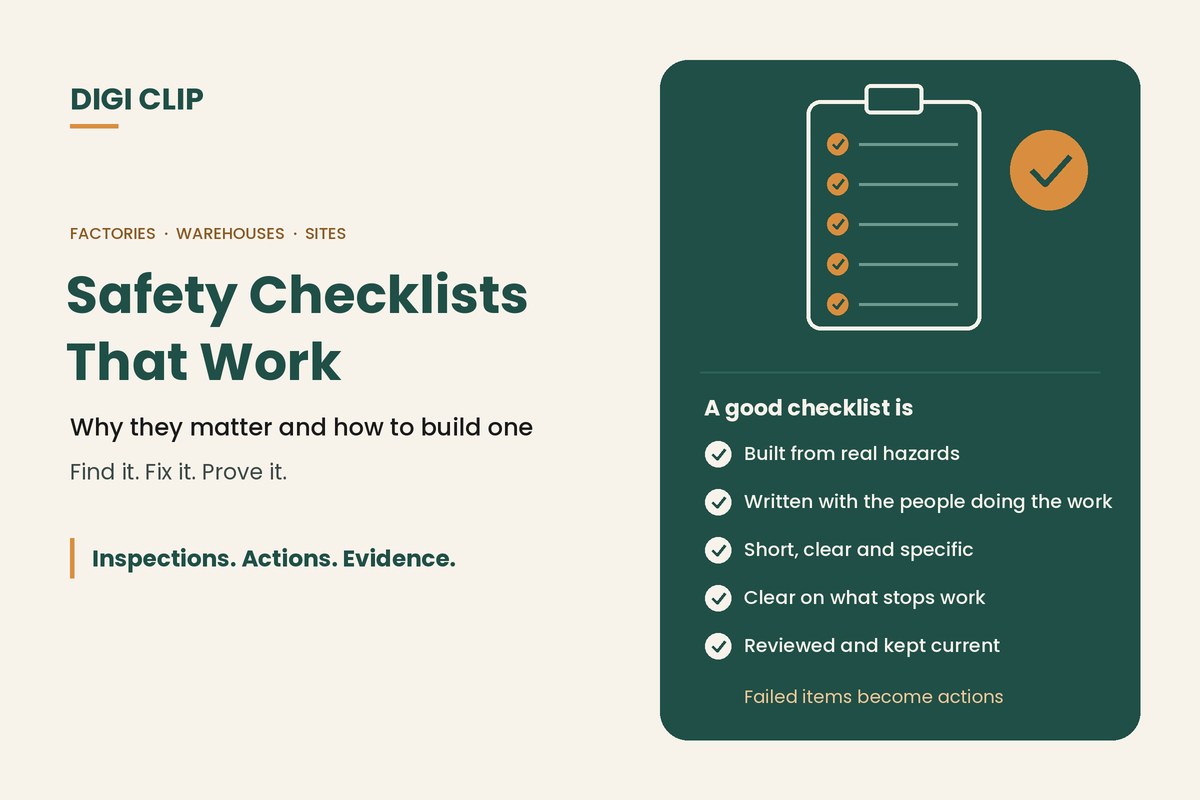
- Build them from real hazards, manufacturer instructions and the people who do the work.
- Keep them short, specific and easy to answer.
- A failed item must lead to an action, not just a cross on a form.
- Review checklists regularly and after incidents or changes.
Why safety checklists matter
- Consistency: everyone checks the same things, in the same way, every time.
- Memory aid: people forget steps when they are busy, tired or new to the job.
- Early warning: small problems are picked up before they become incidents or breakdowns.
- Evidence: completed checklists show that hazards are being identified and controls checked, which supports your duties under WHS law.
- Culture: regular checks keep safety visible and give workers a simple way to raise problems.
Common types of industrial safety checklists
- Pre-start checklists for vehicles, plant and equipment. See our pre-start checklist template.
- Workplace inspection checklists for regular walk-throughs. See our guide to workplace safety inspections.
- Machine and plant checklists, including guards, emergency stops and isolation. See daily plant equipment safety checks.
- Electrical safety checklists. See our electrical safety inspection checklist.
- Fire and emergency checklists for exits, extinguishers, alarms and evacuation.
- Hazardous chemical checklists for storage, labelling and safety data sheets.
- Permit-to-work checklists for hot work, confined spaces and isolation.
- Audit checklists for reviewing the safety system. See our workplace safety audit checklist.
How to build an effective safety checklist
- Define the purpose. Decide what the checklist is for, who uses it, how often and where.
- Identify the hazards. Use risk assessments, incident history, manufacturer instructions and legal requirements to find what really matters.
- Involve the people who do the work. Operators and supervisors know which checks are useful and which get skipped.
- Write clear items. Make each item specific, observable and answerable with a clear yes, no or not applicable.
- Decide what happens on a fail. Mark which items stop work, and set who gets notified and how quickly.
- Test and review. Trial the checklist, get feedback and update it after incidents, changes or regular reviews.
What makes a good checklist item
| Vague | Clear |
|---|---|
| Check guards | All guards on the conveyor are fitted, secure and undamaged |
| Area safe | Walkways and exits are clear of stock and rubbish |
| Fire equipment OK | Fire extinguishers are in place, tagged within the last six months and unobstructed |
| PPE | Hearing protection is worn in the marked noise area |
Keep checklists short enough to complete properly. A 100-item checklist tends to become a tick-and-flick exercise.
Starter checklist for small businesses
If you’re a small business starting from scratch, these ten items cover the basics:
- Walkways, stairs and exits are clear and well lit
- Emergency exits and evacuation plans are marked and current
- Fire extinguishers are in place and within their service date
- The first aid kit is stocked and someone trained in first aid is available
- Electrical leads and power boards are undamaged and not overloaded
- Equipment guards and safety devices are in place and working
- Chemicals are labelled, stored correctly and have safety data sheets
- Heavy items are stored at waist height where possible, and lifting aids are available
- PPE is available, in good condition and being used where required
- Hazards and incidents are reported and followed up
From checklist to action
A cross on a paper form doesn’t fix anything. Make sure failed items lead somewhere:
- Every failed item creates an action with an owner and a due date.
- Items that stop work are clearly marked, so no one carries on regardless.
- Fixes are recorded with evidence, such as a photo.
- Completed checklists are reviewed for trends, such as the same item failing week after week.
With DIGI CLIP, teams complete checklists on a phone or tablet, even without coverage, with photos, comments and signatures. Each form is location- and time-stamped. Smart fields can create an action automatically when a “No”, “Not OK” or “At Risk” answer is selected, and actions flow into the Action Log to be assigned, tracked and closed out with evidence.
Illustrative scenario: a recurring guard fault
A food manufacturer’s weekly machine checklist keeps flagging the same loose guard on a packaging line. Each time, it is tightened and the action is closed. Reviewing the Action Log, the maintenance lead spots the pattern and raises a new action to replace the worn mounting bracket, which fixes the problem for good.
This scenario is illustrative. It shows how a business could use DIGI CLIP and is not an account of a specific customer.
Ready-made templates are available in the DIGI CLIP Form Library. For manufacturing, see digital checklists for manufacturing.
Make Every Checklist Count
Put your safety checklists on your team’s phones and see failed items land in the Action Log, ready to fix and prove.
Start Your 14-Day Free TrialNo credit card required. Set up in minutes.
Frequently asked questions
What is a safety checklist?
A safety checklist is a structured list of items a worker or supervisor checks to confirm that equipment, a work area or a task is safe. In industrial settings, checklists turn safety procedures into consistent, repeatable checks, and create a record of what was checked and what was found.
Why are safety checklists important in industrial workplaces?
They make checks consistent across people and shifts, stop important steps being missed, pick up problems early and create a record showing hazards are being identified and controls checked.
How do you create an effective safety checklist?
Define its purpose, identify the real hazards, involve the people who do the work, write clear and specific items, decide what happens when an item fails, and test and review the checklist regularly.
What should a small business safety checklist include?
Clear walkways and exits, emergency plans, fire extinguishers, first aid, electrical safety, equipment guards, chemical storage, manual handling, PPE, and a way to report and follow up hazards and incidents.
How often should safety checklists be reviewed?
Review them regularly, and whenever there is an incident, a near miss, a change to equipment or processes, or feedback that items are unclear or unworkable.
Can safety checklists be completed on a phone?
Yes. In DIGI CLIP, checklists are completed on a phone or tablet, even without coverage, with photos, comments and signatures, and failed items flow to the Action Log.
About DIGI CLIP Mobile Forms
DIGI CLIP is an Australian-built mobile checklist and inspection platform. Inspections. Actions. Evidence. Teams complete checks on a phone or tablet, turn defects into assigned actions, and keep the proof that each one was fixed and verified.
See our Form Library for ready-made templates.






