Last updated:
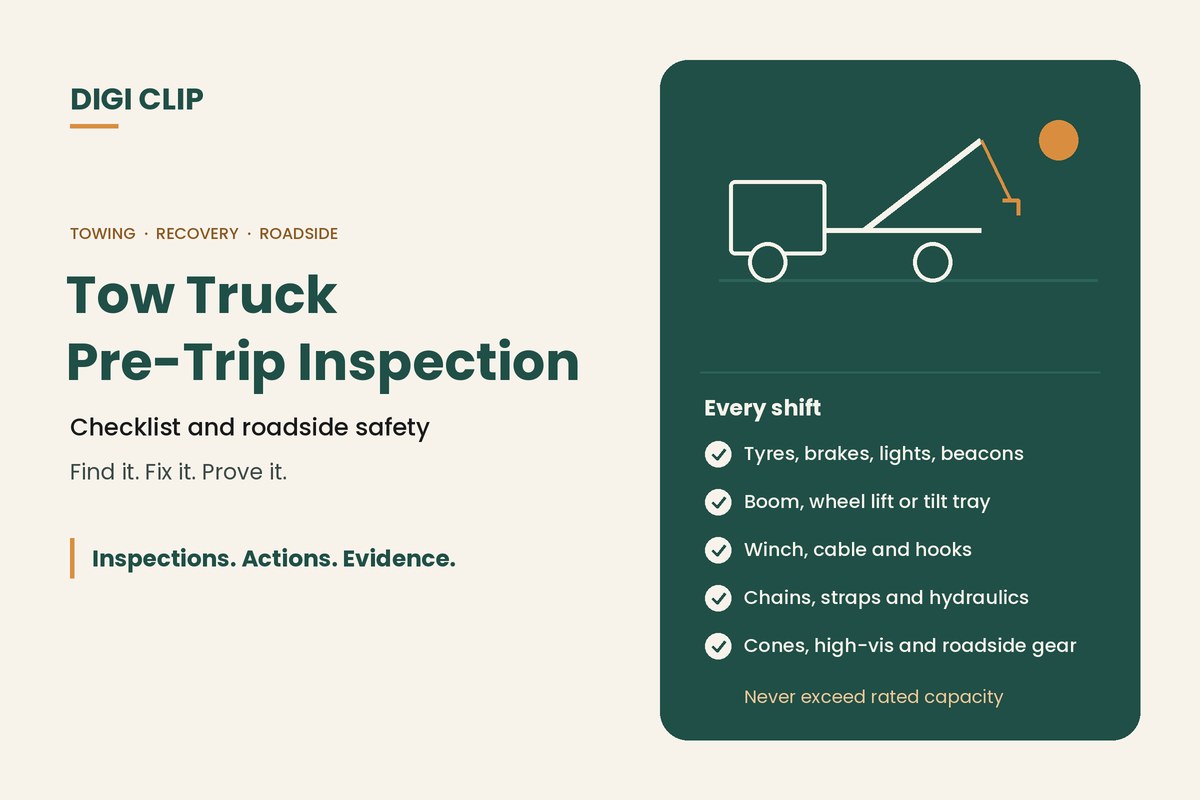
A tow truck pre-trip inspection is the check an operator completes before each shift to confirm the truck and its towing equipment are safe: tyres, brakes, lights and beacons, plus the boom, winch, cables, wheel lift or tilt tray, hydraulics, chains, straps and safety gear. Tow operators work roadside in traffic, so equipment and warning devices must be ready every time.
Tow Truck Pre-Trip Inspection: Checklist and Roadside Safety
Tow operators face a mix of risks few other drivers do: heavy lifting equipment, winching under load, and working on the roadside next to passing traffic, often at night or in bad weather. A thorough pre-trip inspection makes sure the truck, the towing gear and the warning equipment are ready before the first call-out. This guide covers what to check, how to run the inspection and how to keep records.
Key points
- Check the truck and the towing equipment every shift.
- Winch cables, chains and straps wear quickly and need close inspection.
- Beacons, lights and high-visibility gear protect operators at roadside jobs.
- Never exceed the rated capacity of the boom, winch or wheel lift.
- Towing is licensed in some states, so check the local rules that apply.
Truck checks
- Tyres: pressure, tread, damage, and wheel nuts secure
- Brakes and park brake holding
- Headlights, indicators, brake lights, work lights and amber beacons
- Fluids and leaks: engine oil, coolant, fuel and hydraulic oil
- Mirrors, windscreen, wipers, horn and reversing alarm
- Cabin: seatbelts, fire extinguisher and first aid kit
Towing equipment checks
| Equipment | What to check |
|---|---|
| Boom and wheel lift | No cracks or damage, pins and locks in place, rated capacity marked |
| Winch and cable | Cable not kinked, frayed or crushed; hook and safety latch working; winch controls and brake working |
| Tilt tray | Tray locks, rollers, hydraulic rams and hoses free of leaks and damage |
| Chains and straps | No stretched or cracked links, no cuts or fraying, correct ratings |
| Hydraulics | Oil level, hoses, fittings and controls working with no leaks |
| Accessories | Dollies, skates, wheel chocks, safety chains and tow lights present and working |
Roadside safety gear
- High-visibility clothing for day and night
- Traffic cones, warning triangles or signs
- Torch and work lights
- Gloves and safety boots
- Spill kit for fuel and fluid leaks at crash scenes
Some states have “slow down, move over” road rules that require drivers to slow down near stopped tow trucks and other roadside assistance vehicles showing flashing lights. Operators still need to plan every job as if traffic won’t slow down.
Running the pre-trip
- Walk around the truck. Check tyres, lights, beacons, leaks and the cabin.
- Inspect the towing gear. Check the boom, wheel lift or tray, winch, cable and hooks.
- Check chains and straps. Inspect every chain, strap and accessory before it goes on the truck.
- Test the controls. Run the winch, boom, lift or tray through their movements with no load.
- Check roadside gear. Confirm cones, signs, high-vis and lights are on board.
- Record and act. Note defects with photos and take faulty equipment out of service.
Pre-trip checks on the phone
With DIGI CLIP, tow operators complete pre-trip checks on a phone, with photos of the towing gear. Each form is location- and time-stamped. A failed item creates an action in the Action Log, so damaged cables, chains or hydraulics are repaired and closed out with evidence before the truck goes out.
Illustrative scenario: a kinked winch cable
At the start of a night shift, a tow operator finds a kink in the winch cable near the hook. He fails the item in DIGI CLIP with a photo, and the truck is held from call-outs. The workshop replaces the cable within the hour, and the action is closed out with a photo before the truck is released.
This scenario is illustrative. It shows how a towing business could use DIGI CLIP and is not an account of a specific customer.
See also our guides to the flatbed truck pre-trip inspection and the commercial truck safety checklist.
Put Tow Truck Pre-Trips on the Phone
Run pre-trip checks on your operators’ phones and see defects land in the Action Log, ready to fix and prove.
Start Your 14-Day Free TrialNo credit card required. Set up in minutes.
Frequently asked questions
What should a tow truck pre-trip inspection include?
Tyres, brakes, lights, beacons, leaks and the cabin, plus the boom, wheel lift or tilt tray, winch and cable, hydraulics, chains, straps, accessories and roadside safety gear.
How often should a tow truck be inspected?
Before every shift, with extra checks after heavy recoveries or any damage, and scheduled servicing of the truck and towing equipment.
When should a winch cable be replaced?
When it is kinked, crushed, frayed, has broken wires or corrosion, or shows other damage. Damaged cables should be taken out of service straight away.
What safety gear should a tow truck carry?
High-visibility clothing, traffic cones and warning signs, a torch and work lights, gloves, a fire extinguisher, a first aid kit and a spill kit.
Do tow truck operators need a licence?
Some states license tow truck operators and drivers, particularly for crash towing. Check with your state’s transport authority for the rules that apply.
Can tow truck pre-trip checks be done on a phone?
Yes. In DIGI CLIP, operators complete pre-trip checks on a phone with photos, and failed items become actions in the Action Log.
About DIGI CLIP Mobile Forms
DIGI CLIP is an Australian-built mobile checklist and inspection platform. Inspections. Actions. Evidence. Teams complete checks on a phone or tablet, turn defects into assigned actions, and keep the proof that each one was fixed and verified.
See our Form Library for ready-made templates.