Last updated:
ISO 9001 is the international standard for quality management systems (QMS). It sets out how an organisation plans, controls, checks and improves its processes so products and services consistently meet customer and regulatory requirements. It uses a Plan-Do-Check-Act approach and risk-based thinking, and certification is done by an accredited third party.
ISO 9001 in Practice: What It Requires and How to Show It’s Working
ISO 9001 often comes up when a customer or tender asks for it. Like ISO 45001, it isn’t about producing binders of procedures. It’s about running consistent processes, catching problems, fixing them and learning from them, with records that show it’s happening. This page covers the key requirements and the everyday evidence that supports certification.
Key points
- ISO 9001 is voluntary but often required by customers.
- It shares a structure with ISO 45001 and ISO 14001, so systems can be integrated.
- A 2024 amendment added consideration of climate change to the organisation’s context.
- Inspections, nonconformance records and corrective actions are core evidence.
- Internal audits and management reviews close the loop.
Key requirements
| Clause | What it covers |
|---|---|
| 4 Context | Internal and external issues, interested parties, scope of the QMS |
| 5 Leadership | Top management commitment, quality policy, roles and responsibilities |
| 6 Planning | Risks and opportunities, quality objectives, planning changes |
| 7 Support | Resources, competence, awareness, communication, documented information |
| 8 Operation | Customer requirements, design, suppliers, production, release, nonconforming outputs |
| 9 Performance evaluation | Monitoring and measurement, customer satisfaction, internal audit, management review |
| 10 Improvement | Nonconformity, corrective action, continual improvement |
ISO 9001 shares its high-level structure with ISO 45001 and ISO 14001, so many businesses run quality, safety and environmental systems together. See also environmental compliance inspections and ISO 14001.
Everyday evidence
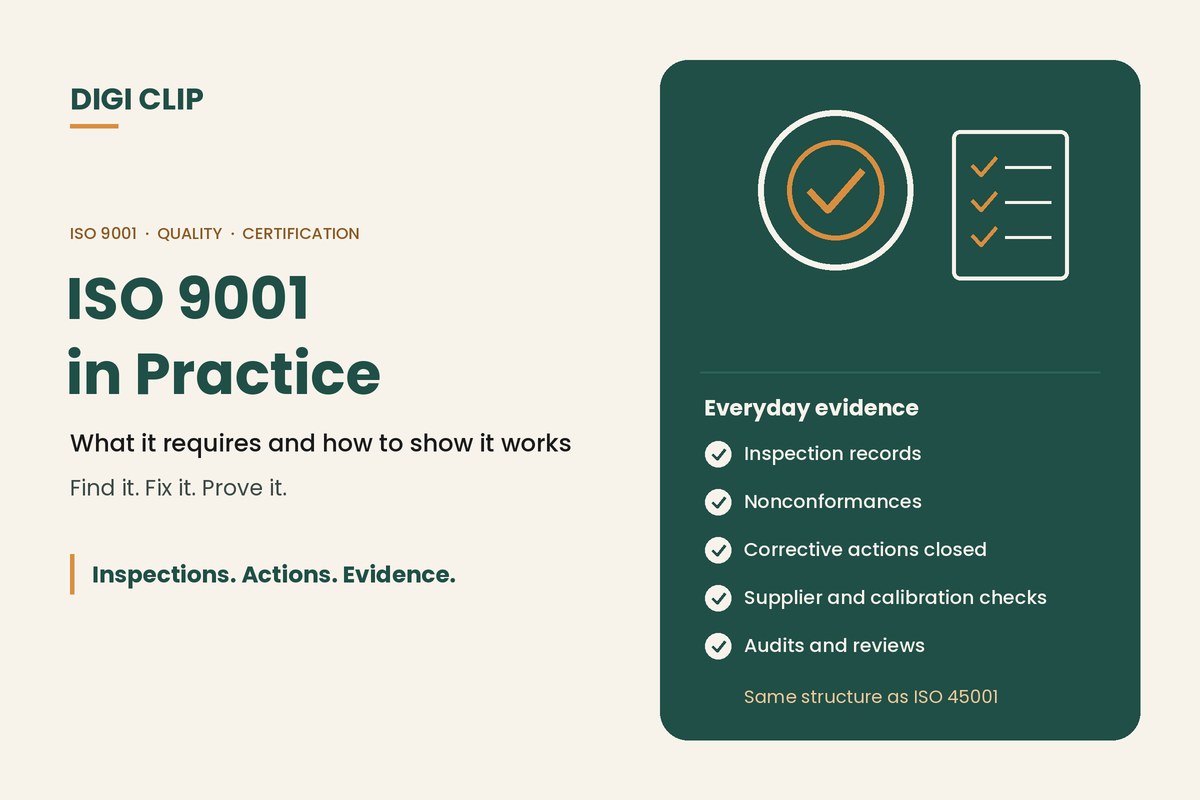
- Inspection records: receiving, in-process and final inspections. See our guide to quality inspection.
- Nonconformance records: what was found, how it was handled and why it happened.
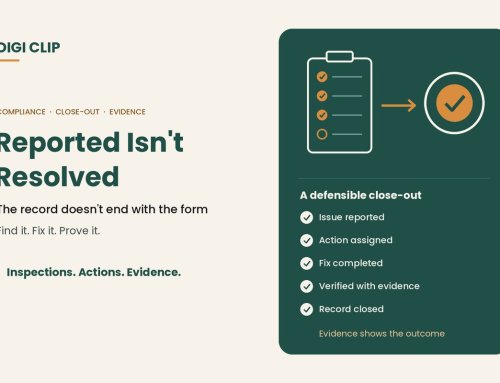
- Corrective actions: assigned, tracked and closed out with evidence.
- Supplier checks: incoming inspections and supplier performance.
- Maintenance and calibration: equipment and measuring tools kept fit for use.
- Training records: competence for key roles.
- Internal audits and management reviews: findings and decisions.
Getting ready for certification
- Do a gap analysis. Compare how you work now against each clause.
- Define your processes. Map key processes, their controls and the records they produce.
- Set up inspections and records. Make sure checks are done consistently and results are kept.
- Run the system. Record nonconformances and close out corrective actions for a few months.
- Audit and review. Run an internal audit and management review, and fix what they find.
- Engage a certification body. Choose an accredited certifier for the stage 1 and stage 2 audits.
Supporting ISO 9001 with DIGI CLIP
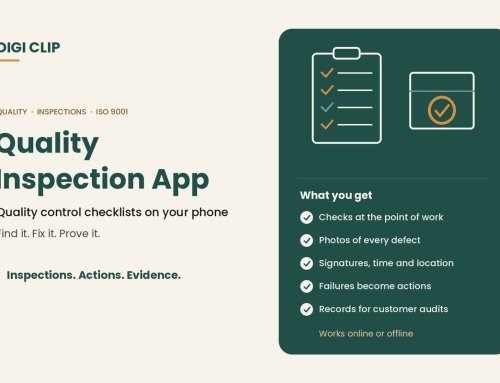
With DIGI CLIP, quality inspections and checks are completed on a phone or tablet, with photos, and each form is location- and time-stamped. Nonconformances become actions in the Action Log, tracked through to close-out with evidence, and records export to PDF or Excel for internal audits and certification audits. See also our quality inspection app guide.
Illustrative scenario: a recurring nonconformance
A small fabrication business preparing for ISO 9001 records final inspections in DIGI CLIP. Over a month, three welds fail the same visual check, each creating an action. Reviewing the actions shows the same machine setting in each case, so a corrective action is raised to update the set-up procedure, and it’s closed out with the revised procedure and a clean inspection record.
This scenario is illustrative. It shows how a business could use DIGI CLIP and is not an account of a specific customer.
Build the Records Your QMS Needs
Put quality inspections on your team’s phones and see nonconformances land in the Action Log, ready to fix and prove.
Start Your 14-Day Free TrialNo credit card required. Set up in minutes.
Frequently asked questions
What is ISO 9001?
The international standard for quality management systems. It sets out how an organisation plans, controls, checks and improves its processes so products and services consistently meet requirements.
Is ISO 9001 mandatory?
No. ISO 9001 is voluntary, but many customers and tenders require it.
What changed in ISO 9001 in 2024?
A 2024 amendment added a requirement for organisations to consider whether climate change is a relevant issue when understanding their context and the needs of interested parties.
What records do ISO 9001 auditors look for?
Inspection records, nonconformance records, corrective actions and close-outs, supplier checks, calibration and maintenance records, training records, internal audits and management reviews.
Can ISO 9001 be combined with ISO 45001 and ISO 14001?
Yes. The standards share a common structure, so many businesses run an integrated management system covering quality, safety and environment.
Can digital inspections support ISO 9001?
Yes. Digital inspection records, nonconformances and tracked corrective actions are useful evidence that the quality system is working.
About DIGI CLIP Mobile Forms
DIGI CLIP is an Australian-built mobile checklist and inspection platform. Inspections. Actions. Evidence. Teams complete checks on a phone or tablet, turn defects into assigned actions, and keep the proof that each one was fixed and verified.
See our Form Library for ready-made templates.