
Last updated:
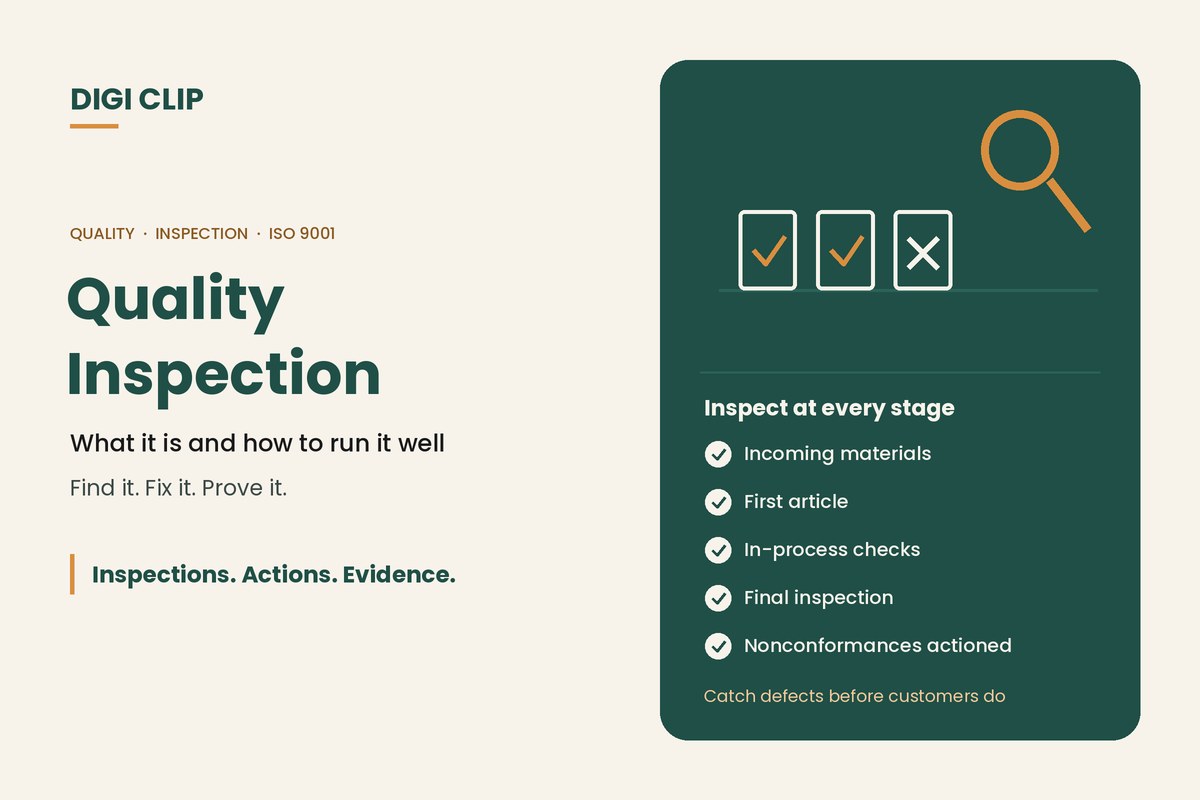
Quality inspection is the process of checking products, materials, work or services against defined requirements, such as specifications, drawings, standards or customer expectations, to find defects before they reach the customer. It can happen when materials arrive, during production or work, and before delivery or handover.
Quality Inspection: What It Is, Types and How to Run It Well
Every defect that reaches a customer costs more than one caught on the floor: rework, returns, warranty claims and lost trust. Quality inspections are how businesses catch problems early and prove the work meets requirements. This guide covers the main types of quality inspection, what to check, how to run inspections consistently and how they fit with ISO 9001.
Key points
- Inspect at receiving, during work and before delivery.
- Check against clear, written acceptance criteria.
- Record results, including photos of defects.
- Every nonconformance needs a decision, a fix and a record.
- Use inspection data to find and fix root causes.
Types of quality inspection
| Type | When | Purpose |
|---|---|---|
| Incoming (receiving) | When materials or parts arrive | Stop defective supplies entering production |
| First article | At the start of a run or new job | Confirm the setup produces conforming output |
| In-process | During production or work | Catch problems before more defects are made |
| Final | Before dispatch or handover | Confirm the finished product meets requirements |
| Pre-shipment | Before goods leave, often by the customer | Verify quantity, packaging and quality |
What to check
- Dimensions and specifications: measurements, tolerances and materials
- Appearance: finish, damage, contamination and workmanship
- Function: the product or work performs as intended
- Labelling and documentation: correct labels, certificates and records
- Packaging and quantity: correct count and protection for transport
Running a quality inspection
- Define acceptance criteria. Write down what good looks like, with limits, photos or reference samples.
- Set the sampling plan. Decide what to inspect, how many and how often.
- Use calibrated tools. Check gauges and instruments are calibrated and suitable.
- Inspect and record. Record results against each criterion, with photos of any defects.
- Segregate nonconforming items. Label and separate them so they can’t be used by mistake.
- Act and review. Decide what happens to nonconforming items and look for root causes.
Handling nonconformances
When an inspection finds a nonconformance, record it and decide how to handle it: rework, repair, use as is with approval, return to supplier or scrap. Then look at why it happened, especially for repeat problems, and put in a corrective action. See our guide to root cause analysis.
Quality inspection and ISO 9001
ISO 9001 is the international standard for quality management systems. Inspections support several of its requirements, including control of externally provided products, monitoring and measurement, release of products and services, control of nonconforming outputs, and corrective action. Inspection records and closed-out actions are useful evidence at audits. See our guide to ISO 9001 compliance.
Digital quality inspections
With DIGI CLIP, inspectors complete quality checks on a phone or tablet, with photos, measurements and pass/fail results. Each form is location- and time-stamped. Nonconformances become actions in the Action Log, with an owner and due date, so they’re resolved and closed out with evidence. To run these checks on a phone, see our quality inspection app guide.
Illustrative scenario: a receiving inspection
At a steel fabrication shop, a storeperson inspects a delivery of plate and finds the mill certificate doesn’t match the grade ordered. He fails the item in DIGI CLIP with photos, and the plate is tagged and set aside. An action goes to purchasing, the supplier replaces the plate, and the action is closed out with the correct certificate attached.
This scenario is illustrative. It shows how a business could use DIGI CLIP and is not an account of a specific customer.
Catch Defects Before Your Customers Do
Put quality inspections on your team’s phones and see nonconformances land in the Action Log, ready to fix and prove.
Start Your 14-Day Free TrialNo credit card required. Set up in minutes.
Frequently asked questions
What is quality inspection?
The process of checking products, materials, work or services against defined requirements, such as specifications, drawings or standards, to find defects before they reach the customer.
What are the main types of quality inspection?
Incoming or receiving inspection, first article inspection, in-process inspection, final inspection and pre-shipment inspection.
What is the difference between quality inspection and quality control?
Quality inspection is the act of checking against requirements. Quality control is the wider set of activities, including inspection, that keeps output meeting requirements.
What should happen when a nonconformance is found?
Record it, segregate the item, and decide whether to rework, repair, use with approval, return or scrap it. For repeat problems, find the root cause and put in a corrective action.
Does ISO 9001 require inspections?
ISO 9001 requires organisations to monitor and measure products and services and control nonconforming outputs. Inspections are a common way to meet these requirements.
Can quality inspections be done on a phone?
Yes. In DIGI CLIP, quality checks are completed on a phone or tablet with photos and measurements, and nonconformances become actions in the Action Log.
About DIGI CLIP Mobile Forms
DIGI CLIP is an Australian-built mobile checklist and inspection platform. Inspections. Actions. Evidence. Teams complete checks on a phone or tablet, turn defects into assigned actions, and keep the proof that each one was fixed and verified.
See our Form Library for ready-made templates.






