Last updated:
An environmental compliance inspection is a planned check of a site’s activities against its environmental obligations: licence and permit conditions, waste, stormwater and spills, chemical and fuel storage, dust, noise and odour, and records. It confirms controls are working and picks up problems before they cause pollution, complaints or regulator action.
Environmental Compliance Inspections: What to Check and How to Run Them
Environmental problems often start small: a leaking drum, a blocked stormwater pit, a skip bin without a lid, dust drifting over the fence. Left alone, they can lead to pollution, community complaints and penalties. Regular environmental inspections catch these early and give you records that show the site is managed. This guide covers the obligations, what to inspect, how to run inspections, and how they fit with ISO 14001.
Key points
- Environmental laws are mostly state and territory based, with EPAs as regulators.
- Licences and permits often include specific monitoring and inspection conditions.
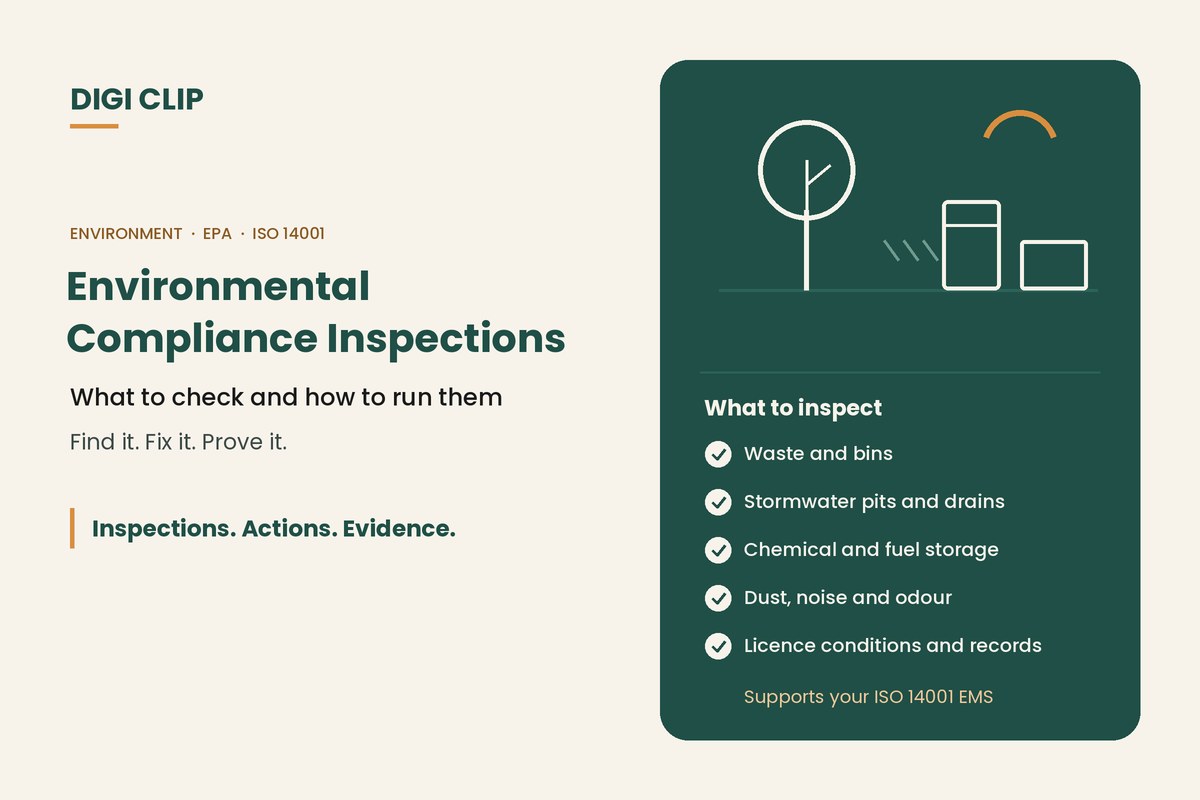
- Focus inspections on waste, stormwater, spills, storage, dust, noise and records.
- Every finding needs an owner, a fix and evidence.
- Inspections support an ISO 14001 environmental management system.
Environmental obligations in Australia
Most environmental regulation in Australia is set by the states and territories and enforced by their environment protection authorities (EPAs), with some federal laws for matters of national significance. Obligations can include:
- Licences and permits: many industrial activities need an environmental licence with conditions on emissions, discharges, waste and monitoring.
- General duties: some states have a general environmental duty to reduce risks of harm, such as Victoria’s general environmental duty under the Environment Protection Act 2017.
- Pollution and waste laws: rules on disposing of waste, preventing pollution of land, air and water, and reporting incidents.
- Local council conditions: development approvals often include conditions on noise, dust, hours and stormwater.
Check with your state or territory EPA and local council for the requirements that apply to your site.
What to inspect
| Area | What to check |
|---|---|
| Waste | Bins labelled and lidded, waste separated, no overflow, licensed contractors, records kept |
| Stormwater | Pits and drains clear, no contaminants near drains, sediment controls in place |
| Chemicals and fuel | Stored in bunds, no leaks, labels and SDS current, spill kits stocked |
| Spills | No stains or spills on ground, spills cleaned up and reported |
| Dust, noise and odour | Dust suppression working, noise within limits and hours, no odour issues |
| Equipment | Plant maintained, no oil leaks, wash-down areas draining correctly |
| Licence conditions | Monitoring done, limits met, required records up to date |
| Complaints | Complaints recorded, investigated and responded to |
Running an inspection
- Know your obligations. List licence conditions, permits and council requirements that apply to the site.
- Build a site checklist. Cover waste, stormwater, storage, spills, dust, noise and records.
- Walk the whole site. Include boundaries, drains, laydown areas and waste points.
- Record findings with photos. Note the location, the issue and how urgent it is.
- Act on urgent issues now. Contain spills and stop discharges straight away, and report incidents as required.
- Assign and follow up. Give each finding an owner and due date, and close it out with evidence.
Inspections and ISO 14001
ISO 14001 is the international standard for environmental management systems (EMS). It follows a Plan-Do-Check-Act approach: identify your environmental aspects and compliance obligations, set objectives and controls, monitor performance, and review and improve. A 2024 amendment added a requirement to consider whether climate change is a relevant issue for the organisation.
Regular inspections support several parts of an ISO 14001 system, including operational control, monitoring and measurement, evaluation of compliance, and nonconformity and corrective action. Inspection records and closed-out actions are useful evidence for internal audits and certification audits.
How often to inspect
- Daily or weekly: quick checks of waste areas, drains, bunds and spill kits on active sites.
- Monthly: a full environmental inspection against your checklist and licence conditions.
- After events: heavy rain, spills, complaints or changes to operations.
Digital environmental inspections
With DIGI CLIP, environmental inspections are completed on a phone or tablet, with photos of drains, bunds, bins and spills. Each form is location- and time-stamped. Findings create actions in the Action Log, so they’re assigned, fixed and closed out with evidence, and records are ready for audits and regulators.
Illustrative scenario: an oily stormwater pit
During a weekly inspection at a transport depot, a yard supervisor notices an oily sheen in a stormwater pit near the wash bay. He fails the item in DIGI CLIP with a photo, and the pit is blocked off and cleaned with a spill kit. An action goes to maintenance, who find a failed oil separator, and it’s closed out with a photo after the repair.
This scenario is illustrative. It shows how a business could use DIGI CLIP and is not an account of a specific customer.
See also our guides to hazardous materials storage inspections and workplace safety audits.
Keep Environmental Checks on Record
Put environmental inspections on your team’s phones and see findings land in the Action Log, ready to fix and prove.
Start Your 14-Day Free TrialNo credit card required. Set up in minutes.
Frequently asked questions
What is an environmental compliance inspection?
A planned check of a site’s activities against its environmental obligations, such as licence conditions, waste, stormwater, spills, chemical storage, dust, noise and records.
Who regulates environmental compliance in Australia?
Mainly state and territory environment protection authorities (EPAs), with local councils regulating some matters and federal laws covering matters of national environmental significance.
What should an environmental inspection checklist include?
Waste, stormwater, chemical and fuel storage, spills, dust, noise and odour, equipment, licence conditions and monitoring, and complaints.
How often should environmental inspections be done?
Quick checks daily or weekly on active sites, a full inspection monthly, and extra checks after heavy rain, spills, complaints or operational changes, plus any frequency set by licence conditions.
What is ISO 14001?
The international standard for environmental management systems. It uses a Plan-Do-Check-Act approach to identify environmental aspects and compliance obligations, control them, monitor performance and improve.
Can environmental inspections be done on a phone?
Yes. In DIGI CLIP, environmental inspections are completed on a phone or tablet with photos, and findings become actions in the Action Log.
About DIGI CLIP Mobile Forms
DIGI CLIP is an Australian-built mobile checklist and inspection platform. Inspections. Actions. Evidence. Teams complete checks on a phone or tablet, turn defects into assigned actions, and keep the proof that each one was fixed and verified.
See our Form Library for ready-made templates.