
Last updated:
ISO 45001 is the international standard for occupational health and safety (OH&S) management systems. It sets out how an organisation plans, runs, checks and improves the way it manages work health and safety, using a Plan-Do-Check-Act approach. In Australia and New Zealand it is published as AS/NZS ISO 45001:2018.
ISO 45001: What It Requires and How to Put It Into Practice
Many businesses look at ISO 45001 because a client or tender asks for it, or because they want a more structured way to manage safety. The standard isn’t about paperwork for its own sake. It’s about having a system that identifies hazards, controls risks, involves workers and gets better over time, with evidence to show it. This guide covers what ISO 45001 requires, how it fits with WHS law, and how inspections and actions support certification.
Key points
- ISO 45001 is voluntary. WHS laws are not.
- It follows Plan-Do-Check-Act, with a strong focus on leadership and worker participation.
- A 2024 amendment added consideration of climate change to the context of the organisation.
- Inspections, incident reports and corrective actions provide much of the evidence auditors look for.
- Certification is done by an accredited third-party certification body.
What ISO 45001 covers
ISO 45001 applies to any organisation, of any size, that wants to manage OH&S risks systematically. It uses the same high-level structure as ISO 9001 (quality) and ISO 14001 (environment), so the three can be run as an integrated management system. In 2024, an amendment to these standards added a requirement to consider whether climate change is a relevant issue for the organisation.
ISO 45001 and WHS law
ISO 45001 is a voluntary standard. Australian WHS laws are mandatory. Certification doesn’t replace legal duties, and meeting the law doesn’t automatically meet the standard. In practice, a well-run ISO 45001 system is a practical way to manage WHS duties, including consultation, hazard identification, risk control and officers’ due diligence, and to show it’s being done.
Key requirements
| Clause | What it covers |
|---|---|
| 4 Context | Internal and external issues, interested parties, scope of the system |
| 5 Leadership and worker participation | Top management commitment, OH&S policy, roles, consultation and participation |
| 6 Planning | Hazard identification, risk assessment, legal requirements, objectives |
| 7 Support | Resources, competence, awareness, communication, documented information |
| 8 Operation | Operational controls, hierarchy of controls, change, procurement and contractors, emergencies |
| 9 Performance evaluation | Monitoring and measurement, compliance evaluation, internal audit, management review |
| 10 Improvement | Incidents, nonconformities, corrective action, continual improvement |
Getting ready for certification
- Do a gap analysis. Compare your current safety system against each clause of the standard.
- Get leadership on board. Agree scope, policy, objectives and resources with senior management.
- Fill the gaps. Build or update risk assessments, procedures, training and consultation arrangements.
- Run the system. Complete inspections, report incidents and close out corrective actions consistently for a few months.
- Audit and review. Run an internal audit and a management review, and fix what they find.
- Engage a certification body. Choose an accredited certifier for the stage 1 and stage 2 audits.
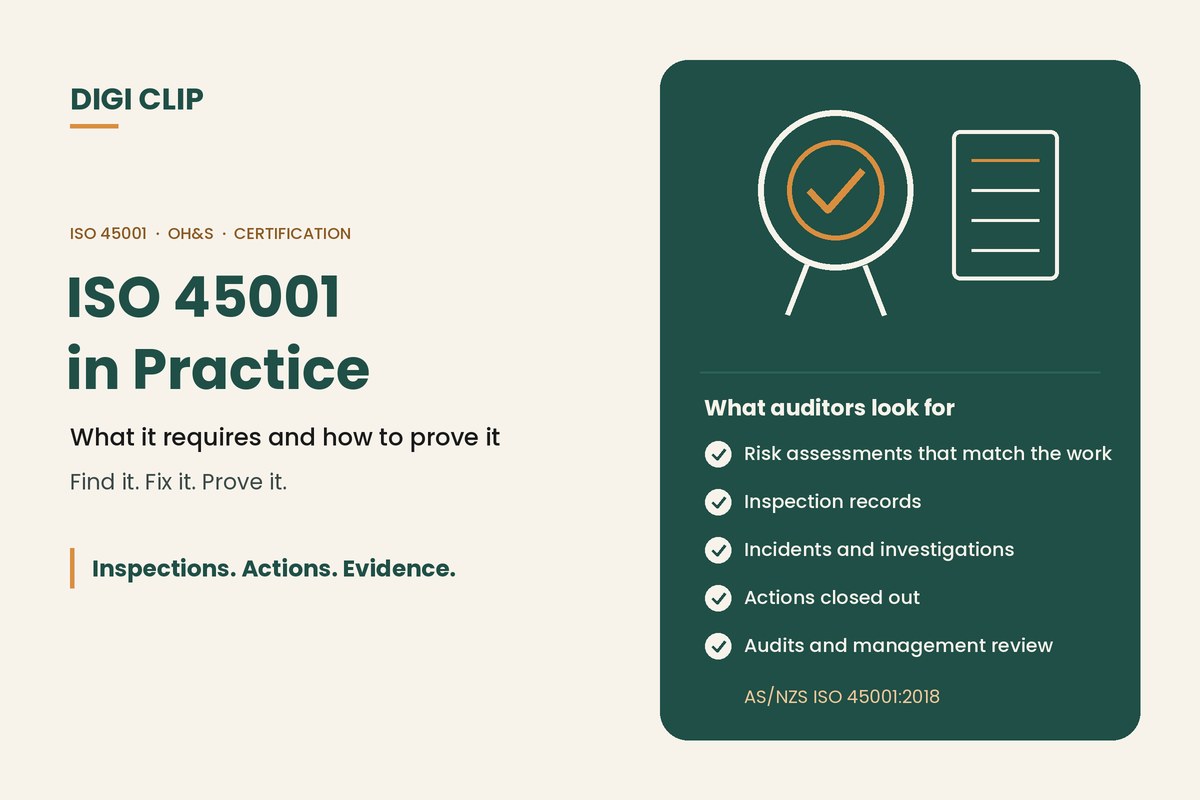
Evidence auditors look for
- Hazard identification and risk assessments that match the actual work
- Records of workplace inspections and pre-start checks
- Incident and near miss reports, with investigations
- Corrective actions assigned, tracked and closed out
- Consultation records, such as toolbox talks and safety meetings
- Training and competency records
- Internal audit results and management review minutes
See our guides to workplace safety audits and root cause analysis.
Supporting ISO 45001 with DIGI CLIP
With DIGI CLIP, inspections, hazard reports and audits are completed on a phone or tablet, with photos, and each form is location- and time-stamped. Problems become actions in the Action Log, tracked through to close-out with evidence, and dashboards and exports make records easy to pull together for internal audits and certification audits.
Illustrative scenario: preparing for a stage 2 audit
A civil contractor preparing for ISO 45001 certification finds that workplace inspections were being done but findings weren’t being tracked. It moves inspections to DIGI CLIP, so each failed item creates an action with an owner and due date. By the stage 2 audit, it can show the auditor inspection records, actions and close-out evidence for the previous three months.
This scenario is illustrative. It shows how a business could use DIGI CLIP and is not an account of a specific customer.
Running other management systems too? See our guides to ISO 9001 and environmental compliance inspections and ISO 14001.
Build the Evidence Your Audit Needs
Put inspections and hazard reports on your team’s phones and see actions land in the Action Log, ready to fix and prove.
Start Your 14-Day Free TrialNo credit card required. Set up in minutes.
Frequently asked questions
What is ISO 45001?
The international standard for occupational health and safety management systems. It sets out how an organisation plans, runs, checks and improves the way it manages work health and safety.
Is ISO 45001 mandatory in Australia?
No. ISO 45001 is voluntary, although some clients and tenders require it. WHS laws are mandatory whether or not a business is certified.
What replaced AS/NZS 4801?
AS/NZS ISO 45001:2018 replaced AS/NZS 4801 as the recognised OH&S management system standard in Australia and New Zealand.
What changed in ISO 45001 in 2024?
A 2024 amendment added a requirement for organisations to consider whether climate change is a relevant issue when understanding their context and the needs of interested parties.
What evidence do ISO 45001 auditors look for?
Risk assessments, inspection records, incident reports and investigations, corrective actions and close-outs, consultation records, training records, internal audits and management reviews.
Can digital inspections support ISO 45001 certification?
Yes. Digital inspection records, hazard reports and tracked corrective actions are useful evidence that the system is being put into practice.
About DIGI CLIP Mobile Forms
DIGI CLIP is an Australian-built mobile checklist and inspection platform. Inspections. Actions. Evidence. Teams complete checks on a phone or tablet, turn defects into assigned actions, and keep the proof that each one was fixed and verified.
See our Form Library for ready-made templates.






