Last updated:
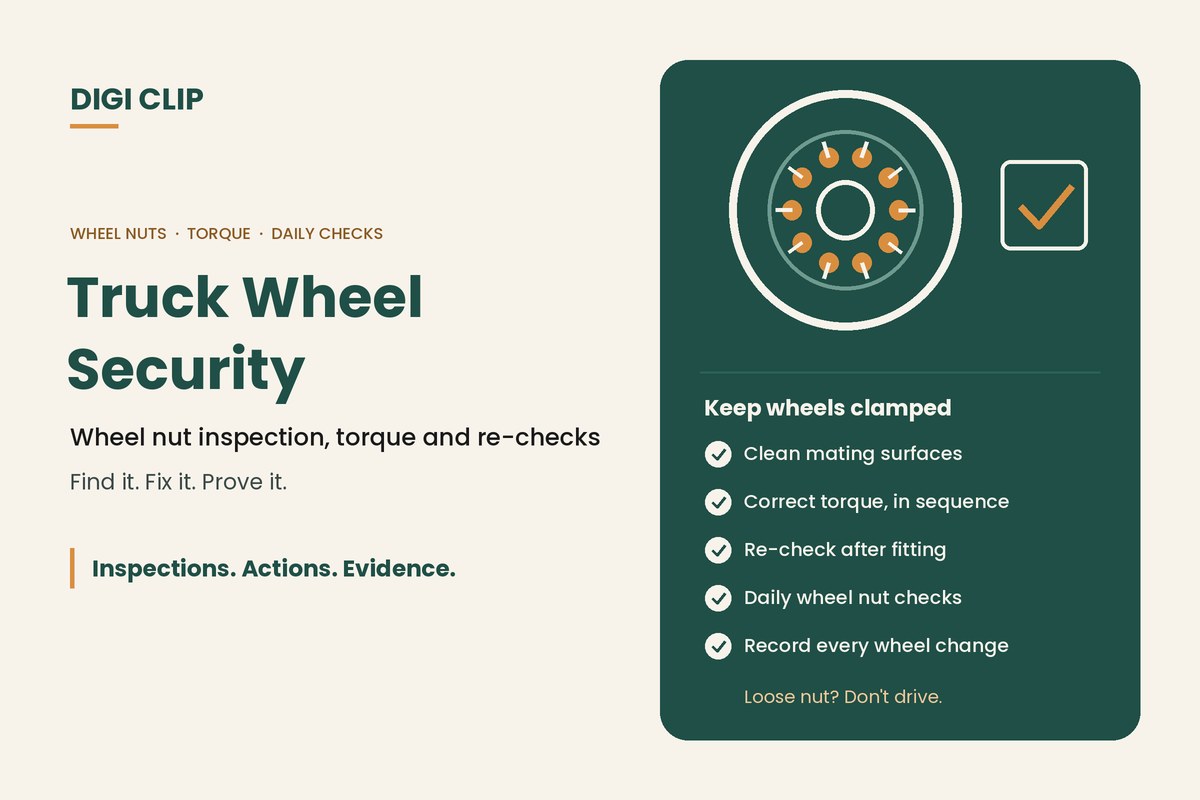
Wheel nut security means keeping a truck’s wheels clamped to the hub with the right force, so they can’t work loose. It depends on clean mounting surfaces, correct torque, re-checking after fitting, and daily checks for signs of loose or damaged wheel nuts. A wheel that comes off a heavy vehicle at speed can be fatal.
Truck Wheel Security: Wheel Nut Inspection, Torque and Re-Check Guide
Wheel separations are rare, but when a wheel comes off a heavy vehicle the consequences can be catastrophic. Almost every case comes down to lost clamping force: dirty or painted mounting faces, incorrect torque, stretched studs, or nuts that weren’t re-checked after a wheel change. This guide covers why wheels come loose, how to fit wheels properly, what drivers should look for every day, and how to keep a record of it.
Key points
- Wheels stay on because of clamping force, not just the nuts being “tight”.
- Clean mating surfaces and correct torque with a calibrated wrench are essential.
- Re-check torque after a wheel change, at the distance the manufacturer specifies.
- Drivers should check wheel nuts, indicators and hubs as part of every daily check.
- Record wheel changes and re-torques so nothing is missed.
NHVR wheel nut requirements
The NHVR sets out when a wheel fails a roadworthiness inspection. Under section 5.2 of the National Heavy Vehicle Inspection Manual, a wheel is rejected if:
- any wheel nuts, studs or bolts are missing, cracked, stripped or broken
- thread engagement is shorter than the thread diameter
- the nuts or bolts are the wrong type for the wheel
- spacer plates are fitted between the hub and wheel, unless the manufacturer fitted them.
The NHVR's guide to creating heavy vehicle daily checks says wheels should be secure, lists missing, cracked or broken wheel nuts, studs or bolts as a fault, and notes that wheel nut indicators, if fitted, are a quick way to spot nuts that aren't properly fastened.
Why wheels come loose
A wheel is held on by the clamping force the studs and nuts create between the wheel and hub. When that force is lost, the wheel can move, the load shifts to fewer studs, and those studs can fatigue and break. Common causes include:
- Dirty or painted mating surfaces: rust, dirt or thick paint between the wheel and hub can compress over time, reducing clamping force.
- Incorrect torque: under-tightening leaves too little force; over-tightening can stretch studs so they no longer hold.
- Worn or damaged parts: damaged threads, stretched studs, worn nuts or elongated wheel holes.
- No re-check: wheels can settle after fitting, so nuts need re-torquing after a short initial run.
- Mismatched components: wrong nuts, studs or wheels for the hub.
Fitting wheels properly
- Inspect the parts. Check studs, nuts, wheels and hubs for damage, cracks, stretched threads and elongated holes. Replace anything damaged.
- Clean the mating surfaces. Remove rust, dirt and excess paint from the hub face and wheel mounting face.
- Lubricate as specified. Apply lubricant only where the manufacturer specifies, usually the stud threads, not the mating faces.
- Tighten in sequence. Snug the nuts in a star or crisscross pattern, then tighten to the specified torque with a calibrated torque wrench.
- Record the job. Note the vehicle, wheel position, torque, who did it and when the re-check is due. Fit wheel nut indicators if you use them.
- Re-check the torque. Re-torque after the initial distance the wheel or vehicle manufacturer specifies, then as part of regular servicing.
Daily wheel checks for drivers
- Every wheel nut is present, with none missing or damaged
- Wheel nut indicators, if fitted, are all lined up
- No rust streaks or shiny marks around nuts, which can show movement
- No cracks around stud holes or in the wheel
- No oil or grease leaking from hubs
- Tyres inflated correctly, with no cuts or bulges
These checks are part of the NHVR daily check area for wheels, tyres and hubs. See our commercial truck safety checklist and truck pre-start checklist.
Warning signs of a loose wheel
- Rust-coloured streaks from wheel nuts or stud holes
- Wheel nut indicators out of line
- Shiny, worn metal around nuts or holes
- Vibration, wobble or a knocking noise while driving
- A hot hub or wheel after driving, compared with the others
If you see any of these, stop, don’t drive the truck, and have the wheel checked by a qualified person. Loose wheels and hot hubs can also contribute to truck fires.
Keeping records
A simple record for every wheel change prevents missed re-torques: vehicle, wheel position, who fitted it, torque applied, and when the re-check was done. With DIGI CLIP, drivers and fitters record wheel checks and changes on a phone, with photos, and each form is location- and time-stamped. A failed wheel nut check creates an action in the Action Log, so it is assigned to the workshop and closed out with evidence.
Illustrative scenario: a missed re-torque caught
After a tyre change at a roadside service, a driver records the wheel change in DIGI CLIP. The next morning, his pre-start check shows two wheel nut indicators slightly out of line on the same wheel. He fails the item with a photo, the workshop re-torques the wheel and inspects the studs before the truck leaves, and the action is closed out with the torque recorded.
This scenario is illustrative. It shows how a fleet could use DIGI CLIP and is not an account of a specific customer.
For tyre checks, see our guide to truck tyre pressure.
Never Miss a Wheel Check
Put wheel checks in every driver’s pre-start and see problems land in the Action Log, ready to fix and prove.
Start Your 14-Day Free TrialNo credit card required. Set up in minutes.
Frequently asked questions
What causes truck wheels to come off?
Usually lost clamping force, caused by dirty or painted mating surfaces, incorrect torque, stretched or damaged studs, worn nuts, mismatched parts, or nuts not being re-checked after a wheel change.
When should wheel nuts be re-torqued?
After a wheel is fitted, re-check the torque after the initial distance the wheel or vehicle manufacturer specifies, and then as part of regular servicing.
What should drivers check on wheels every day?
That all wheel nuts are present and undamaged, wheel nut indicators are lined up, there are no rust streaks or cracks around the nuts, no oil leaking from hubs, and tyres are correctly inflated and undamaged.
What are wheel nut indicators?
Small plastic pointers fitted over wheel nuts and lined up after tightening. If a nut turns, its indicator moves out of line, making loose nuts easier to spot during a walk-around.
What should I do if I find a loose wheel nut?
Don’t drive the vehicle. Report it, and have a qualified person inspect the wheel, studs and nuts and re-torque or replace parts as needed.
Can wheel checks be recorded on a phone?
Yes. In DIGI CLIP, drivers and fitters record wheel checks and changes on a phone with photos, and a failed check creates an action in the Action Log.
About DIGI CLIP Mobile Forms
DIGI CLIP is an Australian-built mobile checklist and inspection platform. Inspections. Actions. Evidence. Teams complete checks on a phone or tablet, turn defects into assigned actions, and keep the proof that each one was fixed and verified.
See how it works for transport and logistics teams.