Last updated:
Correct truck tyre pressure is the inflation pressure set by the tyre or vehicle manufacturer for the tyre size, load and axle position, checked when tyres are cold. Running tyres under or over this pressure increases wear, fuel use and heat, and raises the risk of blowouts and tyre fires, particularly on dual wheels.
Truck Tyre Pressure: How to Check It and Why It Matters
Tyres are one of the biggest running costs in a truck fleet, and one of the most common causes of roadside breakdowns. Most tyre problems start with pressure. An underinflated tyre flexes more, runs hotter and wears faster, and on a dual set it can fail without the driver noticing. This guide covers why pressure matters, how to check it properly, and how to build tyre checks into daily pre-starts.
Key points
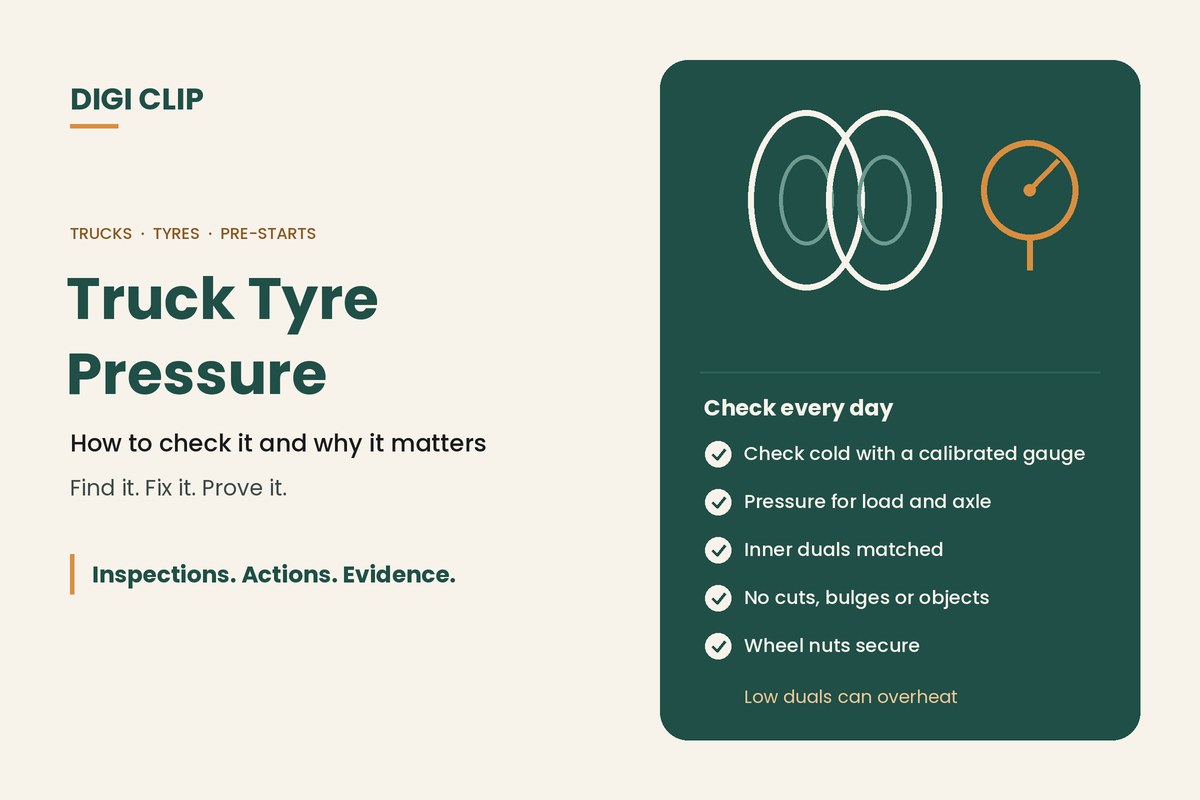
- Use the pressure recommended for the tyre, load and axle position.
- Check pressures when tyres are cold, with a calibrated gauge.
- Underinflation causes heat, wear, higher fuel use and blowouts.
- Dual tyres should be matched in size, tread and pressure.
- Include tyres and wheel nuts in every pre-start.
Why tyre pressure matters
- Safety: correct pressure gives predictable handling and braking, and reduces the risk of blowouts.
- Tyre life: the right pressure spreads wear evenly across the tread.
- Fuel use: underinflated tyres increase rolling resistance and fuel consumption.
- Fire risk: a flat or underinflated tyre on a dual set can overheat and catch fire. See our guide to truck fires.
Under- and overinflation
| Underinflated | Overinflated | |
|---|---|---|
| Wear pattern | Both shoulders wear faster | Centre of the tread wears faster |
| Heat | More flexing and heat build-up | Less flexing, but harsher ride |
| Handling | Sluggish, can pull to one side | Less grip, especially in the wet |
| Damage risk | Sidewall damage, blowouts, fires | Impact damage and cuts |
| Fuel | Higher fuel use | Little fuel benefit for the extra risk |
How to check truck tyre pressure
- Check when cold. Check before the truck has been driven, or after it has stood for a few hours.
- Know the right pressure. Use the pressure recommended by the tyre or vehicle manufacturer for the load and axle position.
- Use a calibrated gauge. Check the gauge regularly against a reference.
- Check every tyre. Include inner duals, using valve extensions if needed, and the spare.
- Adjust and refit caps. Inflate or deflate to the correct pressure and refit valve caps.
- Record and act. Record low tyres and report any that keep losing pressure for repair.
Daily tyre checklist
- Pressures correct, or tyres visibly inflated where a gauge check isn’t done daily
- No cuts, bulges, exposed cords or objects in the tread
- Tread depth above the legal minimum and wearing evenly
- Duals not touching, and no stones between them
- Valve caps fitted and valve extensions secure
- Wheel nuts secure, with no signs of movement such as rust streaks. See our guide to truck wheel security.
Tyre pressure monitoring systems (TPMS) help catch slow leaks between checks, but they don’t replace a visual inspection.
Tyre checks on the phone
With DIGI CLIP, drivers record tyre checks as part of their pre-start, with photos of damage and readings for low tyres. Each form is location- and time-stamped. A failed tyre check creates an action in the Action Log, so the tyre is repaired or replaced and closed out with evidence.
Illustrative scenario: a slow leak on an inner dual
During a morning pre-start, a driver finds an inner dual on the trailer 25 psi below the others. He records the reading in DIGI CLIP, which creates an action for the tyre contractor. A nail is found and the tyre repaired before the truck leaves, and the action is closed out with a photo and the new reading.
This scenario is illustrative. It shows how a transport business could use DIGI CLIP and is not an account of a specific customer.
See also our commercial truck safety checklist.
Catch Tyre Problems in the Pre-Start
Put tyre and pre-start checks on your drivers’ phones and see problems land in the Action Log, ready to fix and prove.
Start Your 14-Day Free TrialNo credit card required. Set up in minutes.
Frequently asked questions
What pressure should truck tyres be?
The pressure recommended by the tyre or vehicle manufacturer for the tyre size, load and axle position. It varies, so check the manufacturer’s tables rather than using one figure for every tyre.
Should truck tyre pressure be checked hot or cold?
Cold. Tyre pressure rises as tyres heat up, so check before driving or after the truck has stood for a few hours. Don’t let air out of hot tyres to reach the cold pressure.
How often should truck tyre pressures be checked?
A visual check every day as part of the pre-start, and a gauge check at least weekly, or more often for high-kilometre or heavily loaded vehicles.
Why must dual tyres be matched?
If one tyre in a dual set is lower or smaller, the other carries more of the load and can overload and fail, while the low tyre flexes, overheats and can catch fire.
Do tyre pressure monitoring systems replace manual checks?
No. TPMS helps catch slow leaks between checks, but drivers still need to inspect tyres for damage, wear and wheel nut problems.
Can tyre checks be recorded on a phone?
Yes. In DIGI CLIP, tyre checks are recorded as part of the pre-start with photos and readings, and problems become actions in the Action Log.
About DIGI CLIP Mobile Forms
DIGI CLIP is an Australian-built mobile checklist and inspection platform. Inspections. Actions. Evidence. Teams complete checks on a phone or tablet, turn defects into assigned actions, and keep the proof that each one was fixed and verified.
See our Form Library for ready-made templates.