
Last updated:
A JSEA (Job Safety and Environmental Analysis) is a step-by-step review of a task that breaks the job into steps, identifies the hazards in each step, and records the controls that will be used before work starts. It is completed by the people doing the work and reviewed on site, so everyone agrees how the job will be done safely.
What Is a JSEA? How to Complete One, With a Practical Example
JSEAs are a daily part of work in mining, construction, oil and gas, utilities and maintenance. Done well, they get the crew talking about hazards before the job starts. Done badly, they become a signature on a form nobody read. This guide explains what a JSEA is, how it differs from a SWMS and JSA, how to complete one step by step, a worked example, and how to keep JSEAs meaningful.
Key points
- A JSEA breaks a task into steps, identifies hazards for each step and sets controls before work starts.
- It covers environmental risks as well as safety, which is where the “E” comes from.
- High-risk construction work needs a Safe Work Method Statement (SWMS) under WHS law; a JSEA is a common site tool, not a legal form.
- The crew doing the work should complete it together, and review it when conditions change.
- A JSEA only works if the controls are actually used on the job.
JSEA vs JSA vs SWMS
| JSEA | JSA | SWMS | |
|---|---|---|---|
| Full name | Job Safety and Environmental Analysis | Job Safety Analysis | Safe Work Method Statement |
| Covers | Safety and environmental hazards | Safety hazards | High-risk construction work |
| Legal status | Site or company requirement | Site or company requirement | Required under the WHS Regulations for high-risk construction work |
| Typical use | Mining, resources, utilities, maintenance | General industry | Construction |
The formats are similar: steps, hazards, controls and sign-off. Many businesses use a JSEA for everyday tasks and a SWMS where the law requires one.
When do you need a JSEA?
- Before non-routine or infrequent tasks
- For higher-risk tasks not already covered by a procedure
- When conditions change, such as weather, location, equipment or crew
- When a site or client requires one before work starts
- After an incident or near miss, to reassess how the task is done
How to complete a JSEA
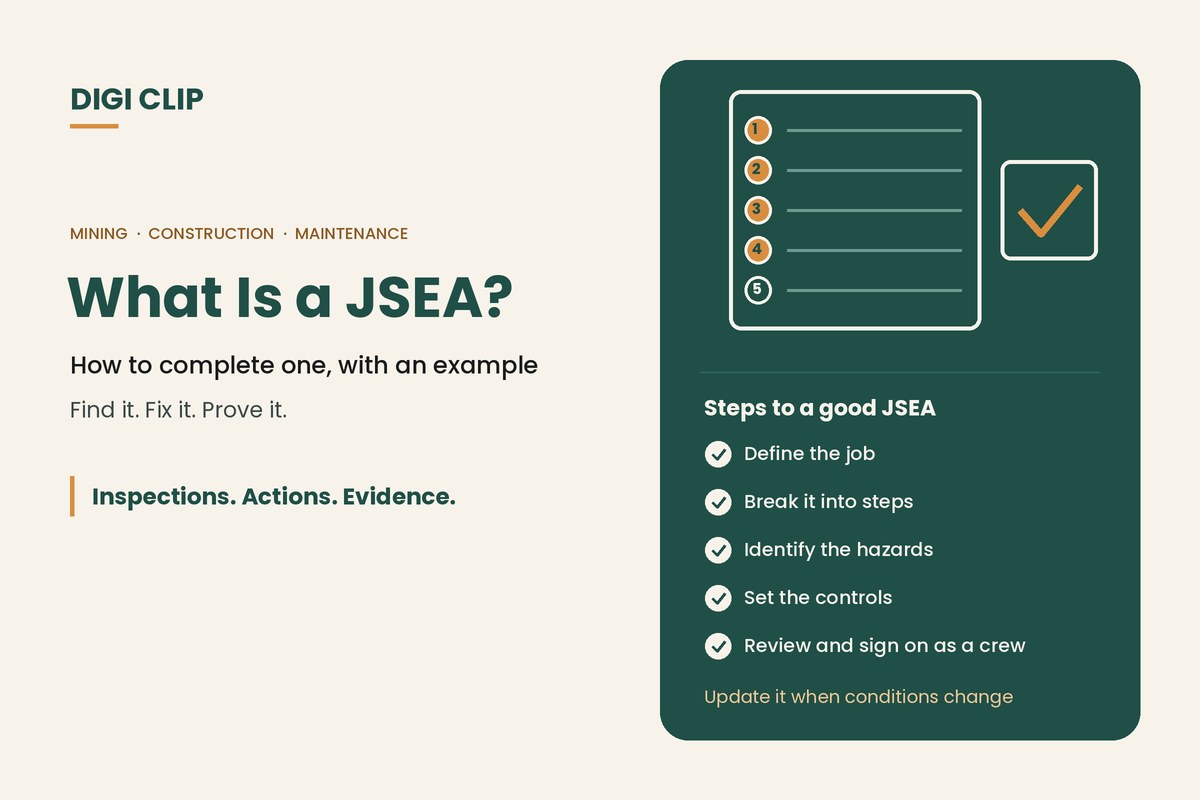
- Define the job. Record the task, location, date, crew, equipment and any permits needed.
- Break it into steps. List the main steps in order, from set-up to clean-up. Keep it to the steps that matter, usually 5 to 10.
- Identify the hazards. For each step, ask what could go wrong: people, equipment, energy, the environment and nearby work.
- Assess the risk. Rate each hazard using your risk matrix, before and after controls.
- Set the controls. Choose controls using the hierarchy of controls, and name who is responsible for each one.
- Review and sign on. Talk through the JSEA with the whole crew, have everyone sign on, and review it again if anything changes during the job.
JSEA example
Task: replacing a conveyor belt roller at a processing plant.
| Step | Hazard | Controls |
|---|---|---|
| 1. Isolate the conveyor | Unexpected start-up | Isolate, lock and tag at the isolation point; test for zero energy |
| 2. Access the roller | Slips, trips and falls | Clear the walkway, use the fixed platform, wear suitable footwear |
| 3. Remove the old roller | Manual handling, pinch points | Two-person lift or lifting aid, gloves, keep hands clear of pinch points |
| 4. Fit the new roller | Dropped objects | Secure tools, exclusion zone below |
| 5. Clean up and dispose | Oil or grease spill | Spill kit on hand, dispose of waste in the correct bin |
| 6. Remove isolation and test | People near moving parts | Guards refitted, area clear, remove locks following procedure |
See our guide to lock out, tag out for more on isolation.
Benefits of a good JSEA
- Shared understanding: the whole crew agrees how the job will be done before it starts.
- Hazards spotted early: talking through each step brings up risks that are easy to miss.
- Worker involvement: the people doing the work shape the controls, which supports WHS consultation duties.
- A record: completed JSEAs show how risks were considered, which helps with audits and investigations.
- Environmental care: spills, waste, dust and noise are considered alongside safety.
Common JSEA mistakes
- Copy and paste: reusing yesterday’s JSEA without checking today’s conditions.
- Written by one person: filled in by the supervisor and signed by the crew without discussion.
- Vague controls: “be careful” or “use PPE” instead of specific controls.
- Not updated: conditions change mid-job but the JSEA doesn’t.
- No follow-up: issues raised in the JSEA are never actioned.
Digital JSEAs
With DIGI CLIP, crews complete JSEAs on a phone or tablet at the job site, even without coverage, and sign on digitally. Each form is location- and time-stamped. Photos can show site conditions, and any issue that needs follow-up flows into the Action Log to be assigned, tracked and closed out with evidence.
Illustrative scenario: a change in conditions
A maintenance crew completes a JSEA for a pump change-out in the morning. By midday, rain has made the access path slippery. The supervisor updates the JSEA in DIGI CLIP, adds a control to lay grip matting, and the crew signs on again before continuing. An action is raised to fix drainage on the path, which is closed out the following week.
This scenario is illustrative. It shows how a business could use DIGI CLIP and is not an account of a specific customer.
For more on assessing risk, see our guide to workplace risk assessments. For construction, see risk assessments in construction.
Complete JSEAs on Site, Not in the Office
Put your JSEA template on every crew’s phone and see issues land in the Action Log, ready to fix and prove.
Start Your 14-Day Free TrialNo credit card required. Set up in minutes.
Frequently asked questions
What does JSEA stand for?
JSEA stands for Job Safety and Environmental Analysis. It is a step-by-step review of a task that identifies the safety and environmental hazards in each step and records the controls that will be used before work starts.
What is the difference between a JSEA and a SWMS?
A SWMS (Safe Work Method Statement) is required under the WHS Regulations for high-risk construction work. A JSEA is a site or company tool used for a wide range of tasks, and it covers environmental hazards as well as safety.
Is a JSEA a legal requirement in Australia?
A JSEA itself isn’t a legal form, but businesses must manage risks and consult workers under WHS law, and a JSEA is a common way to do that for specific tasks. Many sites and clients require one before work starts.
Who should complete a JSEA?
The crew who will do the work, led by a supervisor or team leader. Everyone involved should discuss it and sign on before starting.
When should a JSEA be reviewed?
Whenever conditions change, such as weather, equipment, location or crew, when a new hazard is found during the job, and after any incident or near miss.
Can a JSEA be completed on a phone?
Yes. In DIGI CLIP, crews complete JSEAs on a phone or tablet at the job site, even without coverage, sign on digitally, and any follow-up items flow into the Action Log.
About DIGI CLIP Mobile Forms
DIGI CLIP is an Australian-built mobile checklist and inspection platform. Inspections. Actions. Evidence. Teams complete checks on a phone or tablet, turn defects into assigned actions, and keep the proof that each one was fixed and verified.
See our Form Library for ready-made templates.






