
Last updated:
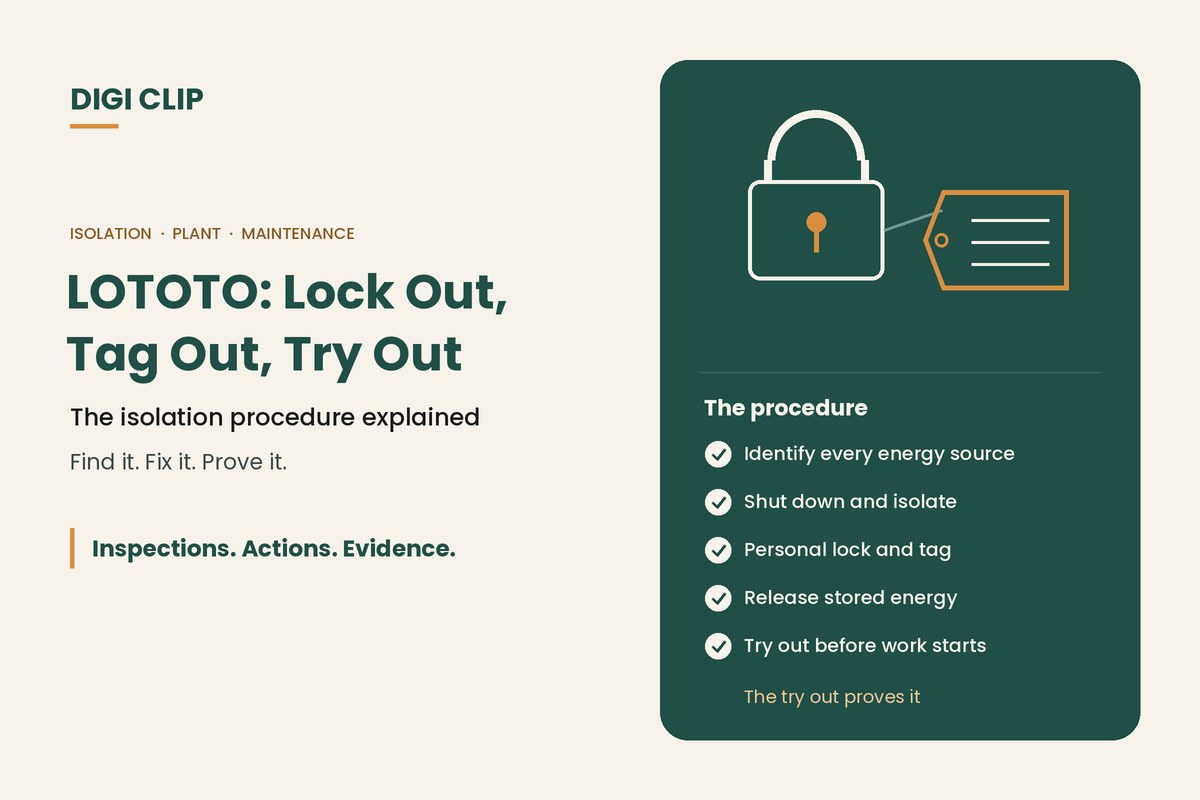
LOTOTO stands for Lock Out, Tag Out, Try Out. It is an isolation procedure that makes plant and equipment safe before maintenance, cleaning or repairs: energy sources are isolated and locked, tags identify who applied the lock and why, and the equipment is tested (tried) to confirm it can’t start or release stored energy.
LOTOTO: The Lock Out, Tag Out, Try Out Procedure Explained
Some of the most serious workplace injuries happen when a machine starts, moves or releases energy while someone is working on it. Isolation procedures exist to stop that. The “try out” step, testing that isolation has actually worked, is what turns a lock and tag into a verified safe state. This guide covers what LOTOTO is, the step-by-step procedure, common failures and how to keep isolation records.
Key points
- LOTOTO isolates all energy sources before people work on plant.
- Each worker applies their own personal lock and tag.
- The try out step tests that the plant can’t start or move.
- Stored energy, such as hydraulic pressure, springs and capacitors, must be released or restrained.
- Only the person who applied a lock should remove it, except under a controlled procedure.
Why isolation matters
Under WHS laws, businesses must manage risks from plant, including during installation, maintenance, cleaning and repair. The WHS regulations require plant to be isolated from energy sources, so far as is reasonably practicable, before this work is done, so it can’t be started or operated unexpectedly. Safe Work Australia’s model Code of Practice on managing the risks of plant in the workplace gives guidance on isolation procedures. Check with your state or territory regulator for the rules that apply to you.
Energy sources to isolate
- Electrical: mains supply, batteries and capacitors
- Mechanical: moving parts, flywheels, springs and gravity (raised loads)
- Hydraulic and pneumatic: pressure in lines, cylinders and accumulators
- Thermal: hot or cold surfaces, steam
- Chemical: process lines and vessels
Many pieces of plant have more than one energy source. Every one of them needs isolating.
The LOTOTO procedure
- Prepare. Identify all energy sources and isolation points, using the plant’s isolation procedure, and tell affected people.
- Shut down. Stop the plant using its normal controls.
- Isolate. Operate each isolation point, such as switches, valves and breakers, to cut off every energy source.
- Lock and tag. Each worker applies their own personal lock and a tag showing their name, the date and the reason.
- Release stored energy. Bleed pressure, discharge capacitors, lower or block raised parts, and let moving parts stop.
- Try out. Test that the plant can’t start or operate, for example by trying the start button, then return controls to off.
When work is finished, check the plant is clear of tools and people, refit guards, and remove locks and tags in a controlled way before restoring energy.
Common failures
- Missing an energy source: isolating the main power but not hydraulic pressure or a second supply.
- Skipping the try out: assuming the isolation worked without testing.
- Shared locks: one lock for a whole crew, so workers aren’t personally protected.
- Out-of-date procedures: isolation points changed but the procedure didn’t.
- Shift changes: locks removed or handed over without a controlled process.
- Missing equipment: not enough locks, tags or lockout devices at the point of work.
See our guide to machine guarding.
LOTO vs LOTOTO
| LOTO | LOTOTO | |
|---|---|---|
| Stands for | Lock Out, Tag Out | Lock Out, Tag Out, Try Out |
| Verification | Often implied, not always stated | Testing the isolation is an explicit step |
| Common use | Widely used term, especially in the US | Common in Australian mining, industrial and maintenance settings |
Digital isolation records
With DIGI CLIP, workers complete isolation checklists on a phone: energy sources identified, isolation points operated, locks applied, stored energy released and try out completed, with photos. Each form is location- and time-stamped. Problems, such as a missing lockout device or an out-of-date procedure, become actions in the Action Log, and supervisors can review isolations across sites.
Illustrative scenario: a missed hydraulic isolation
A fitter is isolating a baler for blade maintenance at a recycling depot. Working through the isolation checklist in DIGI CLIP, he reaches the stored energy step and finds the hydraulic accumulator isn’t listed in the plant’s procedure. He bleeds it down before starting work and raises an action to update the procedure, which is closed out with the revised version the following week.
This scenario is illustrative. It shows how a business could use DIGI CLIP and is not an account of a specific customer.
See also our guide to daily plant equipment safety checks.
Make Every Isolation Verifiable
Put isolation checklists on your team’s phones and see gaps land in the Action Log, ready to fix and prove.
Start Your 14-Day Free TrialNo credit card required. Set up in minutes.
Frequently asked questions
What does LOTOTO stand for?
Lock Out, Tag Out, Try Out. It is an isolation procedure where energy sources are isolated and locked, tags identify who applied each lock, and the plant is tested to confirm it can’t start.
What is the difference between LOTO and LOTOTO?
LOTOTO adds an explicit try out step, testing that the isolation has worked. LOTO procedures often include verification too, but LOTOTO makes it a named step.
Why is the try out step important?
It confirms the right energy sources were isolated and the plant can’t start or move. Without it, a wrong or incomplete isolation may go unnoticed until someone is hurt.
Should each worker have their own lock?
Yes. Each person working on the plant should apply their own personal lock and tag, so the plant can’t be restarted until every worker has removed their lock.
What is stored energy?
Energy that remains in plant after it’s switched off and isolated, such as hydraulic or pneumatic pressure, compressed springs, charged capacitors, raised loads and hot surfaces. It must be released or restrained before work starts.
Can isolation records be kept digitally?
Yes. In DIGI CLIP, isolation checklists are completed on a phone with photos, and problems become actions in the Action Log.
About DIGI CLIP Mobile Forms
DIGI CLIP is an Australian-built mobile checklist and inspection platform. Inspections. Actions. Evidence. Teams complete checks on a phone or tablet, turn defects into assigned actions, and keep the proof that each one was fixed and verified.
See our Form Library for ready-made templates.






