Last updated:
A hazardous manual task is any task where a person has to lift, lower, push, pull, carry, move, hold or restrain something, and it involves repetitive or sustained force, high or sudden force, repetitive movement, sustained or awkward postures, or vibration. These tasks can cause musculoskeletal disorders such as back injuries and sprains.
Manual Handling Risks at Work: How to Identify, Assess and Control Them
Manual handling injuries are among the most common serious workplace injuries in Australia. They build up quietly: a heavy box lifted from floor level all day, a twisting reach into a truck, a trolley with a sticky wheel. The good news is that most are preventable by changing the task, not just training people to lift differently. This guide covers what makes a task hazardous, how to assess it, the controls that work, and how to check they are in place.
Key points
- Five characteristics make a manual task hazardous: force, sudden force, repetition, posture and vibration.
- Risk comes from the work area, the way work is organised, the load and the environment.
- Redesigning the task works better than relying on lifting technique alone.
- Talk to the people who do the task; they know where it hurts.
- Review controls after injuries, complaints or changes.
What makes a task hazardous
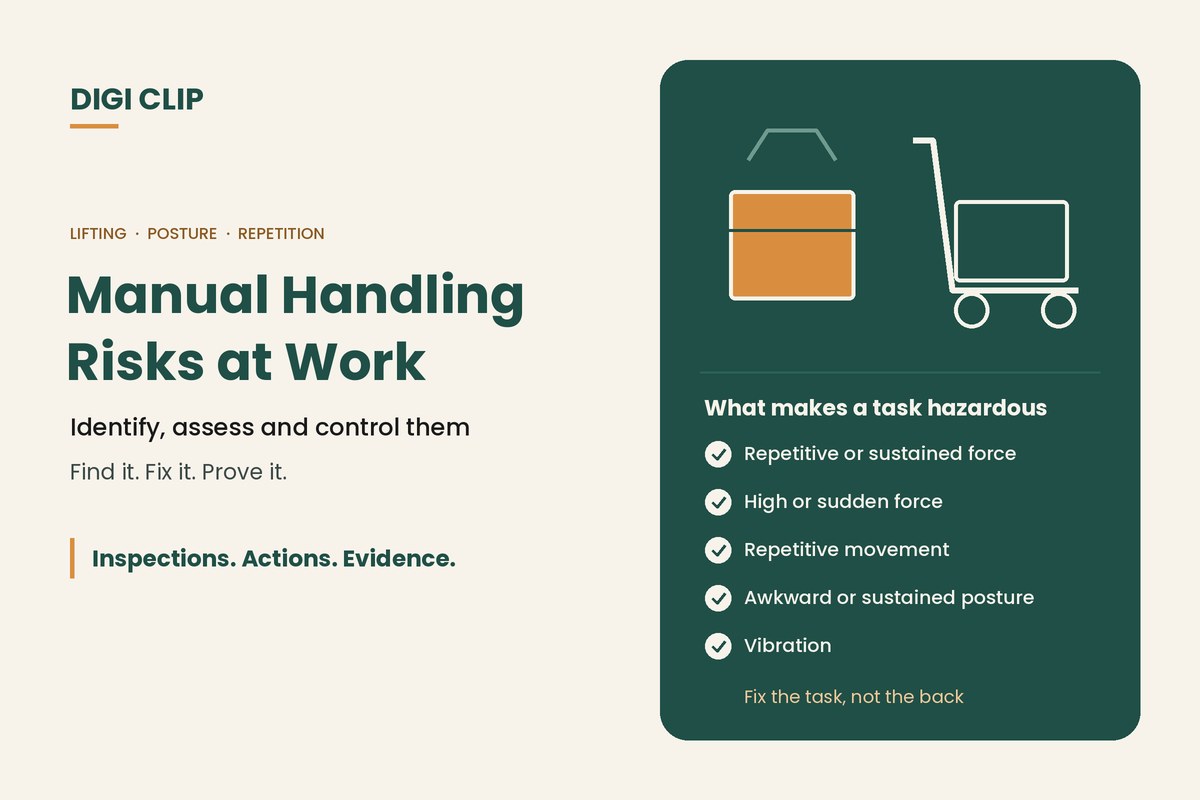
Safe Work Australia’s Code of Practice for hazardous manual tasks identifies five characteristics:
- Repetitive or sustained force: applying effort over and over, or holding it for a long time
- High or sudden force: heavy lifts or jerky, unexpected movements
- Repetitive movement: using the same parts of the body to repeat similar movements
- Sustained or awkward posture: bending, twisting, reaching or holding a position for long periods
- Exposure to vibration: whole-body vibration from vehicles and plant, or hand-arm vibration from tools
Where the risk comes from
- Work area design and layout: shelf heights, bench heights, reach distances and space to move
- Systems of work: pace, workload, staffing, breaks and task variety
- The object handled: weight, size, shape, grip, stability and whether it moves (such as people or animals)
- The environment: heat, cold, wind, lighting and floor surfaces
How to manage manual handling risks
- Identify hazardous tasks. Look at injury and incident records, watch tasks being done and ask workers which tasks are hard, tiring or painful.
- Assess the risks. Look at the force, posture, movement and vibration involved, and the sources of risk, unless the risk and its controls are already well known.
- Remove the task where possible. Ask whether the task needs to be done manually at all.
- Control the risks. Redesign the work area, the load, the tools or the system of work, then add training and procedures.
- Review the controls. Check the controls are used and working, especially after injuries, complaints or changes.
Controls that work
Work down the hierarchy of controls:
- Remove the manual task: automate it, deliver goods directly to where they are used, or use conveyors.
- Change the load: buy in smaller or lighter packs, add handles, or break loads down.
- Use mechanical aids: trolleys, pallet jacks, hoists, vacuum lifters and adjustable tables.
- Redesign the work area: store heavy items between knee and shoulder height, reduce reach distances and twisting, and adjust bench heights.
- Change the system of work: rotate tasks, schedule breaks, share heavy tasks and set realistic pace.
- Train and instruct: teach people to use aids, recognise hazards and report problems. Training in lifting technique alone is not enough.
For more on choosing controls, see our guide to workplace risk assessments.
Common examples and fixes
| Task | Hazard | Better control |
|---|---|---|
| Lifting cartons from floor pallets | Bending and heavy force | Pallet lifter or scissor table to keep loads at waist height |
| Unloading a truck by hand | Awkward reach, twisting, repetition | Palletised loads, roller conveyor or tail-lift |
| Pushing heavy trolleys | High force | Maintained wheels, powered tug, smoother floors |
| Repetitive packing | Repetitive movement, posture | Adjustable bench, task rotation, breaks |
| Using hand-held power tools | Hand-arm vibration | Low-vibration tools, maintenance, limited exposure time |
See also our guides to warehouse safety hazards and workplace safety hazards.
Checking controls are in place
Controls only help if they are used and maintained. Add manual handling items to your workplace inspections, such as lifting aids available and working, heavy items stored at waist height, and trolleys in good repair. With DIGI CLIP, inspections are completed on a phone or tablet, each form is location- and time-stamped, and a failed item creates an action in the Action Log to be assigned and closed out with evidence.
Illustrative scenario: a broken pallet jack
During a weekly warehouse inspection, a supervisor notices staff carrying cartons by hand because the only pallet jack has a broken handle. She fails the item in DIGI CLIP with a photo, which creates an action for the operations manager. A replacement is ordered and a second pallet jack is added to the plan, and the action is closed out with a photo once they arrive.
This scenario is illustrative. It shows how a business could use DIGI CLIP and is not an account of a specific customer.
Keep Manual Handling Controls in Place
Add manual handling checks to your inspections and see problems land in the Action Log, ready to fix and prove.
Start Your 14-Day Free TrialNo credit card required. Set up in minutes.
Frequently asked questions
What is a hazardous manual task?
A hazardous manual task is any task where a person has to lift, lower, push, pull, carry, move, hold or restrain something, and it involves repetitive or sustained force, high or sudden force, repetitive movement, sustained or awkward postures, or vibration. These tasks can cause musculoskeletal disorders such as back injuries and sprains.
Is there a maximum weight a person can lift at work in Australia?
WHS laws don’t set a single weight limit. Weight is only one factor; posture, frequency, duration, the load’s shape and the environment all affect the risk. The task needs to be assessed as a whole.
Is manual handling training enough?
No. Training in lifting technique on its own is one of the least effective controls. Redesigning the task, the load or the work area, or using mechanical aids, is far more effective, with training to support those changes.
What are the most effective manual handling controls?
Removing the manual task, changing the load, using mechanical aids such as trolleys and hoists, and redesigning the work area to reduce bending, reaching and twisting.
Who should be involved in assessing manual tasks?
The workers who do the task, their supervisors and health and safety representatives. Workers know which parts of the job are hardest and often have practical ideas for fixing them.
How often should manual handling risks be reviewed?
Whenever there is an injury or complaint, before changes to tasks, equipment or layout, when controls don’t seem to be working, and as part of regular workplace inspections.
About DIGI CLIP Mobile Forms
DIGI CLIP is an Australian-built mobile checklist and inspection platform. Inspections. Actions. Evidence. Teams complete checks on a phone or tablet, turn defects into assigned actions, and keep the proof that each one was fixed and verified.
See our Form Library for ready-made templates.