Last updated:
A hazardous materials storage inspection is a regular check of where and how hazardous chemicals and dangerous goods are stored: labelling, safety data sheets, segregation of incompatible substances, containers, spill containment, ventilation, signage and emergency equipment. It confirms that storage controls are still working and picks up leaks, damage and poor practice early.
Hazardous Materials Storage Inspections: What to Check and Why It Matters
Chemical stores are easy to set up well and easy to let slip. Containers get moved, labels fade, incompatible products end up on the same shelf and spill kits get used and not refilled. A regular storage inspection keeps the basics in place. This guide covers what WHS law expects, what to check, how often, and how to follow up.
Key points
- Businesses must keep a register of hazardous chemicals and current safety data sheets.
- Containers must be correctly labelled, and incompatible substances kept apart.
- Larger quantities trigger placarding and manifest requirements.
- Spill containment, ventilation, ignition controls and emergency equipment all need checking.
- Regular inspections with follow-up keep storage controls working.
What WHS law expects
Under the WHS regulations, businesses that use, handle or store hazardous chemicals must manage the risks. Key requirements include:
- keeping a register of hazardous chemicals with current safety data sheets (SDS), accessible to workers
- making sure containers are correctly labelled
- storing chemicals so they can’t react with incompatible substances
- providing spill containment, and fire protection and emergency equipment where needed
- displaying placards, and keeping a manifest and notifying the regulator, when quantities exceed set thresholds
Safe Work Australia’s model Code of Practice on managing risks of hazardous chemicals in the workplace gives practical guidance, and Australian Standards such as AS 1940 for flammable and combustible liquids cover specific storage types. Dangerous goods transport has separate rules. Check with your state or territory regulator for requirements where you work.
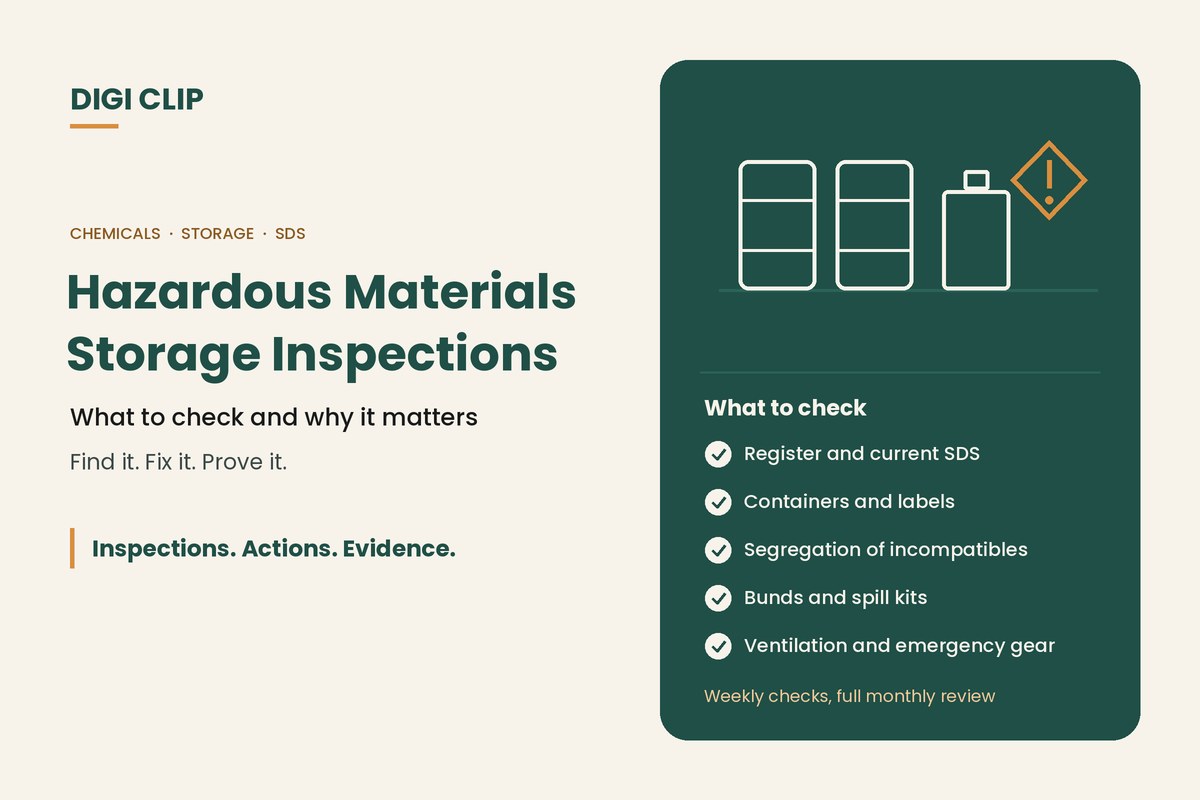
What to check
| Area | What to check |
|---|---|
| Register and SDS | Register up to date, SDS current (within 5 years of issue) and accessible |
| Containers and labels | Containers in good condition, lids closed, labels legible, no unlabelled decants |
| Segregation | Incompatible classes apart, such as oxidisers away from flammables and acids away from alkalis |
| Spill containment | Bunds and sumps clean and intact, spill kits stocked and nearby |
| Ventilation and ignition | Ventilation working, no ignition sources near flammables, no-smoking signs |
| Cabinets and shelving | Cabinets closed and in good order, shelving stable, heavy containers stored low |
| Signage and placards | Hazard signs and placards correct for the quantities stored |
| Emergency equipment | Extinguishers, eyewash and safety showers accessible and tested, emergency plan displayed |
Running a storage inspection
- Start with the register. Check the chemicals on site match the register and that SDS are current.
- Walk each store. Check containers, labels, segregation, containment and shelving.
- Check emergency equipment. Confirm spill kits, extinguishers, eyewash and showers are ready to use.
- Record findings with photos. Note the location, the problem and how urgent it is.
- Fix urgent issues now. Deal with leaks, damaged containers and incompatible storage straight away.
- Assign and follow up. Give each remaining finding an owner and due date, and check it’s closed out.
How often to inspect
- Weekly: a quick visual check of containers, leaks, spill kits and housekeeping in each store.
- Monthly or quarterly: a full inspection including the register, SDS, segregation and emergency equipment.
- After changes: new chemicals, larger quantities, a new store layout or an incident.
Higher-risk stores, such as large flammable liquid stores, may need more frequent checks.
Digital storage inspections
With DIGI CLIP, storage inspections are completed on a phone or tablet, with photos of labels, containers and bunds. Each form is location- and time-stamped. Failed items create actions in the Action Log, so leaks, missing SDS and segregation problems are assigned and closed out with evidence, and reminders prompt the next inspection when it’s due.
Illustrative scenario: incompatible storage
During a monthly inspection at a manufacturing plant, a supervisor finds a container of pool chlorine (an oxidiser) stored in the flammable liquids cabinet. He fails the item in DIGI CLIP with a photo, and the container is moved to the correct store straight away. An action goes to the stores manager to label shelf locations by class, and it’s closed out with a photo the following week.
This scenario is illustrative. It shows how a business could use DIGI CLIP and is not an account of a specific customer.
See also our guide to workplace chemical hazards.
Keep Chemical Stores in Check
Put storage inspections on your team’s phones and see problems land in the Action Log, ready to fix and prove.
Start Your 14-Day Free TrialNo credit card required. Set up in minutes.
Frequently asked questions
What should a hazardous chemicals storage inspection include?
The chemicals register and SDS, container condition and labels, segregation of incompatible substances, spill containment, ventilation and ignition controls, cabinets and shelving, signage and placards, and emergency equipment.
Do businesses need a register of hazardous chemicals?
Yes. Under the WHS regulations, businesses must keep a register of the hazardous chemicals used, handled or stored at the workplace, with current safety data sheets that workers can access.
How often should safety data sheets be updated?
Manufacturers and importers must review SDS at least every 5 years. Businesses should check they hold the current version for each chemical on site.
Why must incompatible chemicals be stored apart?
Some chemicals react dangerously if they mix, producing heat, fire, explosions or toxic gases. For example, oxidisers should be kept away from flammable liquids, and acids away from alkalis.
How often should chemical stores be inspected?
A quick visual check weekly, a full inspection monthly or quarterly, and extra checks after new chemicals, larger quantities, layout changes or an incident.
Can chemical storage inspections be done on a phone?
Yes. In DIGI CLIP, storage inspections are completed on a phone or tablet with photos, and failed items become actions in the Action Log.
About DIGI CLIP Mobile Forms
DIGI CLIP is an Australian-built mobile checklist and inspection platform. Inspections. Actions. Evidence. Teams complete checks on a phone or tablet, turn defects into assigned actions, and keep the proof that each one was fixed and verified.
See our Form Library for ready-made templates.