Last updated:
A fishing vessel safety checklist is a set of checks the skipper and crew complete before and during a trip to confirm the vessel, safety equipment and crew are ready: hull and machinery, fuel, bilges, life-saving and fire equipment, communications, deck gear and weather. It supports the vessel’s safety management system, which every domestic commercial vessel in Australia must have.
Commercial Fishing Vessel Safety Checklists: Protecting Crew and Catch
Commercial fishing combines heavy deck gear, unpredictable weather, long hours and distance from help. Small problems at the wharf, such as a flat EPIRB battery or a sticking bilge pump, can become emergencies at sea. Good checklists make pre-departure and on-board checks consistent, and give skippers and owners a record that supports their safety management system. This guide covers the requirements, what to check, and how to keep checks practical on a working boat.
Key points
- All domestic commercial vessels in Australia must have a safety management system (SMS).
- Changes from 1 June 2025 added requirements such as fatigue risk management and stronger operational and emergency procedures.
- Pre-departure checks cover the vessel, machinery, safety equipment, communications, crew and weather.
- Records show the SMS is being used in practice, not just written down.
- Checklists need to work offline, on a wet deck, with gloves on.
Safety management system requirements
The Australian Maritime Safety Authority (AMSA) states that all domestic commercial vessels must have a safety management system. An SMS should be based on a risk assessment of your operations and describe how safety, maintenance and operations are managed on the vessel. From 1 June 2025, changes to Marine Order 504 introduced new requirements, including fatigue risk management, drug and alcohol policies for some vessel classes, and stronger operational and emergency procedures. A simplified SMS may be available for eligible vessels.
AMSA is clear that an SMS “must be put into practice and be effective”. Regular checklists, drills and maintenance records are how you show that happening. Commercial fishing may also be covered by WHS laws and state fisheries rules, so check what applies to your operation.
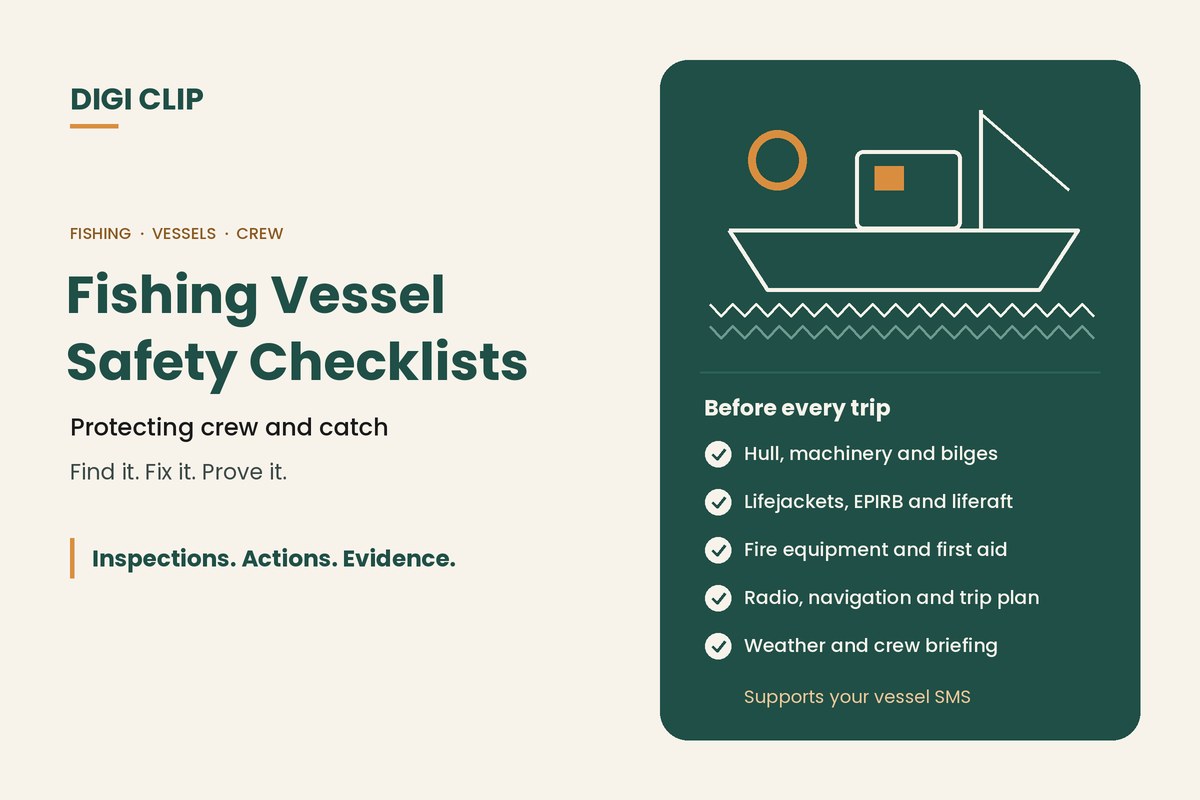
Pre-departure checklist
Vessel and machinery
- Hull, hatches and watertight doors secure
- Engine oil, coolant and fuel checked, with no leaks
- Bilge pumps and alarms tested
- Steering and controls working
- Batteries charged and secure
Safety equipment
- Lifejackets for everyone on board, in date and accessible
- EPIRB registered, in date and with battery serviced
- Liferaft serviced and correctly stowed
- Flares in date
- Fire extinguishers and fire blanket in place and serviced
- First aid kit stocked
Communications and navigation
- VHF radio tested
- Navigation lights, GPS and plotter working
- Trip plan logged with someone ashore
Crew and conditions
- Weather and sea conditions checked
- Crew inducted, fit for work and briefed on emergency procedures
- Fatigue and rest considered for the trip length
On-board and deck safety
- Deck gear: winches, haulers, blocks and wires inspected; guards in place; emergency stops working
- Man overboard: recovery equipment ready, and drills held regularly
- Slips and falls: clean decks, non-slip surfaces and appropriate footwear
- Catch handling: safe lifting, sharp tools controlled, and hazardous species handled carefully
- Refrigeration and holds: safe entry procedures for holds and refrigerated spaces
Putting your checks into practice
- Base checks on your SMS. Build pre-departure, on-board and maintenance checklists from your risk assessment and procedures.
- Keep them short and practical. Focus on items that matter and that can be checked quickly on a working boat.
- Assign responsibility. Make it clear who checks what, from the skipper to deckhands.
- Record and act on faults. Every fault needs an owner and a fix before the vessel relies on that equipment.
- Hold regular drills. Practise man overboard, fire and abandon ship, and record them.
- Review after incidents and each season. Update checklists and your SMS when things change.
Digital checklists at sea
Paper logs get wet, lost or filled in after the fact. With DIGI CLIP, skippers and crew complete pre-departure checks, maintenance checks and drill records on a phone or tablet, even without coverage offshore; the check is submitted with a tap once the device is back online. Each form is location- and time-stamped. Faults create actions in the Action Log, so repairs are assigned and closed out with evidence, and owners can see every vessel’s records in one place.
Illustrative scenario: a bilge alarm fault
During a pre-departure check, a deckhand tests the bilge alarm and it doesn’t sound. She fails the item in DIGI CLIP with a note, which creates an action for the skipper. The departure is delayed while a loose connection is repaired, the alarm is retested, and the action is closed out with a photo before the vessel leaves the wharf.
This scenario is illustrative. It shows how a fishing operation could use DIGI CLIP and is not an account of a specific customer.
See how DIGI CLIP works for commercial fishing and aquaculture, and our guide to fatigue management.
Keep Vessel Checks on Record
Put pre-departure and maintenance checks on your crew’s phones and see faults land in the Action Log, ready to fix and prove.
Start Your 14-Day Free TrialNo credit card required. Set up in minutes.
Frequently asked questions
Do commercial fishing vessels need a safety management system?
Yes. AMSA states that all domestic commercial vessels must have a safety management system, based on a risk assessment of the operation and describing how safety, maintenance and operations are managed.
What changed for safety management systems in 2025?
From 1 June 2025, changes to Marine Order 504 introduced requirements such as fatigue risk management plans, drug and alcohol policies for some vessel classes, and stronger operational and emergency procedures, with a simplified SMS option for eligible vessels.
What should a fishing vessel pre-departure checklist include?
Hull and machinery, fuel and bilges, lifejackets, EPIRB, liferaft, flares, fire equipment, first aid, VHF radio and navigation, a trip plan logged ashore, weather, and crew fitness and briefing.
How often should safety drills be held on a fishing vessel?
As set out in your safety management system. Regular man overboard, fire and abandon ship drills, recorded each time, show your procedures are being practised.
Who is responsible for safety on a commercial vessel?
Owners, masters and crew all have safety duties under the national law. Owners must provide a safe vessel and an SMS, masters must implement it, and crew must follow procedures and take reasonable care.
Can vessel checklists be completed offshore without coverage?
Yes. In DIGI CLIP, checklists can be completed without coverage and submitted with a tap once the device is back online.
About DIGI CLIP Mobile Forms
DIGI CLIP is an Australian-built mobile checklist and inspection platform. Inspections. Actions. Evidence. Teams complete checks on a phone or tablet, turn defects into assigned actions, and keep the proof that each one was fixed and verified.
See our Form Library for ready-made templates.