
Last updated:
Electric forklift safety covers the checks, work practices and charging controls that keep battery-powered forklifts safe to use. It includes the daily pre-start check, safe operation around pedestrians, and managing the battery: charging, changing and the charging area.
Electric Forklift Safety: Pre-Start Checks, Charging and Safe Operation
Electric forklifts are quiet, produce no exhaust at the point of use and suit indoor work, which is why they are common in warehouses and cold stores. They also bring their own risks: a heavy battery, charging areas with electrical and chemical hazards, and a quiet machine that pedestrians may not hear coming. This guide covers the electric-specific pre-start checks, safe charging practices, setting up a charging area, and safe operation and parking.
Key points
- Do the standard forklift pre-start check, plus battery, cable, connector and charge-level checks.
- Only trained and authorised people should charge or change batteries, following the manufacturer’s instructions.
- Charge in a designated, well-ventilated area with an eyewash station, spill kit, fire equipment and barriers to protect the chargers.
- Electric forklifts are quiet, so pedestrian separation and warning devices matter even more.
- Record failed checks and charging-area issues so they are fixed and the fix is recorded.
Electric forklift pre-start checks
An electric forklift needs the same pre-start check as any other forklift: tyres, forks, mast and chains, hydraulics, overhead guard, data plate, seatbelt, brakes, steering and warning devices. Our forklift pre-start checklist covers those in full. On top of that, check the electrical system:
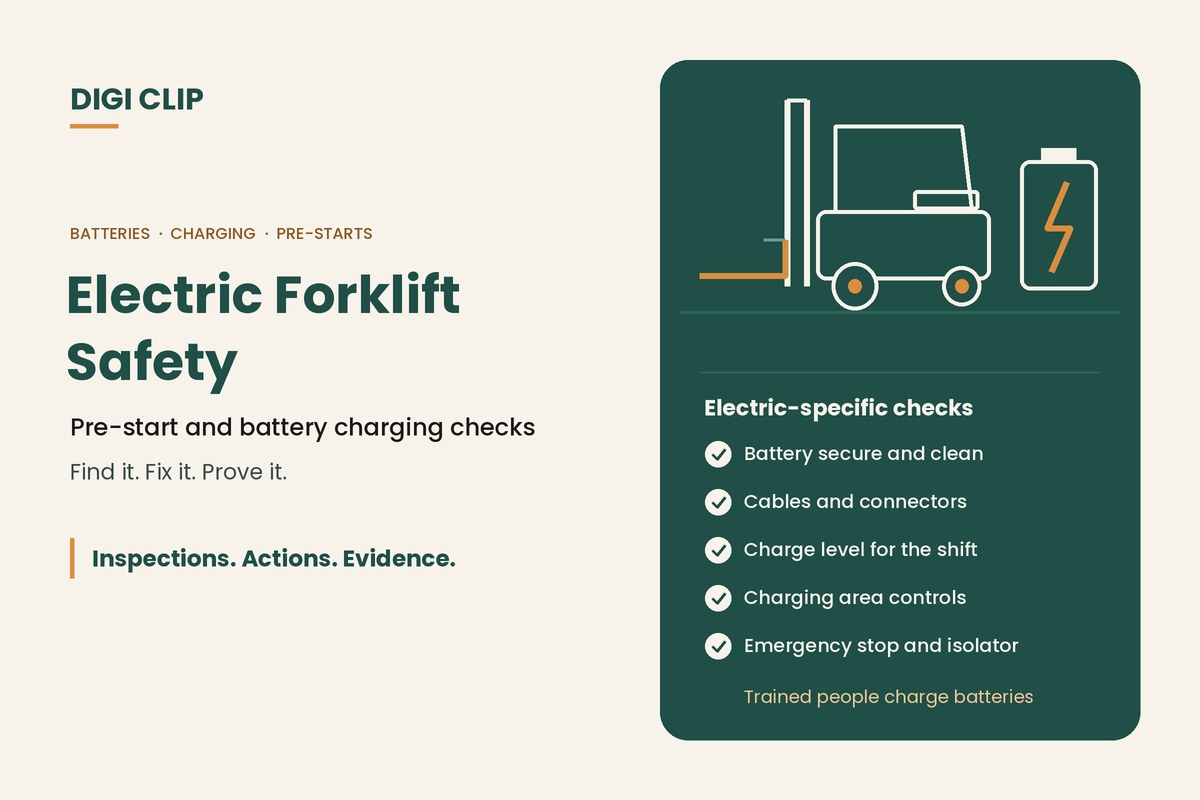
- Battery secure: the battery is seated correctly, its restraint or retaining device is in place, and the cover or compartment closes properly
- Battery condition: the case isn’t cracked, swollen or leaking, and the top is clean and dry
- Cables and connectors: no cuts, exposed conductors, burn marks or loose terminals, and the plug and socket are undamaged
- Charge level: the battery gauge shows enough charge for the shift, with no fault codes on the display
- Emergency stop and isolator: the emergency disconnect works and is easy to reach
- Warning devices: horn, lights, reversing alarm and any pedestrian warning lights work, which matters more on a quiet machine
For lead-acid batteries, your procedure may also include checking electrolyte levels, but only when the manufacturer’s instructions call for it and only by a trained person wearing the right PPE. Lithium-ion batteries are usually sealed; follow the manufacturer’s instructions and report any damage, swelling or unusual heat straight away.
Step-by-step check
- Park and isolate. Make sure the forklift is on level ground with the forks lowered, the park brake on, the key off and the charger disconnected.
- Do the walk-around. Check the tyres, forks, mast, chains, hydraulic hoses, overhead guard, load backrest, data plate and any attachment, and look underneath for leaks.
- Check the battery and cables. Check the battery is secure and undamaged, the top is clean and dry, and the cables, plug and connectors are in good condition.
- Check the seat and controls. Adjust the seat, fasten the seatbelt, switch on and check the battery gauge, display and warning lights.
- Run the function tests. Test the brakes, park brake, steering, horn, lights, reversing alarm, emergency stop and mast functions through their full range.
- Record and report. Complete the checklist, photograph any defect and report it. If the forklift isn’t safe to use, lock it out and tag it.
Safe battery charging
WorkSafe Victoria’s forklift guidance says only trained and authorised people should charge and change batteries, charging should happen at locations designed for it, and the manufacturer’s charging instructions should be provided and followed. Good charging practice includes:
- Park in the charging area, lower the forks, apply the park brake and switch off before connecting the charger.
- Use only the charger specified for that battery, and check the charger lead and plug before use.
- Open battery vents or covers if the manufacturer says to.
- Keep sparks, flames and smoking away. Lead-acid batteries can give off hydrogen while charging, which is why ventilation matters.
- Wear the PPE your procedure specifies, such as eye protection, gloves and an apron when handling electrolyte.
- Switch the charger off before disconnecting, and don’t leave charger leads lying across walkways or traffic routes.
- Report damaged chargers, leads or batteries and take them out of use.
Battery changing involves heavy lifting and pinch points. Use the lifting equipment and procedure the manufacturer specifies, never lift a battery by hand, and keep other people clear.
Setting up a charging area
WorkSafe Victoria’s guidance lists several features for designated recharging zones. A well set-up charging area typically has:
- Good ventilation, as the charger and battery manufacturers specify
- An emergency eyewash station close by
- A spill kit suitable for battery electrolyte
- Fire-fighting equipment suitable for electrical fires, plus any extra controls the battery manufacturer specifies
- High-impact barriers to protect chargers from forklift movements
- Signs prohibiting smoking and naked flames
- Clear floor space, with charger leads kept off the floor
Add a short charging-area inspection to your weekly checks so damaged leads, blocked eyewash stations or empty spill kits are picked up and fixed.
Safe operation and parking
Operating
- Only licensed and authorised operators should use the forklift. Most forklifts need a high risk work licence in the LF class, or LO for order-pickers.
- Keep to separate traffic routes, and remember pedestrians may not hear an electric forklift approaching.
- Use the horn at blind corners and doorways, and slow down in shared areas.
- Never exceed the capacity on the data plate or load chart, and de-rate for attachments.
- Travel with the forks low and the load tilted back, and look in the direction of travel.
- Don’t use the forklift to lift people unless it is fitted with a work platform designed for that purpose.
Parking
Safe Work Australia’s forklift information sheet says to park on level ground with the load removed, the park brake applied, the controls in neutral and the power shut off. Lower the forks to the ground, remove the key and park away from exits, walkways and fire equipment.
Faults that take an electric forklift out of service
Along with the usual forklift defects, such as brakes, steering, forks, chains and hydraulics, take an electric forklift out of service if you find:
- A cracked, swollen, leaking or unusually hot battery
- Damaged, exposed or burnt battery cables, plugs or connectors
- A battery that isn’t secured in its compartment
- An emergency stop or isolator that doesn’t work
- Fault codes or warning lights that stay on
- A horn, reversing alarm or warning lights that don’t work
Lock out and tag the forklift, record the fault with a photo and report it. Battery and electrical repairs should only be done by a competent person.
Recording checks digitally
With DIGI CLIP, operators complete the electric forklift pre-start check on a phone or tablet and add photos to failed items. Checks can be completed without coverage and submitted with a tap once the device is back online. Failed items, such as a damaged charger lead or a swollen battery, flow into the Action Log, where they are assigned, tracked and closed out with evidence. You can build a separate weekly charging-area inspection the same way. Comparing options? Our inspection app buyer's guide sets out the criteria that matter.
Illustrative scenario: a damaged charger lead
During his pre-start check, an operator in a cold store notices the outer sheath on his forklift’s charger lead is split near the plug. He fails the item in DIGI CLIP, adds a photo and tags the charger out of use. The site supervisor sees the action, arranges an electrician and closes out the action with a photo of the replacement lead.
This scenario is illustrative. It shows how a business could use DIGI CLIP and is not an account of a specific customer.
Setting up forklift checks for your fleet? Start with our equipment inspection checklist template or plant pre-start checklist.
Take Your Forklift Checks Digital
Put your electric forklift checks on every operator’s phone and see defects land in the Action Log, ready to fix and prove.
Start Your 14-Day Free TrialNo credit card required. Set up in minutes.
Frequently asked questions
What should be checked on an electric forklift before use?
Do the standard forklift pre-start check, covering tyres, forks, mast, chains, hydraulics, overhead guard, seatbelt, brakes, steering and warning devices. Then check the battery is secure and undamaged, the cables and connectors are in good condition, the charge level is enough for the shift and the emergency stop works.
Who can charge or change an electric forklift battery?
Only trained and authorised people, following the manufacturer’s charging instructions and your site procedure. Battery changing should use the lifting equipment the manufacturer specifies.
Why does a forklift charging area need ventilation?
Lead-acid batteries can give off hydrogen while charging, and hydrogen is flammable. Good ventilation, no ignition sources and following the charger and battery manufacturers’ instructions help control that risk.
What should a forklift charging area have?
A designated, well-ventilated space with an emergency eyewash station, a spill kit, suitable fire-fighting equipment, barriers to protect chargers from forklifts, no-smoking signs and charger leads kept off the floor.
Are electric forklifts safer than LPG or diesel forklifts?
They remove exhaust emissions at the point of use, which suits indoor work, but they bring their own risks, including battery charging hazards and being harder for pedestrians to hear. Every forklift type needs a pre-start check, a licensed operator and good traffic management.
Do you need a licence to drive an electric forklift?
Most forklifts, including electric ones, need an operator with a high risk work licence. The LF class covers forklift trucks and the LO class covers order-picking forklifts. Check the rules for your situation with your state or territory regulator.
About DIGI CLIP Mobile Forms
DIGI CLIP is an Australian-built mobile checklist and inspection platform. Inspections. Actions. Evidence. Teams complete checks on a phone or tablet, turn defects into assigned actions, and keep the proof that each one was fixed and verified.
See how it works for transport and logistics teams.






