Last updated:
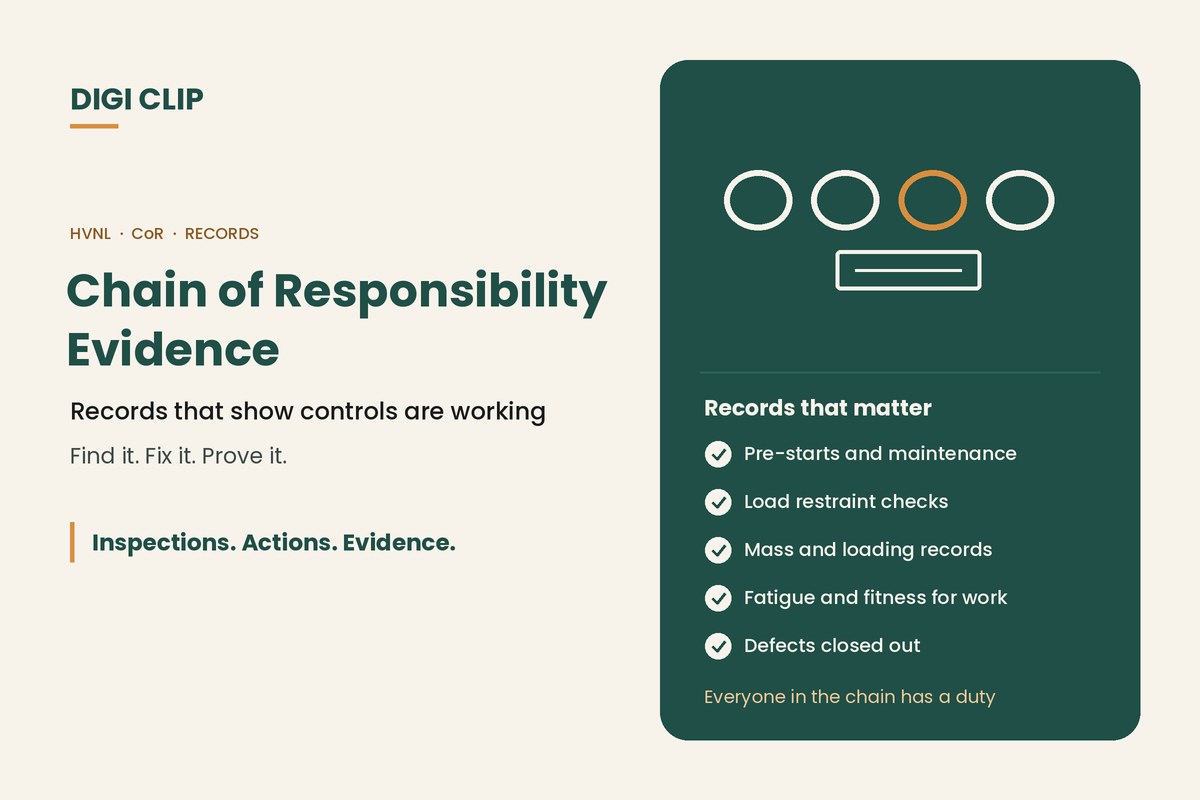
Chain of responsibility (CoR) is the principle in the Heavy Vehicle National Law (HVNL) that everyone who can influence heavy vehicle transport activities shares responsibility for their safety, not just the driver. Parties in the chain must make sure, so far as is reasonably practicable, that their transport activities are safe, and records are how they show what they did.
Chain of Responsibility Evidence: Records That Show Your Controls Are Working
Under chain of responsibility, a business can’t just say its trucks are safe. It needs to be able to show it. That means records: vehicle checks, maintenance, load restraint, fatigue management, training and follow-up of problems. This guide covers who has CoR duties, what evidence matters, and how to keep records that stand up.
Key points
- Every party in the chain has a primary duty for the safety of their transport activities.
- Executives must exercise due diligence to make sure the business meets its duty.
- Records of checks, maintenance, loading and fatigue show controls are in place.
- Records must show problems were followed up, not just found.
- The HVNL applies in most states and territories, but not in WA or the NT.
Who has CoR duties
Parties in the chain of responsibility include:
- employers and prime contractors of drivers
- operators of heavy vehicles
- schedulers of goods or passengers, and schedulers of drivers
- consignors and consignees
- loading managers, loaders and unloaders
- executive officers of these businesses, who have a due diligence duty
The HVNL applies in all states and territories except Western Australia and the Northern Territory, which have their own arrangements. The National Heavy Vehicle Regulator (NHVR) provides guidance, including the Master Code for managing risks. Check which rules apply to your operations.
What evidence matters
| Risk area | Records that help show control |
|---|---|
| Vehicle standards and maintenance | Daily pre-starts, defect reports and repairs, service records |
| Load restraint | Load restraint checks, photos of secured loads, equipment inspections |
| Mass and dimension | Weighbridge dockets, loading records, loading procedures |
| Fatigue | Work diaries where required, rosters, fitness for work checks |
| Speed and scheduling | Realistic schedules, consignment terms, delivery windows |
| People | Inductions, training and competency records, toolbox talks |
| Follow-up | Actions raised from checks and incidents, with close-out evidence |
Building a CoR evidence system
- Map your transport activities. Identify your role in the chain and the risks you can influence.
- Set controls. Write procedures for vehicle checks, loading, fatigue and scheduling.
- Record the checks. Use consistent forms for pre-starts, load restraint and fitness for work.
- Follow up every problem. Assign defects and non-compliances, and record the fix.
- Review regularly. Executives should review records, incidents and trends as part of due diligence.
- Keep records retrievable. Make sure you can find a vehicle’s or driver’s records quickly when asked.
CoR evidence with DIGI CLIP
With DIGI CLIP, drivers, loaders and supervisors complete pre-starts, load restraint checks and fitness for work checks on a phone, with photos. Each form is location- and time-stamped. Defects and non-compliances become actions in the Action Log, closed out with evidence, and records can be exported to PDF or Excel for audits, customers or the regulator. For driver hours and rest, see our guide to fatigue management.
Illustrative scenario: a customer CoR audit
A mid-sized carrier is asked by a major customer to show its CoR controls. The operations manager exports three months of pre-starts, load restraint checks and closed-out defect actions from DIGI CLIP, including photos, time stamps and repair records. The customer’s auditor can trace a reported brake defect from the driver’s pre-start through to the workshop repair.
This scenario is illustrative. It shows how a business could use DIGI CLIP and is not an account of a specific customer.
See also our guides to vehicles as a workplace, flatbed load restraint and the commercial truck safety checklist.
Build Your CoR Evidence Trail
Put pre-starts and load checks on your team’s phones and see defects land in the Action Log, ready to fix and prove.
Start Your 14-Day Free TrialNo credit card required. Set up in minutes.
Frequently asked questions
What is chain of responsibility?
The principle in the Heavy Vehicle National Law that everyone who can influence heavy vehicle transport activities shares responsibility for their safety, not just the driver.
Who is part of the chain of responsibility?
Employers, prime contractors, operators, schedulers, consignors, consignees, loading managers, loaders and unloaders, with executive officers having a due diligence duty.
Does the Heavy Vehicle National Law apply in every state?
No. It applies in all states and territories except Western Australia and the Northern Territory, which have their own arrangements.
What records help show CoR compliance?
Vehicle pre-starts and maintenance records, load restraint checks, mass records, fatigue and fitness for work records, training records, and actions raised and closed out from checks and incidents.
What is executive due diligence under CoR?
Executive officers must take reasonable steps to make sure the business meets its safety duty, such as understanding the risks, providing resources and reviewing records and incidents.
Can CoR records be kept digitally?
Yes. In DIGI CLIP, checks are completed on a phone with photos and time and location stamps, defects become actions, and records can be exported to PDF or Excel.
About DIGI CLIP Mobile Forms
DIGI CLIP is an Australian-built mobile checklist and inspection platform. Inspections. Actions. Evidence. Teams complete checks on a phone or tablet, turn defects into assigned actions, and keep the proof that each one was fixed and verified.
See our Form Library for ready-made templates.