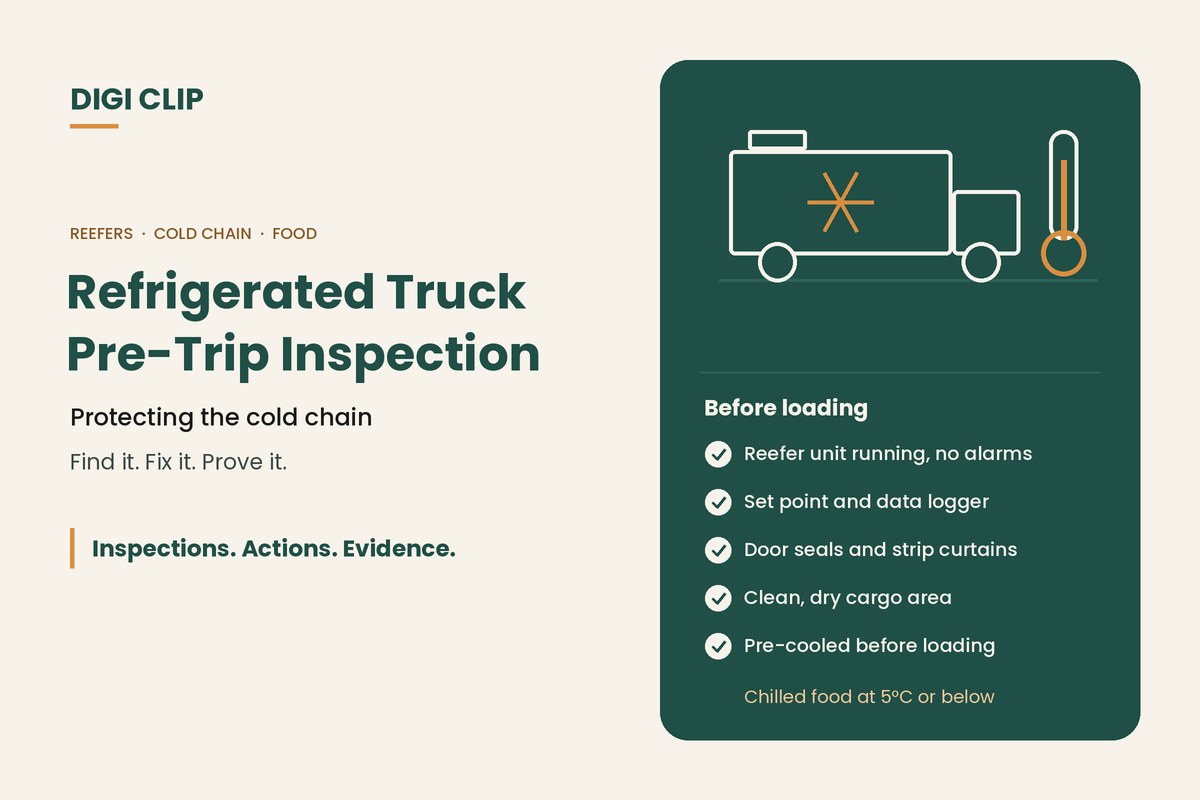
A refrigerated truck pre-trip inspection is the check a driver completes before loading and departure to confirm the truck, the refrigeration unit and the cargo area will keep temperature-sensitive goods safe: the reefer unit, set point and pre-cooling, door seals, curtains, drainage, cleanliness, temperature recording, and the usual truck safety checks.
Refrigerated Truck Pre-Trip Inspection: Protecting the Cold Chain
In a refrigerated truck, a problem can spoil a whole load before anyone notices. A failed reefer unit, a torn door seal or a box that wasn’t pre-cooled can push food, medicines or flowers out of range. A pre-trip inspection that covers both the truck and the refrigeration system protects the driver, the load and the business. This guide covers what to check, temperature basics and how to keep cold chain records.
Key points
- Check the truck and the refrigeration system before every trip.
- Pre-cool the cargo area to the set point before loading.
- Chilled potentially hazardous food should be kept at 5°C or below, and frozen food frozen hard.
- Door seals, curtains and drainage affect temperature as much as the unit does.
- Temperature records show the cold chain was maintained.
Refrigeration unit checks
- Unit starts and runs without alarms or fault codes
- Set point correct for the load
- Fuel level for diesel-powered units, or power connection for electric standby
- Condenser and evaporator clear of debris, fans working
- Defrost cycle working
- Temperature display and data logger working and calibrated
Cargo area checks
| Item | What to check |
|---|---|
| Cleanliness | Clean, dry, free of odours, spills and pests |
| Door seals | No tears, gaps or damage; doors close and lock properly |
| Strip curtains | In place and undamaged |
| Floor and drains | Floor intact, drains clear |
| Air flow | Air chutes and bulkheads in place, room for air to circulate around the load |
| Pre-cooling | Cargo area at set point before loading starts |
Truck checks
Refrigerated trucks need the same safety checks as any truck: tyres and wheel nuts, brakes, lights, fluids and leaks, mirrors, coupling for trailers, and cabin safety equipment. See our commercial truck safety checklist.
Running the pre-trip
- Check the truck. Complete the standard walk-around safety check.
- Start the reefer unit. Confirm it runs with no alarms and set the correct temperature for the load.
- Inspect the cargo area. Check cleanliness, seals, curtains, floor and drains.
- Pre-cool. Run the unit until the cargo area reaches the set point before loading.
- Check product temperature at loading. Record the temperature of the goods and reject any out of range.
- Monitor and record. Keep the data logger running and check temperatures during the trip.
Temperature basics
Under the Food Standards Code, potentially hazardous food must be kept at 5°C or below or 60°C or above, and frozen food should remain frozen during transport. Many businesses and customers set tighter ranges, and medicines and other products have their own requirements. Refrigeration units are designed to hold temperature, not to cool warm product, so goods should be at the right temperature when they are loaded. See our guide to food safety checklists.
Cold chain records on the phone
With DIGI CLIP, drivers complete refrigerated pre-trips and temperature records on a phone, with photos. Each form is location- and time-stamped. A failed item or out-of-range temperature creates an action in the Action Log, so faults are fixed and closed out with evidence, and records are ready to show customers and auditors.
Illustrative scenario: a failed pre-cool
A driver starts the reefer unit for a chilled dairy run, but after 30 minutes the cargo area is still at 11°C. She records it in DIGI CLIP, which creates an action for the fleet workshop, and switches to a spare trailer. A technician finds a blocked condenser, cleans it and retests the unit, and the action is closed out with the new reading.
This scenario is illustrative. It shows how a transport business could use DIGI CLIP and is not an account of a specific customer.
See also DIGI CLIP for cold storage and warehousing.
Protect the Cold Chain on Every Trip
Put refrigerated pre-trips and temperature records on your drivers’ phones and see faults land in the Action Log, ready to fix and prove.
Start Your 14-Day Free TrialNo credit card required. Set up in minutes.
Frequently asked questions
What should a refrigerated truck pre-trip inspection include?
The standard truck safety checks, plus the refrigeration unit, set point, fuel or power, data logger, cargo area cleanliness, door seals, strip curtains, floor and drains, air flow and pre-cooling.
What temperature should chilled food be transported at?
Potentially hazardous chilled food should be kept at 5°C or below, and frozen food should remain frozen. Many customers set tighter ranges.
Why should a refrigerated truck be pre-cooled?
So the cargo area is at the right temperature before goods are loaded. Refrigeration units are designed to hold temperature, not to bring warm product down quickly.
Can a refrigeration unit cool warm product?
Not reliably. Units are designed to maintain temperature. Product should be at the correct temperature when it is loaded, and out-of-range product should be rejected.
How are cold chain records kept?
With data loggers or unit records, plus temperature checks at loading, during the trip and at delivery. These records show the cold chain was maintained.
Can refrigerated truck checks be done on a phone?
Yes. In DIGI CLIP, drivers complete pre-trips and temperature records on a phone with photos, and failed items become actions in the Action Log.
About DIGI CLIP Mobile Forms
DIGI CLIP is an Australian-built mobile checklist and inspection platform. Inspections. Actions. Evidence. Teams complete checks on a phone or tablet, turn defects into assigned actions, and keep the proof that each one was fixed and verified.
See our Form Library for ready-made templates.