Last updated:
Your Inspections Are Being Recorded. Are They Being Managed?
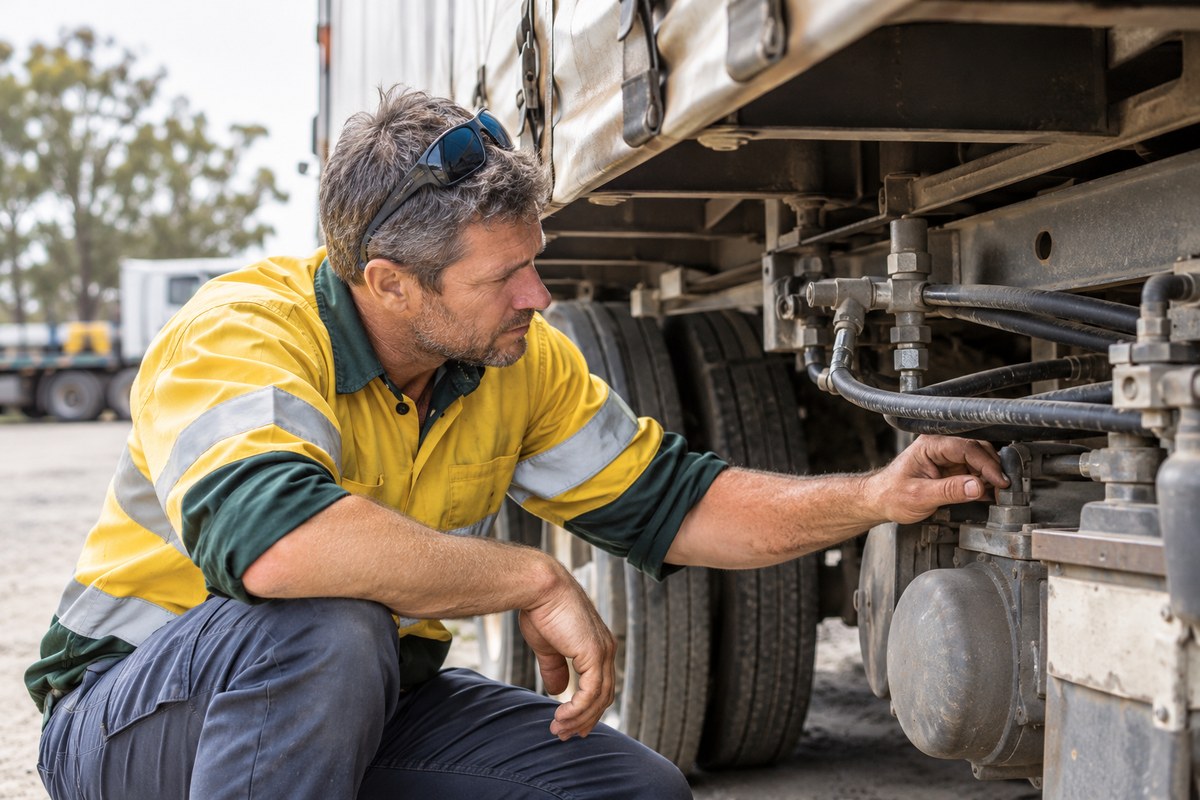
A driver finds a slow air leak on a trailer during the pre-start. He writes it on the sheet, marks the item "No" and hands the form in. The sheet goes in the tray.
Three weeks later, the same trailer is on another run. A different driver writes up the same fault. Nobody can say whether the first note ever reached the workshop, who was meant to deal with it, or whether it was fixed and has come back.
Both inspections were completed. Both forms were filed. On paper, the business is doing everything right. In practice, it has no idea what happened to the fault.
It's a scene most fleets will recognise, and the same pattern turns up on farms, in warehouses and on construction sites: a guard noted as damaged, a rack flagged as bent, a step reported as cracked. The problem is rarely that nobody inspects. It's that nobody can show what happened after the inspection found something.
Do you have an inspection process, or a recording process?
Most businesses that run regular inspections believe they are managing risk. What many actually have is a recording process. People fill in the form, the form gets filed, and everyone assumes the system has done its job.
The difference isn't the technology. It's whether a finding has an owner, a deadline, a fix and a record that the fix happened. Here's how the two compare in practice.
| Recorded inspection | Managed inspection | |
|---|---|---|
| The finding | Written on a form, often as a bare "No" | Described, with a photo, so the problem is clear |
| Ownership | Assumed | A named person |
| Timing | Whenever someone gets to it | A due date |
| Follow-up | Depends on someone remembering | Overdue items get chased |
| Close-out | "I think Dave sorted it" | Verified and recorded |
| Proof later | Dig through folders, emails and phones | Inspection, action and evidence kept together |
Three gaps sit between those two columns. Most businesses have all three and have never looked for them.
Gap 1: A finding that nobody owns
When an inspection finds something, three things need to happen. Someone has to know about it. Someone has to own the fix. And someone has to confirm it was fixed. On paper, none of those is guaranteed.
"I told Dave" isn't a system. Defects get reported verbally, by text, or by a note left on a desk. There's no record of who was told, when, or what they did about it.
Everyone assumes someone else has it. Without a named owner and a due date, a finding drifts. The driver assumes the workshop knows. The workshop assumes the supervisor has it scheduled. The supervisor assumes the driver would say if it got worse.
The same fault looks like a one-off. When different people report the same defect on different days and each report is handled in isolation, the pattern never becomes visible. When a fault keeps coming back, a method like the 5 Whys helps you find the root cause rather than fixing the symptom again.
The gap between finding and knowing. A hazard found on Monday may not reach the person who can fix it until Friday. Sometimes it never does.
That's the biggest gap, and the one that matters most. A finding with no owner, no due date and no close-out is a note, not an action.
Gap 2: A ticked form that doesn't show a check happened
A page of "Yes" ticks looks like control. It doesn't show that the check was done carefully, at the time, at the right place.
A bare "No" tells you something is wrong but not what. Paper can be filled in after the fact, in the office, from memory. And the inspections that didn't happen leave no trace at all, because an empty tray looks exactly like a quiet week.
None of this means your people are cutting corners. It means a form on its own can't tell you whether the inspection was real. Evidence like a photo, a comment on a failed item, and a record of when and where the check was done is what turns a tick into proof.
Gap 3: A record you can't pull up when it matters
Sooner or later someone asks. An auditor, an insurer, a client, or your own review after an incident: what was checked, what was found, and what happened next?
The record probably exists somewhere. In a folder, in the ute, on someone's phone, in an email thread. Pulling it together takes hours, and many businesses have never tested whether they could do it at all.
A simple test: pick one vehicle, machine or site. Ask for the last defect found on it and what was done about it. If the answer takes more than a few minutes, you've found the gap.
Why this matters more than it looks
This isn't only about tidiness. Under the model WHS laws, which apply in every state and territory except Victoria (Victoria has its own legislation), officers of a business have a duty to exercise due diligence to make sure the business meets its health and safety obligations. Section 27 of the model Act spells out what that includes, and one element is having appropriate processes for receiving and considering information about hazards and responding to it in a timely way.
In transport, the Heavy Vehicle National Law (which applies everywhere except WA and the NT) places a primary duty on every party in the chain of responsibility to ensure, so far as is reasonably practicable, the safety of its transport activities. Executives are expected to exercise due diligence to ensure the organisation meets that duty.
Neither law tells you to use a particular system. But when something goes wrong and someone reviews what you did, "we inspected" is a thin answer. "We found it, assigned it, fixed it on this date, and here's the evidence" is a strong one. A record that shows a known problem and nothing after it can be hard to explain.
The five-question self-check
Try these on your own operation. Use a real vehicle, site or machine, not a hypothetical one.
- When someone last reported a defect or hazard, can you show who owned the fix, the due date, and when it was closed?
- Which inspections were due last week but didn't happen, and how would you know?
- Could you produce the last fault found on a particular vehicle, machine or site, and what was done about it, within a few minutes?
- When a form says "No", what does it tell you about the problem, or is "No" the whole answer?
- If your most diligent supervisor was away for a month, what would stop happening?
As a rough guide, if you can't answer three or more of these with confidence, you probably have a recording process rather than an inspection process. That's common, and it's fixable.
Corrective action tracking: how to close the loop on inspection findings
You don't need any particular software to do this. A disciplined team can make it work on paper. But notice where paper starts to struggle as the volume grows.
- Capture the finding properly. Describe what's wrong and where, and attach a photo. A bare "No" isn't a finding.
- Turn it into an action with a named owner and a due date. "The workshop" isn't an owner. A person and a date make corrective action tracking possible.
- Make overdue items visible. Someone should be told when a due date passes without a result, rather than discovering it months later.
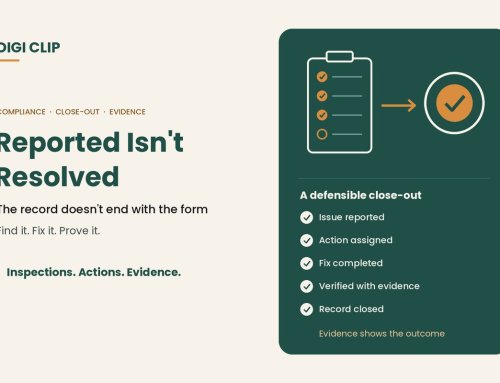
- Verify the close-out. Confirm the fix, and record how, by whom and when. "Done" isn't evidence, and reported isn't resolved.
- Keep it all together. The inspection, the photos, the action and the close-out should sit in one place you can search in minutes.
Steps 1 and 2 are easy on paper. Steps 3 to 5 are where it usually breaks down: chasing overdue items by hand, verifying fixes, and finding the record months later.
Where DIGI CLIP fits
DIGI CLIP is built around that loop. It doesn't stop at the checklist.
- Failed items turn into actions. Smart fields prompt for detail when an answer is "No", "Not OK" or "At Risk", and automatically create an action in the Action Log, so a finding doesn't sit on the form.
- Actions are tracked to close-out. Overdue actions trigger alert emails, and you can open the original report, photos included, from the action itself.
- Fixes are verified. A close-out verification form documents that the fault was dealt with, using either one-step or two-step close-out.
- Records carry evidence. Forms are location- and time-stamped, with photos, comments and signatures.
- Checks come round on schedule. Recurring checks can be set up with reminders when a check is due.
An inspection isn't finished when the checklist is submitted. It's finished when the finding has been dealt with, and you can prove what happened. If that's the gap you want to close, you can read more about Find it. Fix it. Prove it. or try DIGI CLIP free for 14 days.
Frequently asked questions
What's the difference between completing an inspection and managing one?
Completing an inspection means filling in and submitting the form. Managing an inspection means making sure every finding has an owner, a due date, a fix and a verified close-out, and that the evidence is kept. A completed inspection tells you what was found. A managed inspection tells you what happened next.
What should happen after an inspection item fails?
The finding should be described and backed with a photo, turned into an action with a named owner and a due date, followed up if it becomes overdue, verified as fixed, and recorded alongside the original inspection. If any of those steps relies on someone remembering, it's a weak point.
How long should inspection records be kept?
It depends on the type of record, the industry and the state or territory. Some WHS records have specific retention requirements, and transport records can differ again. Check with your regulator or adviser, then set one consistent retention rule rather than relying on whoever last tidied the filing cabinet.
What does "due diligence" mean for a business owner or manager?
Under the model WHS laws, officers must take reasonable steps to make sure their business meets its health and safety duties. That includes knowing the risks, providing resources, and having processes to receive and respond to information about hazards and incidents. Safe Work Australia's guidance on the officer duty is the best place to start. This is general information, not legal advice.
How do you stop people ticking "Yes" to everything?
You can't remove it completely, but you can make it harder and less rewarding. Require a photo or comment when something fails, capture when and where the check happened, review results regularly, and most importantly make sure reported problems lead to something. People stop reporting when they see nothing happens.
Do I need software to manage inspection findings?
No. A disciplined team can manage findings on paper. It tends to break down at the same points as volumes grow: capturing evidence, keeping time and location records, chasing overdue actions, and retrieving records quickly. That's where a tool like DIGI CLIP helps.
Further reading
- Safe Work Australia: The health and safety duty of an officer (section 27)
- NHVR: Regulatory advice on the primary duty (Chain of Responsibility)
- RMIT: Using digital technology to share health and safety knowledge
- EU-OSHA: Smart digital systems for improving worker safety and health
This article is general information only and isn't legal advice. Requirements differ by state, territory and industry, so check with your regulator or a qualified adviser for your situation.