
Last updated:
A gemba walk is when managers go to the place where the work actually happens (the “gemba”, Japanese for “the real place”) to observe the process, talk to the people doing the work and understand problems first-hand. It comes from lean management, and it is used to improve safety, quality and efficiency.
What Is a Gemba Walk? How to Run One That Leads to Real Improvements
Reports and dashboards only tell part of the story. A gemba walk gets leaders out of the office and onto the floor, the site or the depot, to see how work really gets done and what gets in the way. Done well, it builds trust and uncovers problems early. Done badly, it feels like an inspection with an audience. This guide covers what a gemba walk is, how it differs from a safety inspection, how to run one, and how to turn what you see into action.
Key points
- A gemba walk is about observing and learning, not checking up on people.
- Focus on the process and one theme at a time, such as safety, quality or flow.
- Ask open questions and listen more than you talk.
- Record what you see and follow up, so people know it was worth their time.
- Walk regularly, so it becomes normal rather than an event.
Why gemba walks matter
- See reality: procedures and reports often differ from how work is really done.
- Find problems early: workarounds, bottlenecks and hazards are easier to spot in person.
- Build trust: workers see that leaders care about their work and their problems.
- Improve safety: officers have due diligence duties under WHS law, including understanding the hazards and risks of the business’s operations. Seeing the work first-hand is a practical way to do that.
- Better decisions: improvements are based on what actually happens, not assumptions.
Gemba walk vs safety inspection
| Gemba walk | Safety inspection | |
|---|---|---|
| Purpose | Understand the process and find improvements | Check conditions and controls against a standard |
| Approach | Observe, ask open questions, listen | Work through a checklist |
| Who | Leaders and managers | Supervisors, safety staff, HSRs |
| Output | Insights, ideas and improvement actions | Hazards and corrective actions |
The two work well together. See our guide to workplace safety inspections.
How to run a gemba walk
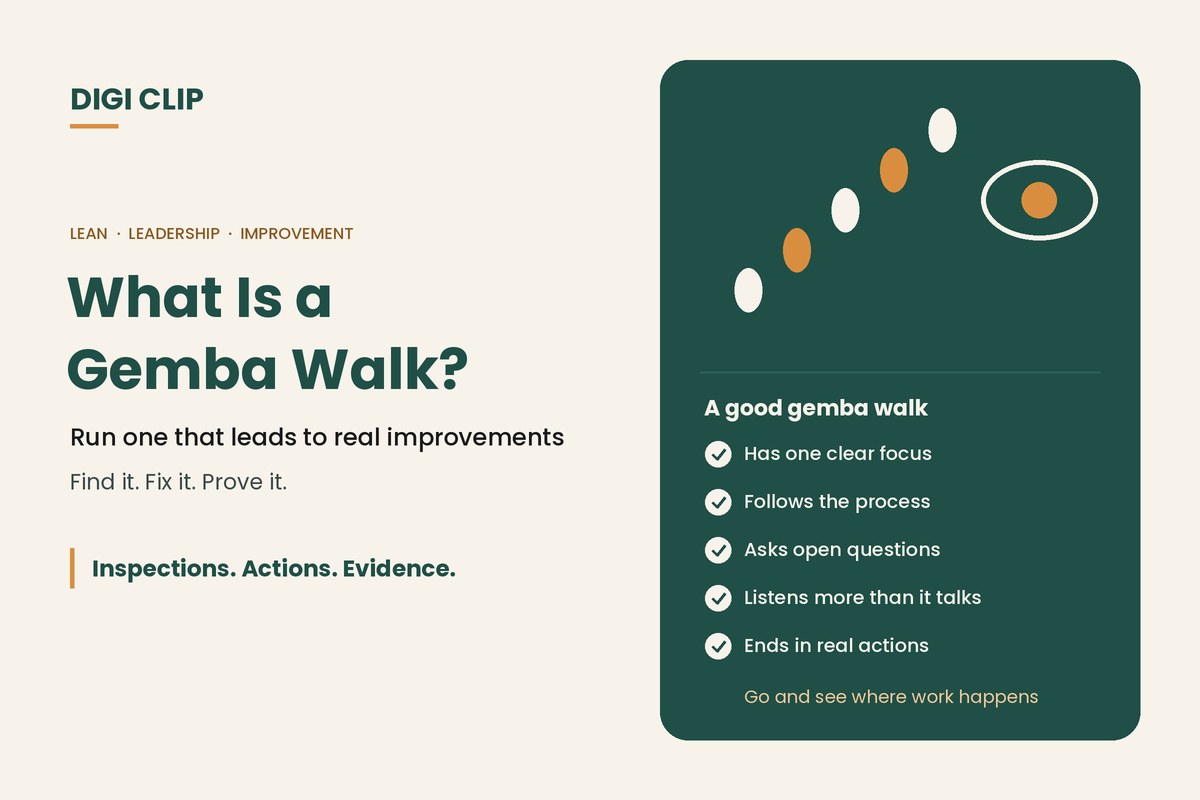
- Pick a focus. Choose one theme, such as safety, quality, flow or a recent problem, and one area or process.
- Let people know. Tell the team you’re coming and why, so it doesn’t feel like a surprise audit.
- Follow the process. Walk the work in the order it happens, from start to finish.
- Observe and ask. Watch how the work is done and ask open questions. Focus on the process, not on blaming people.
- Record what you find. Note observations, ideas and problems, with photos where helpful.
- Follow up. Agree actions, assign owners and dates, and tell the team what happened as a result.
Questions to ask
- Can you walk me through how this job is done?
- What slows you down or makes this harder than it should be?
- Where do you feel least safe doing this task?
- What happens when something goes wrong here?
- If you could change one thing about this process, what would it be?
- Is there anything you need that you don’t have?
Common mistakes
- Turning it into an audit: criticising people instead of learning about the process.
- Too many topics: trying to cover everything and seeing nothing clearly.
- Talking more than listening: the goal is to learn from the people doing the work.
- No follow-up: people stop raising issues if nothing changes.
- One-off events: walks work best as a regular habit.
Recording gemba walks
With DIGI CLIP, leaders can use a simple gemba walk form on a phone to record observations, photos and ideas as they walk. Each form is location- and time-stamped. Anything that needs fixing becomes an action in the Action Log, with an owner and due date, so the team can see what came of it.
Illustrative scenario: a gemba walk at a depot
A general manager spends 30 minutes walking the dispatch process at a distribution depot, focusing on safety. A loader shows her how pickers step around a pallet stack to reach a scanner, into the forklift path. She records it with a photo and an action to move the scanner station. The action is closed out the following week, and she mentions the change at the next toolbox talk.
This scenario is illustrative. It shows how a business could use DIGI CLIP and is not an account of a specific customer.
For more on improving processes, see our guides to quality inspection and effective toolbox talks.
Turn Gemba Walk Findings Into Action
Record observations on your phone and see improvement actions land in the Action Log, ready to fix and prove.
Start Your 14-Day Free TrialNo credit card required. Set up in minutes.
Frequently asked questions
What is a gemba walk?
A gemba walk is when managers go to the place where the work actually happens to observe the process, talk to the people doing the work and understand problems first-hand. It comes from lean management, and it is used to improve safety, quality and efficiency.
What does gemba mean?
Gemba is a Japanese word meaning “the real place”. In lean management, it refers to the place where value is created, such as the factory floor, warehouse, site or depot.
How is a gemba walk different from a safety inspection?
A safety inspection checks conditions against a checklist or standard. A gemba walk is more open: leaders observe the process, ask questions and listen, to understand problems and find improvements.
How often should gemba walks be done?
Regularly enough to become a habit, such as weekly for frontline managers and monthly for senior leaders. Short, frequent walks usually work better than long, occasional ones.
Who should do gemba walks?
Leaders and managers at every level, including senior executives. Involving supervisors and workers from the area makes the walk more useful.
What happens after a gemba walk?
Record what you saw, agree actions with owners and due dates, follow them up, and tell the team what changed as a result.
About DIGI CLIP Mobile Forms
DIGI CLIP is an Australian-built mobile checklist and inspection platform. Inspections. Actions. Evidence. Teams complete checks on a phone or tablet, turn defects into assigned actions, and keep the proof that each one was fixed and verified.
See our Form Library for ready-made templates.






