
Last updated:
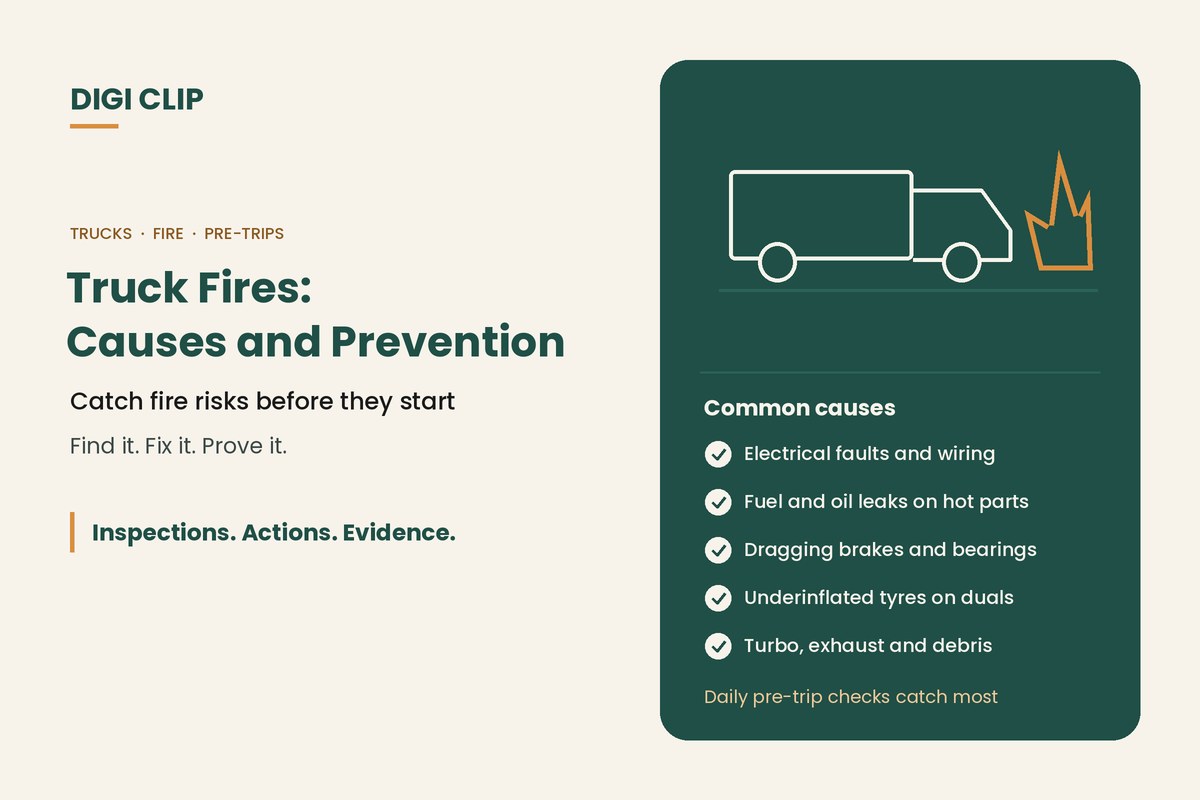
Truck fires usually start when heat meets fuel: an electrical fault, a fuel or oil leak onto a hot surface, overheating brakes, bearings or tyres, or a turbo or exhaust problem. Most causes show warning signs first, which is why regular inspections and maintenance are the best way to prevent them.
Truck Fires: Common Causes and How to Prevent Them
A truck fire can destroy a vehicle and its load in minutes, close a highway and put the driver and other road users at risk. The good news is that most fires start with a problem that could have been found earlier: a chafed wire, a weeping fuel line, a dragging brake or an underinflated tyre. This guide covers the common causes, the checks that catch them, and what drivers should do if a fire starts.
Key points
- Electrical faults, fuel and oil leaks, and overheating wheel ends are common causes.
- Underinflated or failed tyres, especially on duals, can overheat and ignite.
- Daily pre-trip checks and regular maintenance catch most warning signs.
- Drivers need a working extinguisher and clear training on what to do.
- Every defect found needs to be fixed before the truck goes back on the road.
Common causes of truck fires
| Cause | How it starts |
|---|---|
| Electrical faults | Chafed or damaged wiring, poor connections, aftermarket accessories, battery cables shorting |
| Fuel and oil leaks | Leaking lines, fittings or seals spraying or dripping onto hot engine, turbo or exhaust parts |
| Brakes and wheel ends | Dragging or poorly adjusted brakes, seized slack adjusters, failed wheel bearings |
| Tyres | Underinflated or flat tyres, especially on duals, overheating from flexing and friction |
| Turbo and exhaust | Turbo failures, exhaust leaks and hot DPF regeneration near combustible material |
| Debris and load | Built-up grease, dust, straw or rubbish near hot parts; load shifting onto heat sources |
Warning signs
- Smell of burning rubber, hot brakes or diesel
- Smoke from wheels, under the bonnet or the cab
- Warning lights, flickering lights or blown fuses
- Sudden loss of power or unusual noises from the engine or turbo
- Tyre pressure warnings, or a tyre that looks low on a dual set
- Wet patches, drips or residue around fuel lines and fittings
Preventing truck fires
- Do a pre-trip check every day. Look for leaks, damaged wiring, tyre condition and pressure, and fire extinguisher condition.
- Check wheel ends at stops. Look and feel (carefully) for hubs, tyres or brakes that are much hotter than the rest.
- Keep up scheduled maintenance. Brakes, bearings, turbo, fuel system and electrics serviced to the manufacturer’s schedule.
- Control electrical work. Have accessories fitted and repaired by qualified people, with proper fusing and protected wiring.
- Keep engine bays clean. Remove built-up oil, grease and debris.
- Fix defects before use. Take trucks out of service until faults that could cause a fire are repaired.
If a fire starts
- Pull over somewhere safe, away from buildings, fuel and dry grass where possible, and switch the engine off
- Get out and move everyone well clear and upwind
- Call 000
- Only use the extinguisher on a small fire if it is safe to do so, and never open a bonnet on an engine fire
- Warn other road users and report the incident to your business
Pre-trip checks on the phone
With DIGI CLIP, drivers complete pre-trip checks on a phone, with photos of leaks, damaged wiring or tyre problems. Each form is location- and time-stamped. A failed item creates an action in the Action Log, so the workshop sees it straight away and the repair is closed out with evidence before the truck goes back out.
Illustrative scenario: a weeping fuel fitting
During his pre-trip check, a line-haul driver notices diesel residue around a fuel fitting near the turbo. He fails the item in DIGI CLIP with a photo, and the truck is held at the depot. The workshop replaces the fitting and cleans the engine bay that morning, and the action is closed out with a photo before the truck leaves.
This scenario is illustrative. It shows how a transport business could use DIGI CLIP and is not an account of a specific customer.
See our commercial truck safety checklist and our guide to truck wheel security.
Catch Fire Risks in the Pre-Trip
Put pre-trip checks on your drivers’ phones and see defects land in the Action Log, ready to fix and prove.
Start Your 14-Day Free TrialNo credit card required. Set up in minutes.
Frequently asked questions
What is the most common cause of truck fires?
Common causes include electrical faults, fuel and oil leaks onto hot parts, overheating brakes and wheel bearings, and underinflated or failed tyres. Most show warning signs before a fire starts.
Can a flat tyre cause a truck fire?
Yes. An underinflated or flat tyre, especially on a dual set, can overheat from flexing and friction and eventually ignite.
How can truck fires be prevented?
Daily pre-trip checks, checking wheel ends at stops, scheduled maintenance, qualified electrical work, clean engine bays, and taking trucks out of service until fire-risk defects are fixed.
What should a driver do if their truck catches fire?
Pull over somewhere safe, switch off the engine, get everyone well clear and upwind, and call 000. Only use an extinguisher on a small fire if it’s safe, and never open the bonnet on an engine fire.
What should a pre-trip check include to reduce fire risk?
Fuel and oil leaks, wiring and battery condition, tyre condition and pressure, signs of brake or bearing overheating, engine bay cleanliness, and a charged, in-date fire extinguisher.
Can pre-trip checks be done on a phone?
Yes. In DIGI CLIP, drivers complete pre-trip checks on a phone with photos, and failed items become actions in the Action Log.
About DIGI CLIP Mobile Forms
DIGI CLIP is an Australian-built mobile checklist and inspection platform. Inspections. Actions. Evidence. Teams complete checks on a phone or tablet, turn defects into assigned actions, and keep the proof that each one was fixed and verified.
See our Form Library for ready-made templates.






