A pre-start checklist is a short, structured check an operator completes before using a vehicle, machine or piece of equipment. It confirms the item is safe to use, records any defects, and stops faulty equipment being put to work until it has been repaired.
The Benefits of Pre-Start Checklists (and Why Digital Ones Go Further)
A pre-start takes a few minutes. Skipping it can cost a breakdown on the highway, a hydraulic failure on site, or an injury that was visible at 6am. This guide covers the main benefits of pre-start checklists for safety, maintenance and compliance, what a good checklist includes, and what changes when you move pre-starts from paper books to a phone.
Key points
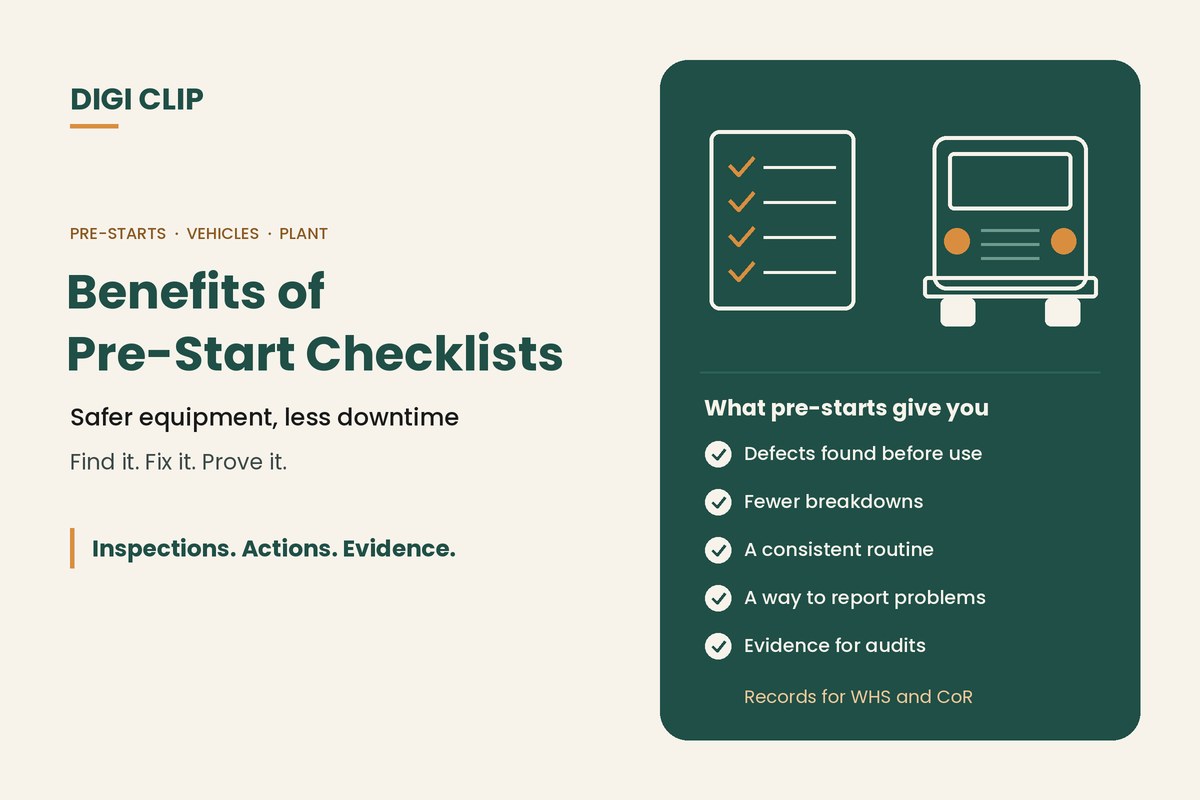
- Pre-starts catch defects before equipment is used, when they’re cheapest to fix.
- They give operators a clear, consistent routine and a way to report problems.
- Completed checks are evidence of how you manage plant and vehicle risks under WHS laws and chain of responsibility.
- The benefit depends on follow-up: a reported defect still has to be fixed.
- Digital pre-starts add photos, time and location stamps, and tracked actions.
Benefits of pre-start checklists
| Benefit | How it helps |
|---|---|
| Safer equipment | Faulty brakes, leaks, damaged guards or missing safety devices are found before the equipment is used. |
| Less downtime | Small problems, like a weeping hose or a worn tyre, are fixed before they turn into breakdowns. |
| Lower repair costs | Early repairs are usually cheaper than repairs after a failure, and they reduce secondary damage. |
| Consistent routine | Every operator checks the same items in the same order, regardless of experience. |
| A way to speak up | Operators have a simple, expected way to report problems instead of mentioning them in passing. |
| Evidence | Completed checks show that equipment was inspected and what was found, which matters after an incident or during an audit. |
| Better maintenance planning | Recurring defects on a machine or vehicle show where servicing or replacement is due. |
See also the importance of pre-starts in workplace safety.
What a pre-start checklist should include
Base each checklist on the manufacturer’s instructions and the way the equipment is used. Most pre-starts cover:
- Walk-around: visible damage, leaks, loose or missing parts
- Fluids: oil, coolant, hydraulic fluid and fuel
- Tyres, wheels or tracks: condition, pressure and wheel nuts
- Brakes and steering: function and warning lights
- Lights, alarms and horn: including reversing alarms and beacons
- Safety devices: seatbelts, guards, interlocks, emergency stops and fire extinguishers
- Attachments and loads: hitches, couplings, forks and load restraint
- Sign-off: who checked it, when, and whether it’s safe to use
For equipment-specific examples, see our truck pre-start checklist app, light vehicle pre-start checklist, plant pre-start checklist and forklift pre-start checks.
Paper vs digital pre-starts
| Capability | Paper pre-start book | Digital pre-start |
|---|---|---|
| Seen by supervisors | When the book is handed in | When the form is submitted |
| Photos of defects | No | Yes |
| Time and location | Handwritten, if at all | Each form is time-stamped and location-stamped |
| Defect follow-up | Depends on someone reading the book | Failed items create assigned actions |
| Finding old records | Searching through books | Stored centrally and exported to PDF or Excel |
We compare the two in more detail in pre-start checklist books vs digital pre-starts.
Pre-starts and your legal duties
Under the model Work Health and Safety laws, businesses must manage the risks of plant and vehicles used for work, so far as is reasonably practicable. The model Code of Practice for managing the risks of plant in the workplace describes inspection and maintenance as part of that. For heavy vehicles, the Heavy Vehicle National Law adds chain of responsibility duties, including for vehicle standards and maintenance, in participating states and territories.
No law prescribes one pre-start form, but a documented pre-start routine, with defects followed up, is one of the most practical ways to show you are managing these risks. See our guide to chain of responsibility evidence.
Getting pre-starts right
- Write checklists per equipment type. Use the manufacturer’s instructions and your own incident history.
- Keep them short. Focus on items that affect safety and can be checked in a few minutes.
- Train operators. Show what a fail looks like and what to do when they find one.
- Set a clear rule for defects. Decide which items mean the equipment is tagged out until repaired.
- Follow up every defect. Assign it, fix it and record the repair.
- Review the records. Look for repeat defects and missed checks, and act on them.
Pre-starts with DIGI CLIP
With DIGI CLIP, operators complete pre-starts on a phone or tablet, with photos of any defects and a signature. Each form is location- and time-stamped. A “No”, “Not OK” or “At Risk” answer creates an action in the Action Log, assigned and tracked to close-out with evidence. Checks can be completed without coverage and submitted with a tap once back online, and recurring checks send reminders when they’re due. For help choosing a tool, see our inspection checklist app guide.
Illustrative scenario: a leak found before the shift
At a civil contractor’s yard, an operator’s pre-start on a loader records a weeping hydraulic fitting, with a photo. The answer creates an action for the workshop, the loader is tagged out, and a fitter replaces the fitting before mid-morning. The action is closed out with a photo of the repair, and the loader goes back to work the same day.
This scenario is illustrative. It shows how a business could use DIGI CLIP and is not an account of a specific customer.
Put Pre-Starts on Every Operator’s Phone
Replace pre-start books with checks your team completes in minutes, and see defects land in the Action Log, ready to fix and prove.
Start Your 14-Day Free TrialNo credit card required. Set up in minutes.
Frequently asked questions
What are the benefits of pre-start checklists?
They find defects before equipment is used, reduce breakdowns and repair costs, give operators a consistent routine and a way to report problems, and provide evidence that equipment was checked.
Are pre-start checklists a legal requirement in Australia?
WHS laws require businesses to manage the risks of plant and vehicles, and heavy vehicle chain of responsibility adds duties for vehicle standards and maintenance. No law prescribes one pre-start form, but a documented pre-start routine is a practical way to show you are managing those risks.
What should a pre-start checklist include?
A walk-around for damage and leaks, fluids, tyres or tracks, brakes and steering, lights and alarms, safety devices, attachments and loads, and a sign-off showing who checked it and whether it is safe to use.
How long should a pre-start take?
Usually a few minutes. Keep the checklist focused on items that affect safety so operators complete it properly rather than rushing it.
What happens when a pre-start finds a defect?
The defect should be reported, assessed and fixed, with equipment tagged out if it is unsafe. In DIGI CLIP, a failed item creates an action in the Action Log that is tracked to close-out with evidence.
Can pre-starts be done on a phone without coverage?
Yes. In DIGI CLIP, pre-starts can be completed without coverage, saved to the Offline Folder and submitted with a tap once the device is back online.
About DIGI CLIP Mobile Forms
DIGI CLIP is an Australian-built mobile checklist and inspection platform. Inspections. Actions. Evidence. Teams complete checks on a phone or tablet, turn defects into assigned actions, and keep the proof that each one was fixed and verified.
See our Form Library for ready-made templates.