Last updated:
Cold storage safety and compliance covers the checks that keep people safe and products in range in freezers, cool rooms and chilled warehouses: temperature monitoring, cold room entry and escape, forklift and floor safety in the cold, refrigeration plant, hygiene and pest control, and the records that show it was all done.
Cold Storage and Warehousing: Safety, Temperature Control and Compliance Checks
Cold storage combines the usual warehouse risks with a few of its own: extreme cold, icy floors, doors that must open from the inside, refrigeration plant and products that can spoil in hours if temperatures drift. Customers and regulators also expect records that prove the cold chain held. This guide covers the key hazards, the daily and weekly checks that matter, and how to keep temperature and safety records that stand up.
Key points
- Record temperatures at set times and act fast when they drift.
- Cold rooms need working inside releases, alarms and lighting.
- Manage cold exposure with PPE, time limits and warm-up breaks.
- Icy floors, condensation and forklifts are a risky mix.
- Records should show both the reading and what was done about problems.
Cold storage hazards and controls
| Hazard | Key controls |
|---|---|
| Cold exposure | Insulated PPE, time limits, warm-up breaks, training on cold stress signs |
| Being trapped in a cold room | Inside door releases, alarms, lighting, check-in and check-out procedures |
| Slips on ice and condensation | Floor checks, de-icing, door seals and heater strips maintained, suitable footwear |
| Forklifts in the cold | Pre-starts, battery care, speed limits, pedestrian separation, clear visibility at doors |
| Refrigeration plant | Maintenance by competent technicians, leak detection, emergency procedures for refrigerant leaks |
| Racking and stacking | Racking inspections, safe stacking, ice build-up removed |
See our guides to warehouse safety hazards and forklift pre-start checks.
Temperature control and records
Under the Food Standards Code, potentially hazardous food should be kept at 5°C or below, and frozen food should stay frozen. Many businesses and customers set tighter ranges, and pharmaceuticals and other products have their own requirements. Good temperature control means:
- recording temperatures at set times, and checking data loggers or alarms work
- using calibrated thermometers and probes
- checking product temperatures on receipt and dispatch
- having a clear procedure for out-of-range readings, including who is told and what happens to product
- keeping records that show both the reading and the action taken
See our guides to food safety checklists and refrigerated truck pre-trips.
Daily and weekly checks
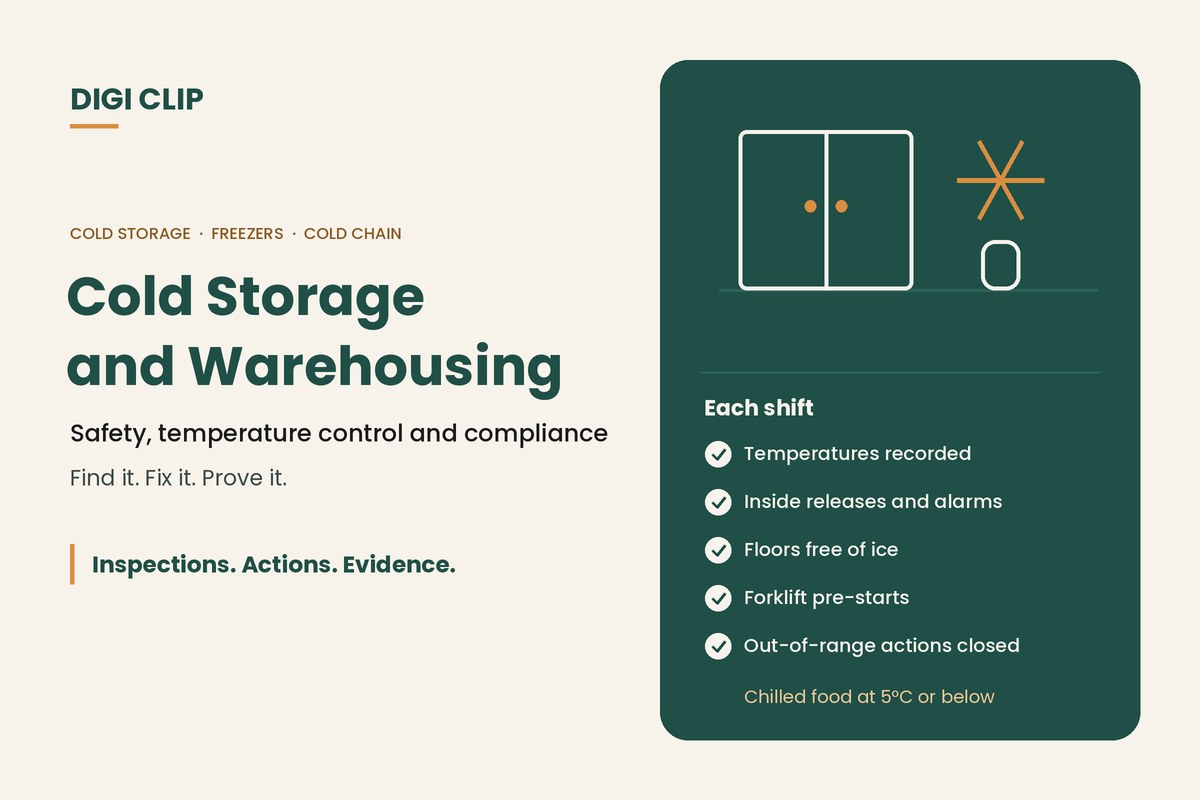
- Each shift: cold room and freezer temperatures, alarms, door seals and closers, floor condition, forklift pre-starts.
- Daily: inside release and alarm test where required by your procedures, housekeeping, spills and ice build-up.
- Weekly: racking condition, evaporators and drains, pest control stations, PPE stock and condition.
- As scheduled: refrigeration plant servicing, thermometer calibration and emergency drills.
Setting up cold storage checks
- List your cold areas. Record each freezer, cool room and chilled zone with its required temperature range.
- Set recording times. Decide when temperatures are checked and who does it.
- Write the out-of-range procedure. Spell out what staff do and who they tell when a reading is out of range.
- Add safety checks. Include door releases, alarms, floors, forklifts and PPE.
- Use reminders. Set recurring checks so nothing is missed on busy shifts.
- Review the records. Look for patterns such as a room that keeps running warm, and fix the cause.
Cold storage checks with DIGI CLIP
With DIGI CLIP, staff record temperatures and complete cold room safety checks on a phone or tablet, with photos. Each form is location- and time-stamped, and recurring checks send reminders when they’re due. An out-of-range reading or failed safety item creates an action in the Action Log, so it’s assigned and closed out with evidence. Records export to PDF or Excel for customers and auditors.
Illustrative scenario: a freezer running warm
At a cold storage warehouse, the 6am check records a freezer at −12°C against a target of −18°C. The reading creates an action in DIGI CLIP for the maintenance lead. A refrigeration technician clears an iced-up evaporator that morning, the product temperatures are checked and recorded, and the action is closed out with the new reading.
This scenario is illustrative. It shows how a business could use DIGI CLIP and is not an account of a specific customer.
Keep the Cold Chain on Record
Put temperature logs and cold room checks on your team’s phones and see problems land in the Action Log, ready to fix and prove.
Start Your 14-Day Free TrialNo credit card required. Set up in minutes.
Frequently asked questions
What are the main hazards in cold storage?
Cold exposure, being trapped in a cold room, slips on ice and condensation, forklifts operating in the cold, refrigeration plant and refrigerant leaks, and racking and stacking.
What temperature should chilled and frozen food be stored at?
Potentially hazardous chilled food should be kept at 5°C or below, and frozen food should stay frozen. Many businesses and customers set tighter ranges.
How often should cold room temperatures be recorded?
At set times each shift, or as required by your food safety program and customers, with data loggers and alarms checked regularly.
What safety features should a cold room have?
An inside door release, an alarm, lighting, and procedures for checking people in and out. These should be checked regularly to confirm they work.
What should happen when a temperature is out of range?
Follow your procedure: tell the right person, check product temperatures, decide what happens to affected stock, fix the cause, and record the reading and actions taken.
Can cold storage checks be recorded on a phone?
Yes. In DIGI CLIP, temperature logs and cold room checks are completed on a phone or tablet, and out-of-range readings become actions in the Action Log.
About DIGI CLIP Mobile Forms
DIGI CLIP is an Australian-built mobile checklist and inspection platform. Inspections. Actions. Evidence. Teams complete checks on a phone or tablet, turn defects into assigned actions, and keep the proof that each one was fixed and verified.
See our Form Library for ready-made templates.