
Last updated:
A safety-first culture is a workplace where people at every level treat safety as part of how the work gets done, not an extra task. Workers feel able to speak up about hazards and mistakes, leaders act on what they hear, and problems are followed through to a fix. Psychological safety, the confidence that speaking up won’t be punished, sits at its core.
Building a Safety-First Culture: Psychological Safety, Measurement and Digital Tools
Policies and procedures set the rules, but culture decides whether they’re followed when no one is watching. A strong safety culture shows up in small things: a worker who stops a job because something doesn’t look right, a near miss reported instead of hidden, a supervisor who fixes a problem the same day. This guide covers what a safety-first culture looks like, why psychological safety matters, how to measure progress, and how digital tools help make safe behaviour the easy option.
Key points
- Culture is what people do when no one is watching.
- People only report hazards and mistakes when they feel safe to speak up.
- Psychosocial hazards must be managed under WHS laws.
- Measure leading indicators, not just injuries.
- Acting visibly on reports is what builds trust.
What a safety-first culture looks like
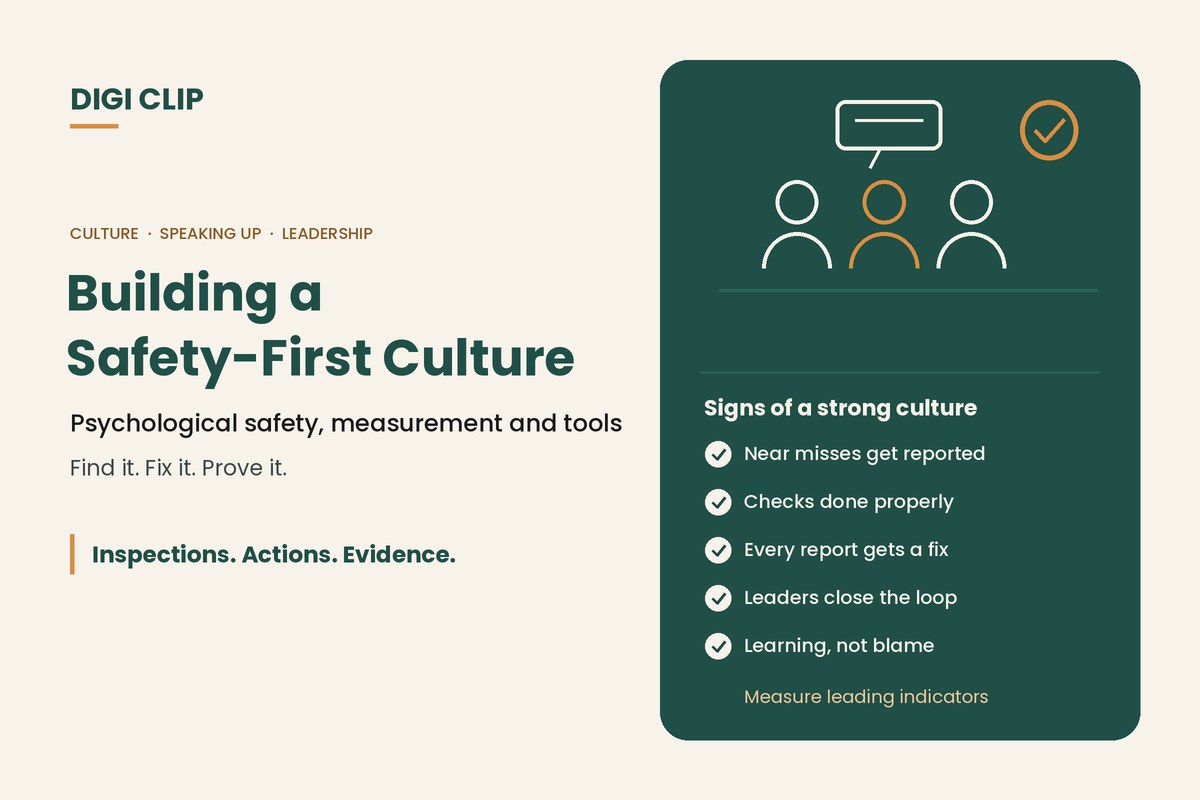
| Weak culture | Safety-first culture |
|---|---|
| Near misses go unreported | Near misses are reported and discussed |
| Checks are ticked without looking | Checks are done properly and problems recorded |
| Reports disappear without a response | Every report gets a response and a fix |
| Safety is the safety officer’s job | Leaders and workers share ownership |
| Blame follows incidents | Incidents are investigated to fix systems |
Psychological safety
Psychological safety is the shared belief that it’s safe to speak up, ask questions, raise concerns or admit mistakes without being punished or embarrassed. Without it, hazards stay hidden and near misses go unreported. With it, problems surface early, when they’re cheapest and easiest to fix.
It also links to legal duties. WHS regulations require businesses to manage psychosocial hazards, such as high job demands, low support, poor workplace relationships, bullying and harassment, in the same way as physical hazards. Safe Work Australia’s model Code of Practice on managing psychosocial hazards at work gives guidance.
How leaders build psychological safety
- Thank people for reporting, even when the news is bad
- Ask for input before making decisions that affect the work
- Focus investigations on systems, not blame
- Show what changed as a result of reports
- Admit your own mistakes
Measuring safety culture and its value
Injury rates alone are lagging indicators: they tell you what already went wrong. Leading indicators show whether the culture is heading the right way:
| Indicator | What it tells you |
|---|---|
| Hazard and near miss reports | Whether people are speaking up |
| Inspection and pre-start completion | Whether checks are actually being done |
| Action close-out time | Whether reports lead to fixes |
| Overdue actions | Where follow-up is breaking down |
| Toolbox talk attendance and issues raised | Whether workers are engaged |
| Injury rates such as LTIFR | Longer-term outcomes |
The value of a strong safety culture shows up in fewer injuries and incidents, less downtime and rework, lower workers’ compensation costs, and better retention and reputation. To estimate the return for your business, compare the cost of your safety program with the costs of incidents it prevents, such as lost time, repairs, claims and disruption, using your own records rather than industry averages.
Building a safety-first culture
- Lead visibly. Leaders walk the floor, join toolbox talks and follow safety rules themselves.
- Make reporting easy. Give everyone a quick way to report hazards and near misses, on the spot.
- Respond to every report. Acknowledge it, assign an owner and fix it.
- Close the loop. Tell people what changed because they spoke up.
- Learn without blame. Investigate incidents to fix systems, and share lessons.
- Measure and review. Track leading indicators and act on trends.
How digital tools support safety culture
Digital tools can’t create culture, but they remove friction. With DIGI CLIP, anyone can report a hazard or near miss on their phone in under a minute, with a photo. Each form is location- and time-stamped. Reports become actions in the Action Log, assigned and closed out with evidence, so the person who reported can see it was fixed. Dashboards show leading indicators like completion rates and open actions, and Safety Tracker records incidents, investigations and LTIFR.
Illustrative scenario: closing the loop
At a transport depot, a new driver reports that a yard light near the refuelling bay is out. The report creates an action for the facilities officer, the light is replaced the next day, and the action is closed out with a photo. At the next toolbox talk, the supervisor mentions the fix and thanks the driver, and near miss reports at the depot rise over the following month.
This scenario is illustrative. It shows how a business could use DIGI CLIP and is not an account of a specific customer.
See also our guides to effective toolbox talks, gemba walks and workplace safety hazards.
Make Speaking Up Easy
Put hazard and near miss reporting on everyone’s phone and see reports land in the Action Log, ready to fix and prove.
Start Your 14-Day Free TrialNo credit card required. Set up in minutes.
Frequently asked questions
What is a safety-first culture?
A workplace where people at every level treat safety as part of how the work gets done, feel able to speak up about hazards and mistakes, and see problems followed through to a fix.
What is psychological safety at work?
The shared belief that it’s safe to speak up, ask questions, raise concerns or admit mistakes without being punished or embarrassed.
Are psychosocial hazards covered by WHS laws?
Yes. WHS regulations require businesses to manage psychosocial hazards, such as high job demands, low support, bullying and harassment, in the same way as physical hazards.
How do you measure safety culture?
Track leading indicators such as hazard and near miss reports, inspection completion, action close-out times and overdue actions, alongside lagging indicators such as injury rates.
How do you work out the return on safety?
Compare what your safety program costs with the costs of incidents it prevents, such as lost time, repairs, claims and disruption, using your own records.
Can digital tools improve safety culture?
They can make reporting quicker and show people their reports lead to fixes, which builds trust. Culture still depends on how leaders respond.
About DIGI CLIP Mobile Forms
DIGI CLIP is an Australian-built mobile checklist and inspection platform. Inspections. Actions. Evidence. Teams complete checks on a phone or tablet, turn defects into assigned actions, and keep the proof that each one was fixed and verified.
See our Form Library for ready-made templates.






