
Last updated:
A biological hazard is any living organism, or substance produced by one, that can harm people at work. It includes bacteria, viruses, fungi and moulds, parasites, and material such as blood, body fluids, animal products and contaminated water or soil. Workers can be exposed by breathing, swallowing, skin contact, cuts and needlestick injuries, or animal and insect bites.
Biological Hazards in the Workplace: Types, Risk Groups and Practical Controls
Biological hazards aren’t only a concern for hospitals and laboratories. Farm workers, meat processors, cleaners, plumbers, waste collectors, childcare staff and anyone working with water systems or soil can be exposed. Because many biological hazards are invisible, controls rely on good systems and consistent checks. This guide covers the main types, how risk groups work, where exposure happens, and the controls that keep people safe.
Key points
- Biological hazards include bacteria, viruses, fungi, parasites and contaminated materials.
- Microorganisms are classed into four risk groups, from low to high risk.
- Exposure happens through breathing, swallowing, skin contact, cuts and bites.
- Manage them like any other WHS hazard: identify, assess, control and review.
- Hygiene, cleaning, equipment and PPE only work if they are checked and maintained.
Types of biological hazards
- Bacteria: such as Legionella in water systems, Salmonella in food and Coxiella burnetii, which causes Q fever, from livestock.
- Viruses: such as influenza, hepatitis B and C, and HIV, which can spread through air, blood or body fluids.
- Fungi and moulds: which can cause allergic and respiratory illness in damp buildings or when handling mouldy materials.
- Parasites: such as worms and protozoa from animals, soil or contaminated water.
- Blood and body fluids: in healthcare, first aid, cleaning and waste handling, including needlestick injuries.
- Animal products and bites: from livestock, animal tissue, droppings, and insect or animal bites.
Risk groups explained
Microorganisms are commonly classified into four risk groups, for example in Australian Standard AS/NZS 2243.3 for laboratories. The higher the group, the greater the risk and the stricter the controls:
| Risk group | Risk to individuals | Risk to the community |
|---|---|---|
| Group 1 | Low | Low: unlikely to cause disease |
| Group 2 | Moderate | Limited: effective treatment or prevention usually available |
| Group 3 | High | Limited: can cause serious disease, but spread is limited |
| Group 4 | High | High: serious disease that spreads readily, often with no treatment |
Most workplaces outside laboratories won’t classify organisms formally, but the idea is useful: the more serious and transmissible the hazard, the stronger the controls need to be.
Where workers are exposed
- Agriculture and meat processing: livestock, animal tissue and birthing products, dust and manure
- Healthcare, aged care and childcare: blood, body fluids, sharps and respiratory infections
- Cleaning and waste: sharps, body fluids, mould and contaminated waste
- Plumbing and water systems: sewage and cooling towers or warm-water systems
- Construction and demolition: contaminated soil, bird and bat droppings, and mould
- Food service: foodborne bacteria and viruses
How to manage biological hazards
- Identify the hazards. List the tasks, materials, animals, people and places where workers could be exposed.
- Assess the risks. Consider how workers could be exposed, how often and how serious the illness could be.
- Control the risks. Use the hierarchy of controls, starting with removing or isolating the source.
- Consult and train workers. Explain the hazards, the controls and how to report exposures.
- Respond to exposures. Have a plan for first aid, medical follow-up and reporting, for example after a needlestick injury.
- Monitor and review. Check that controls are working and review after incidents, changes or new information.
Practical controls
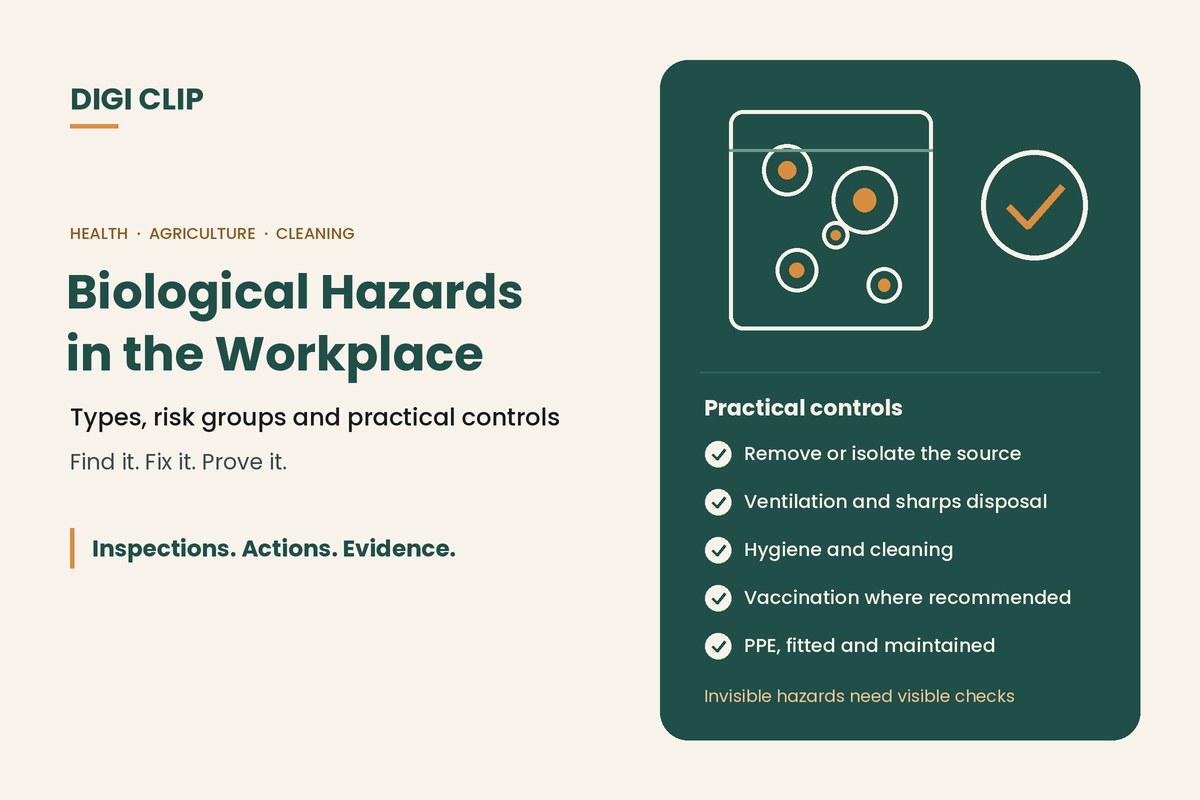
- Remove or isolate the source: fix leaks and damp, remove contaminated material, and restrict access to affected areas.
- Engineering controls: ventilation, sharps containers, safety-engineered needles and water system treatment.
- Hygiene and cleaning: hand washing, cleaning and disinfection schedules, and separate eating areas.
- Safe work procedures: spill clean-up, waste handling and animal handling procedures.
- Vaccination: where recommended for the work, such as hepatitis B for some healthcare and cleaning roles, or Q fever for at-risk agricultural and meat workers.
- PPE: gloves, eye protection, respiratory protection and protective clothing, fitted and maintained. See our guide to personal protective equipment.
Checking biological controls
Many biological controls are routine tasks that are easy to let slip: cleaning schedules, hand-wash stations stocked, sharps containers not overfilled, water system checks and PPE supplies. With DIGI CLIP, these checks are completed on a phone or tablet with photos, and each form is location- and time-stamped. A failed item creates an action in the Action Log, so it is assigned and closed out with evidence.
Illustrative scenario: an overfilled sharps container
During a weekly hygiene check at a cleaning contractor’s site, a supervisor finds a sharps container in a public bathroom filled past the line. She fails the item in DIGI CLIP with a photo, which creates an action for the site manager. The container is replaced that day, collection frequency is increased, and the action is closed out with a photo of the new container.
This scenario is illustrative. It shows how a business could use DIGI CLIP and is not an account of a specific customer.
See also our guides to workplace chemical hazards, workplace safety hazards and pest monitoring and biosecurity forms.
Keep Biological Controls Checked
Put hygiene and biological hazard checks on your team’s phones and see problems land in the Action Log, ready to fix and prove.
Start Your 14-Day Free TrialNo credit card required. Set up in minutes.
Frequently asked questions
What is a biological hazard?
A biological hazard is any living organism, or substance produced by one, that can harm people at work. It includes bacteria, viruses, fungi and moulds, parasites, and material such as blood, body fluids, animal products and contaminated water or soil.
What are the four biological risk groups?
Group 1 is low risk to individuals and the community. Group 2 is moderate individual risk with limited community risk. Group 3 is high individual risk with limited community risk. Group 4 is high risk to both, often with no effective treatment.
Which jobs have the highest exposure to biological hazards?
Healthcare, aged care, childcare, laboratories, agriculture, meat processing, cleaning, waste management, plumbing and some construction work, depending on the tasks and materials involved.
How are biological hazards controlled at work?
By removing or isolating the source, engineering controls such as ventilation and sharps containers, hygiene and cleaning, safe work procedures, vaccination where recommended, and PPE.
What should happen after a needlestick injury?
Provide first aid straight away by washing the area, report it, and seek prompt medical assessment. The business should then investigate how it happened and improve controls.
Can biological hazard checks be recorded digitally?
Yes. In DIGI CLIP, hygiene, cleaning and biological hazard checks are completed on a phone or tablet with photos, and failed items become actions in the Action Log.
About DIGI CLIP Mobile Forms
DIGI CLIP is an Australian-built mobile checklist and inspection platform. Inspections. Actions. Evidence. Teams complete checks on a phone or tablet, turn defects into assigned actions, and keep the proof that each one was fixed and verified.
See our Form Library for ready-made templates.






