Last updated:
Safe container packing is loading a shipping container so the cargo is evenly distributed, properly restrained and within weight limits, and the container’s declared weight is accurate. Poorly packed or overweight containers can shift, roll or overload trucks on the road, so packers, consignors and transport operators all have chain of responsibility duties.
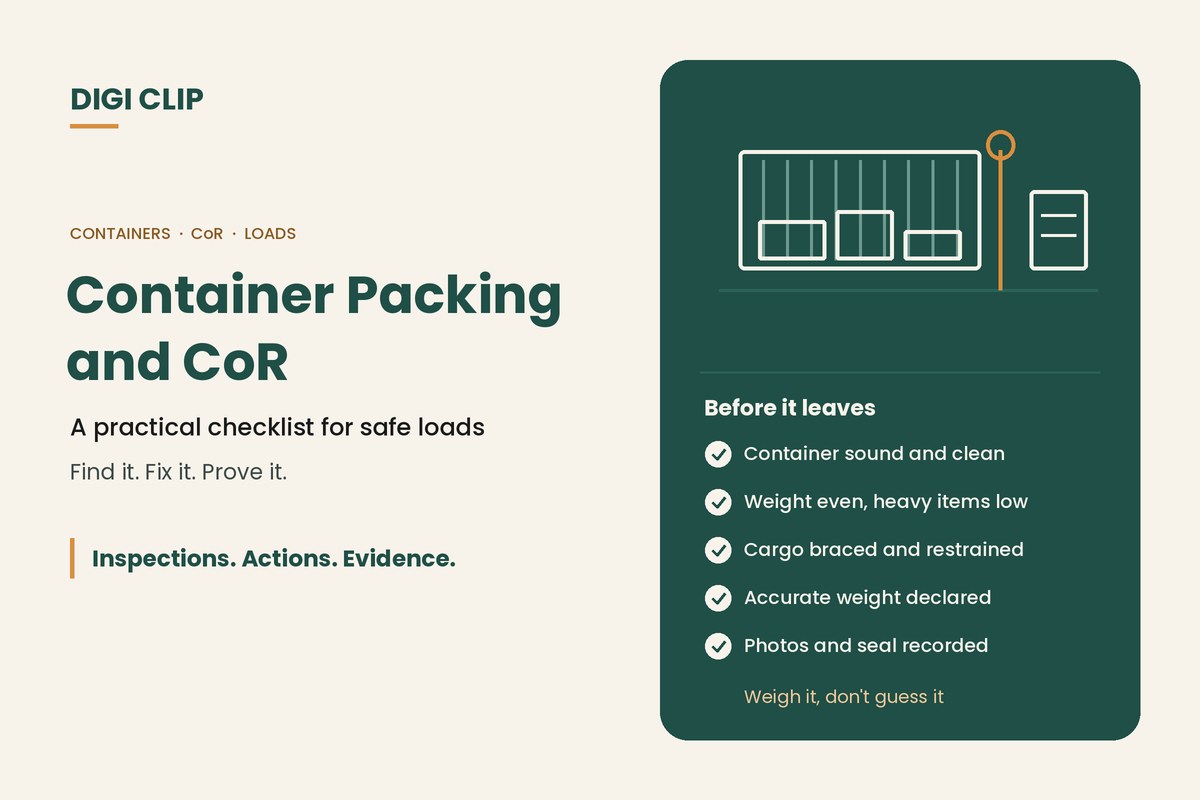
Container Packing and Chain of Responsibility: A Practical Checklist
A container can look fine from the outside and still be a problem: heavy cargo stacked at one end, loads that aren’t braced, or a declared weight that doesn’t match reality. On the road, that can mean overloaded axles, poor handling and rollovers. This guide covers the risks, the CoR duties, what to check when packing and receiving containers, and the lessons that come up again and again in cargo transport incidents.
Key points
- Packers and consignors share responsibility for safe loads under chain of responsibility.
- Freight containers moved by road need an accurate container weight declaration.
- Export containers also need a verified gross mass (VGM) under shipping rules.
- Distribute weight evenly and restrain cargo against movement in every direction.
- Photos and records at packing show the container left in a safe condition.
Risks of poorly packed containers
- Overweight or misdeclared containers: overloaded axles, damage to vehicles and roads, and handling problems.
- Uneven weight distribution: heavy cargo at one end or side can cause rollovers and unstable lifts.
- Unrestrained cargo: loads that shift in transit change the vehicle’s balance and can burst doors.
- Unloading injuries: cargo that has moved can fall when doors are opened.
- Hazardous goods: incorrect segregation, labelling or documentation.
CoR duties and weight declarations
Under the Heavy Vehicle National Law, everyone in the chain who influences transport, including consignors, packers, loading managers, loaders and operators, must make sure, so far as is reasonably practicable, that their activities are safe. For freight containers carried by heavy vehicles, the law requires a container weight declaration: a declaration of the weight of the container and its contents that the operator can rely on. It must be accurate.
For export containers, international shipping rules under SOLAS also require a verified gross mass (VGM) before a container is loaded onto a ship. The IMO/ILO/UNECE Code of Practice for Packing of Cargo Transport Units (the CTU Code) gives detailed guidance on safe packing. Check the requirements that apply to your operations.
Container packing checklist
| Stage | What to check |
|---|---|
| Before packing | Container sound, clean, dry and undamaged; doors and seals working; correct container type |
| Planning | Weight within container rating; heavy items low and centred; hazardous goods segregated |
| Packing | Weight distributed evenly along the length and width; gaps filled; cargo braced, blocked or lashed |
| Documentation | Accurate weight recorded; container weight declaration and VGM where required; dangerous goods documents |
| Closing | Photos of the packed load; doors closed; seal applied and number recorded |
| Receiving | Seal intact and matches paperwork; check for shifted cargo before opening doors fully |
Putting container checks into practice
- Inspect the container. Check its condition before anything goes in.
- Plan the load. Work out weight and placement, keeping heavy items low and centred.
- Pack and restrain. Fill gaps and brace or lash cargo so it can’t move in any direction.
- Weigh and declare. Record an accurate weight and complete the container weight declaration and VGM where required.
- Photograph and seal. Take photos of the packed load and record the seal number.
- Review problems. Follow up any issues reported by drivers or receivers and fix the cause.
Lessons from cargo transport incidents
- Declared weights aren’t always right: weigh rather than estimate, and question declarations that don’t look right.
- Heavy items need securing, not just placing: dense cargo such as machinery, steel or bagged goods can shift under braking.
- Drivers are the last check: give them a way to report concerns and a right to refuse an unsafe load.
- Problems repeat without follow-up: recurring issues with a supplier or packer need to go back to the source.
Container checks on the phone
With DIGI CLIP, packers, loaders and drivers complete container checks on a phone, with photos of the container, the packed load and the seal. Each form is location- and time-stamped. Problems become actions in the Action Log, closed out with evidence, and records can be exported as part of your chain of responsibility evidence.
Illustrative scenario: a shifted load
A receiver opening a container at a warehouse finds pallets have shifted against the doors. The team opens the doors carefully, records the problem in DIGI CLIP with photos, and an action goes to the freight forwarder. The packing site adds bracing requirements to its checklist, and the action is closed out with photos of the next correctly braced load.
This scenario is illustrative. It shows how a business could use DIGI CLIP and is not an account of a specific customer.
See also our guides to chain of responsibility evidence and load restraint on flatbeds.
Record Every Container You Pack
Put container checks on your team’s phones and see problems land in the Action Log, ready to fix and prove.
Start Your 14-Day Free TrialNo credit card required. Set up in minutes.
Frequently asked questions
Who is responsible for safe container packing?
Everyone in the chain who influences the load, including consignors, packers, loading managers, loaders and transport operators, under chain of responsibility.
What is a container weight declaration?
A declaration of the weight of a freight container and its contents, which the Heavy Vehicle National Law requires for freight containers carried by heavy vehicles. It must be accurate.
What is VGM?
Verified gross mass, the confirmed total weight of a packed export container, which international shipping rules under SOLAS require before the container is loaded onto a ship.
How should weight be distributed in a container?
Evenly along the length and width, with heavy items low and centred, and within the container’s rated capacity.
What should be checked when receiving a container?
That the seal is intact and matches the paperwork, and that cargo hasn’t shifted, by opening doors carefully in case cargo is leaning against them.
Can container packing checks be recorded on a phone?
Yes. In DIGI CLIP, container checks are completed on a phone with photos, and problems become actions in the Action Log.
About DIGI CLIP Mobile Forms
DIGI CLIP is an Australian-built mobile checklist and inspection platform. Inspections. Actions. Evidence. Teams complete checks on a phone or tablet, turn defects into assigned actions, and keep the proof that each one was fixed and verified.
See our Form Library for ready-made templates.