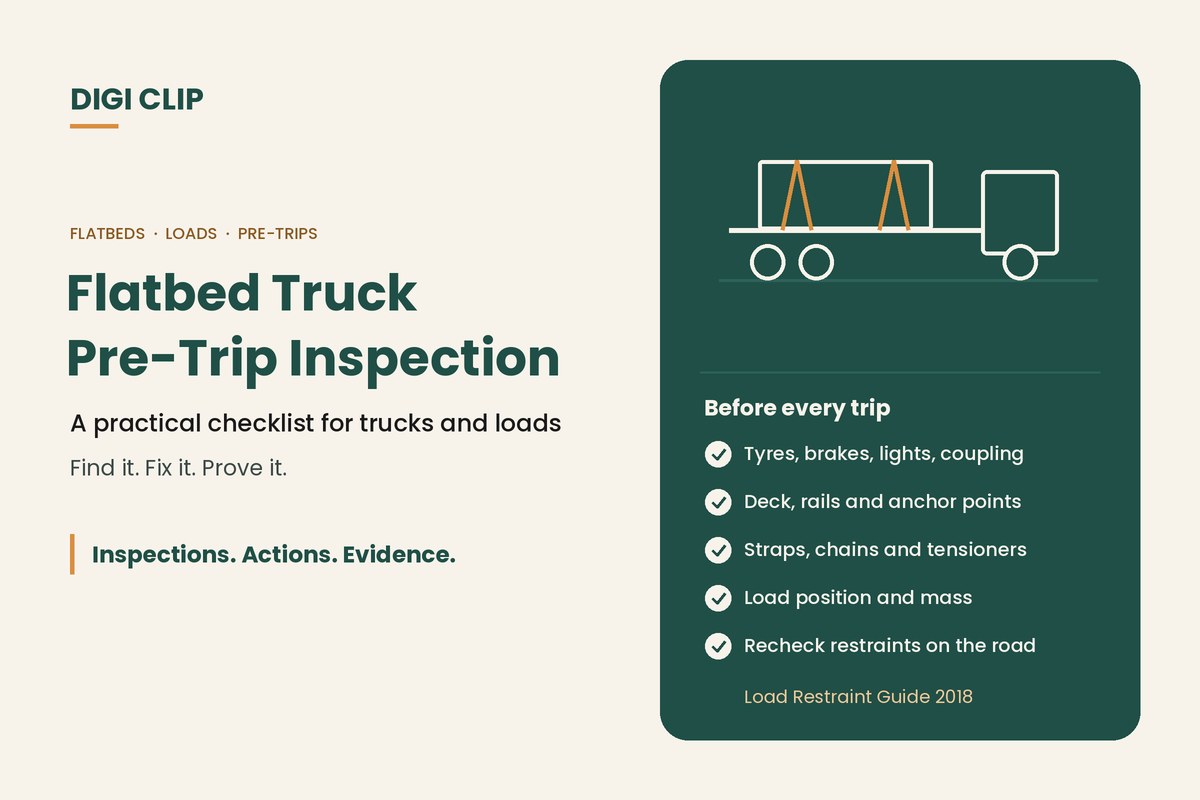
A flatbed truck pre-trip inspection is the check a driver completes before each trip to confirm the truck, trailer deck and load restraint equipment are safe: tyres, brakes, lights, coupling, deck condition, straps, chains and gates, and how the load is positioned and secured. On a flatbed, the load restraint is as important as the truck itself.
Flatbed Truck Pre-Trip Inspection: A Practical Checklist
Flatbeds carry the loads other trucks can’t: steel, timber, machinery, building materials and oversize freight. With no walls or roof, everything depends on the deck, the restraint equipment and how the load is secured. This guide covers what to check on the truck, the deck and the load, the load restraint performance standards, and how to keep pre-trip records.
Key points
- Check the truck, the deck and the restraint equipment before every trip.
- The Load Restraint Guide 2018 sets the performance standards loads must meet.
- Straps, chains and dunnage wear out and need checking before use.
- Recheck restraints early in the trip and after load changes.
- Chain of responsibility duties apply to everyone who loads and schedules.
Truck and trailer checks
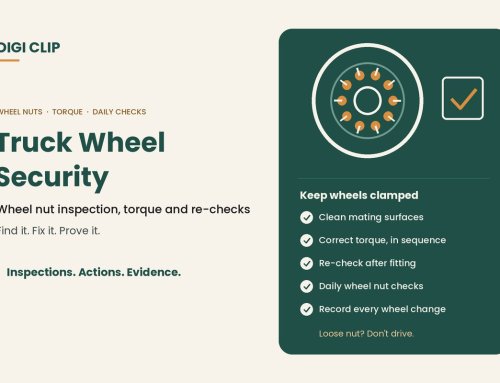
- Tyres: pressure, tread, damage, and wheel nuts secure. See our guide to truck wheel security.
- Brakes: air pressure build-up, leaks, and park brake holding
- Lights and reflectors, including marker lights and any oversize signs or flags
- Coupling: fifth wheel or drawbar locked, safety chains and air and electrical lines connected
- Fluids and leaks: engine oil, coolant, fuel and hydraulics
- Cabin: mirrors, windscreen, horn, seatbelt, fire extinguisher and first aid kit
Load restraint checks
| Item | What to check |
|---|---|
| Deck | Floor boards or plates sound, no holes, rot or loose sections |
| Anchor points and rails | Rated, undamaged, not bent or cracked |
| Headboard and gates | Secure and rated for the load where relied on |
| Webbing straps | No cuts, burns, fraying or missing labels |
| Chains and tensioners | No stretched or cracked links, tensioners locked |
| Dunnage and edge protectors | Right size, in good condition, protecting straps from sharp edges |
| Load position | Evenly distributed, within axle mass limits, against the headboard where possible |
Load restraint performance standards
The National Transport Commission’s Load Restraint Guide 2018 sets out the performance standards a restraint system must meet. It must be able to withstand forces equal to 80% of the load’s weight forward, 50% rearward and sideways, and 20% upward. The guide also explains how to work out how many straps or chains you need for common load types. Chain of responsibility duties under the Heavy Vehicle National Law mean loaders, schedulers and consignors share responsibility for safe loading.
Running the pre-trip
- Walk around the truck. Check tyres, lights, coupling, leaks and the cabin.
- Inspect the deck. Look for damage to the floor, rails, headboard and anchor points.
- Check restraint equipment. Inspect every strap, chain, tensioner and edge protector before it’s used.
- Secure the load. Position the load correctly and apply enough restraint to meet the performance standards.
- Record the check. Note defects with photos and don’t leave until safety defects are fixed.
- Recheck on the road. Check restraints early in the trip, at rest stops and after any load change.
Pre-trip checks on the phone
With DIGI CLIP, drivers complete flatbed pre-trips on a phone, with photos of the load and any damaged equipment. Each form is location- and time-stamped. A failed item creates an action in the Action Log, so damaged straps, chains or deck sections are replaced and closed out with evidence.
Illustrative scenario: a damaged strap
Before a steel delivery, a driver checks his webbing straps in DIGI CLIP and finds one cut near the hook. He fails the item with a photo, swaps in a spare strap and bins the damaged one. The action goes to the yard manager to restock straps, and it’s closed out with a photo of the new stock.
This scenario is illustrative. It shows how a transport business could use DIGI CLIP and is not an account of a specific customer.
See also our commercial truck safety checklist.
Put Flatbed Pre-Trips on the Phone
Run pre-trip and load restraint checks on your drivers’ phones and see defects land in the Action Log, ready to fix and prove.
Start Your 14-Day Free TrialNo credit card required. Set up in minutes.
Frequently asked questions
What should a flatbed pre-trip inspection include?
Tyres, brakes, lights, coupling, leaks and the cabin, plus the deck, anchor points, headboard and gates, straps, chains, tensioners, dunnage and how the load is positioned and secured.
What are the load restraint performance standards in Australia?
Under the Load Restraint Guide 2018, a restraint system must withstand forces equal to 80% of the load’s weight forward, 50% rearward and sideways, and 20% upward.
How often should load restraints be checked during a trip?
Early in the trip, at rest stops and after any change to the load, such as a partial drop-off. Loads can settle and straps can loosen as the truck moves.
When should a webbing strap be replaced?
When it has cuts, burns, fraying, broken stitching, damaged hardware or a missing or unreadable label. Damaged straps should be removed from service.
Who is responsible for load restraint?
The driver, but not only the driver. Under chain of responsibility, loaders, schedulers, consignors and managers who influence the transport task also have duties.
Can flatbed pre-trip checks be done on a phone?
Yes. In DIGI CLIP, drivers complete pre-trip and load restraint checks on a phone with photos, and failed items become actions in the Action Log.
About DIGI CLIP Mobile Forms
DIGI CLIP is an Australian-built mobile checklist and inspection platform. Inspections. Actions. Evidence. Teams complete checks on a phone or tablet, turn defects into assigned actions, and keep the proof that each one was fixed and verified.
See our Form Library for ready-made templates.