
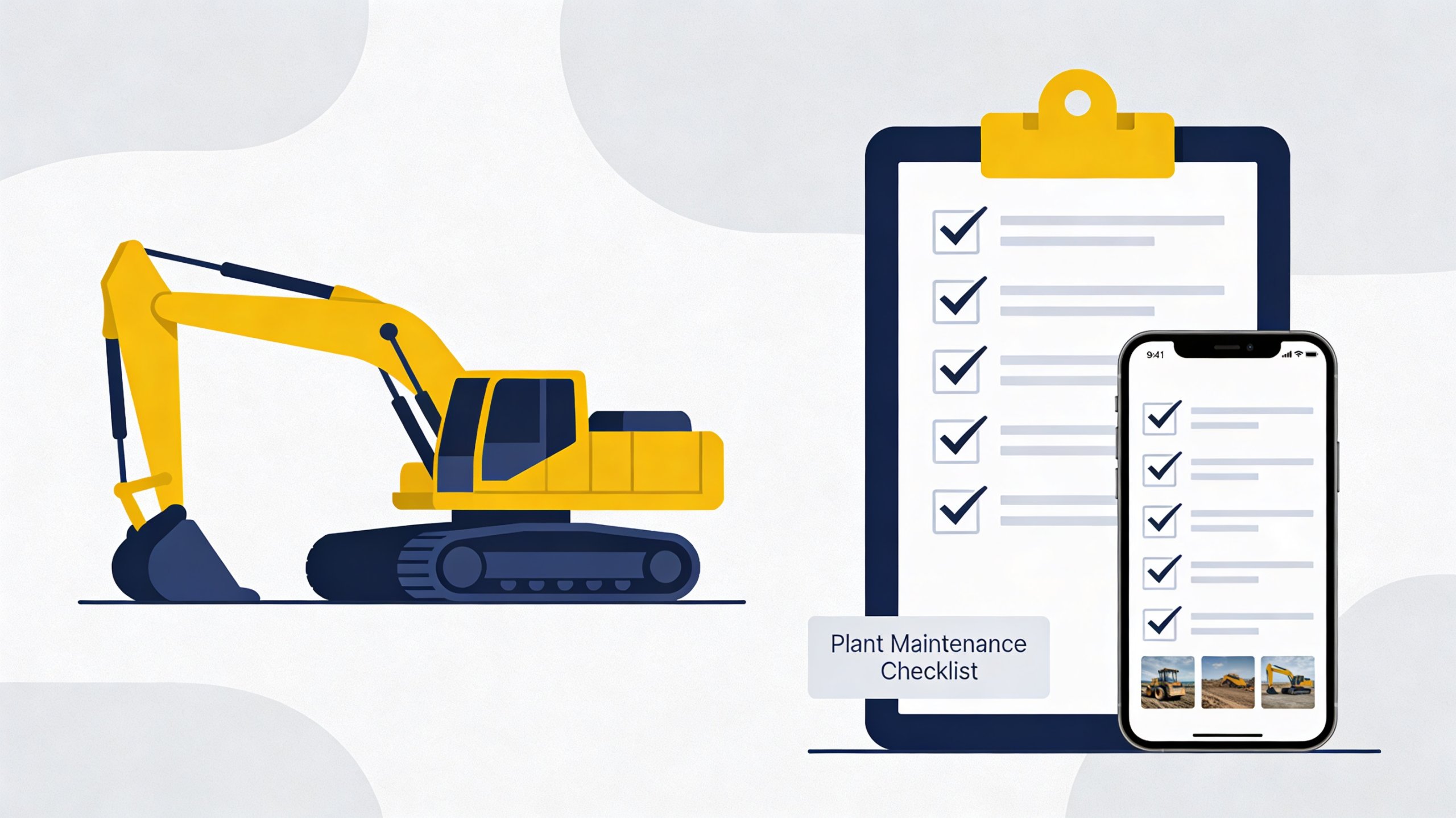
Plant machinery maintenance checklist: a structured inspection and servicing list used to identify defects early, keep equipment safe to operate, and maintain performance across electrical, engine, hydraulic, pneumatic, and mechanical systems.
Plant Machinery Maintenance Checklist: Safety Tips for Optimal Performance
What this gives you: a practical plant machinery maintenance checklist you can use daily, weekly, and pre-start—plus best-practice safety steps.
Why it matters: consistent maintenance reduces unplanned failures, controls risk, and provides stronger evidence for audits and incident investigations.
Best next step: digitise your checks so defects trigger follow-up actions, photo evidence is captured, and reporting is instant.
Plant and heavy equipment keeps projects moving—but it also introduces high-consequence risk when maintenance is rushed, inconsistent, or poorly documented. This guide upgrades your current approach with a clear, usable plant machinery maintenance checklist that supports safer operation, fewer breakdowns, and more predictable performance across electrical, hydraulic, pneumatic, and mechanical systems.
Table of Contents
- Why plant machinery maintenance matters
- Safety essentials before maintenance starts
- Plant machinery maintenance checklist (core sections)
- Best practices for plant machinery maintenance
- How often should checks be done?
- Digital vs paper: what changes?
- How to run a plant machinery maintenance checklist (step-by-step)
- Mini case study: downtime reduction
- Useful resources
- Frequently asked questions
- Conclusion
Why Plant Machinery Maintenance Matters
Regular maintenance is about more than "keeping it running". A strong maintenance program reduces the likelihood of unplanned failures, improves reliability, and supports compliance expectations for plant used in workplaces under WHS laws and codes of practice. It also lowers the risk of high-impact incidents caused by degraded components—particularly where hydraulic systems, moving parts, and electrical connections are involved.
What good maintenance protects
- People: fewer unexpected failures, safer isolation, less exposure to hazards
- Plant: longer service life, better performance, less secondary damage
- Operations: less downtime, fewer delays, improved scheduling confidence
- Compliance evidence: clearer maintenance records and defect close-out
Safety Essentials Before Maintenance Starts
Before you touch a spanner, the safety controls must be right. If your process isn't consistent, your checklist will be inconsistent too.
- Wear appropriate PPE (eye protection, gloves, hearing protection, hi-vis)
- Shut down and isolate energy sources (electrical, hydraulic, pneumatic)
- Apply lockout/tagout (LOTO) procedures where required
- Verify isolation before starting work ("try out" where applicable)
- Secure plant against movement (chocks, stands, pins, isolation)
- Use the right tools and follow manufacturer instructions
- Plan for emergencies (first aid, comms, rescue plan where relevant)
Internal tip: If you're building stronger isolation processes, link your teams to your LOTO guide: LOTOTO Procedure: Lock Out, Tag Out, Try Out.
Plant Machinery Maintenance Checklist
This plant machinery maintenance checklist is structured so it can be used as:
- a daily or pre-start inspection (operators)
- a scheduled preventive maintenance checklist (maintenance teams)
- a compliance evidence checklist (managers and auditors)
1) Electrical System Checks
- Check for loose connections, frayed wires, damaged insulation
- Inspect battery condition, corrosion, and secure mounting
- Confirm lights, alarms, indicators, and signals function correctly
- Check starter motor/alternator function (as applicable)
2) Engine and Cooling Checks
- Check engine oil level and signs of contamination
- Inspect air filter condition and replace if restricted
- Check fuel filter condition and water traps (where fitted)
- Check coolant level and inspect hoses, radiator, and clamps
- Inspect belts for wear, cracking, and correct tension
3) Hydraulic System Checks
- Check hydraulic fluid level and condition
- Inspect hoses, fittings, and cylinders for leaks or damage
- Check pumps and motors for abnormal noise or heat
- Confirm pressure relief/safety devices are functional
4) Pneumatic System Checks
- Check compressor lubrication and operational condition
- Inspect air lines, fittings, and couplings for leaks and wear
- Check air filters and moisture traps
- Test pressure relief valves and safety devices
5) Mechanical, Braking, and Moving Parts
- Inspect moving components (pins, bushes, bearings, linkages)
- Lubricate per manufacturer specs (and record it)
- Check brakes, pads, lines, and adjustment
- Check steering response and suspension condition
- Inspect guarding, access points, steps/handholds
When issues are identified during a plant machinery maintenance checklist, they should be tracked through to completion. Tools like the Action Log can help track corrective actions from assignment through to verification and close-out, with evidence attached.
Best Practices for Plant Machinery Maintenance
- Align your maintenance schedule with manufacturer guidance, hours of use, and site risk assessments.
- Train operators and maintenance personnel on both the checklist and the safe isolation procedures that sit behind it.
- Keep maintenance and repair records organised and accessible so you can demonstrate compliance and identify trends.
- Use suitable tools, parts, and competent persons for tasks, especially where high-risk plant or critical components are involved.
How Often Should a Plant Machinery Maintenance Checklist Be Done?
A practical way to run this is to split checks into tiers. This improves consistency and reduces "checkbox fatigue".
| Checklist Frequency | Who | What to focus on |
|---|---|---|
| Pre-start / Daily | Operator | Leaks, obvious damage, safety devices, lights/alarms, fluid levels, tyre/track condition |
| Weekly | Supervisor / maintenance | Lubrication, filters, battery, hoses/fittings, wear points, guarding, general condition |
| Scheduled (hours-based) | Maintenance team | Services aligned to OEM guidance, component checks, calibrations, planned parts replacement |
| Major inspections | Qualified service provider | Structural integrity, high-risk components, compliance verification, deeper teardown inspections |
If you're building a broader maintenance program, this guide on preventative maintenance using digital checklists explains how to schedule inspections and reduce unplanned downtime.
Digital Plant Machinery Maintenance Checklist vs Paper
Paper checklists often fail for predictable reasons: they go missing, they're completed late, handwriting is unclear, and "No" findings don't reliably trigger follow-up actions. Digital checklists fix the workflow.
| Paper checklist | Digital checklist (DIGI CLIP) |
|---|---|
| Easy to lose or submit late | Submitted instantly with time-stamping and central storage |
| "Defects" don't reliably become actions | Defects can trigger follow-up actions and notifications |
| Limited evidence (no photos) | Photo capture + comments + signatures for audit-ready records |
| Hard to report trends | Searchable data + reporting and analytics over time |
| No automated reminders for scheduled services | Reminders and recurring schedules reduce missed services |
If you want the "why" behind digital adoption, link this supporting post: Top 10 Pain Points Driving SMBs from Paper to Digital Safety Checklists.
How to Run a Plant Machinery Maintenance Checklist (Step-by-Step)
This is the simplest workflow that produces consistent, credible results—especially when multiple operators use the same equipment.
- Confirm the checklist version (daily/pre-start, weekly, or scheduled service).
- Isolate and make safe (shutdown, energy isolation, LOTO where required).
- Walk-around inspection first (leaks, damage, guards, access points, tyres/tracks).
- Complete system checks in order (electrical → engine → hydraulic → pneumatic → mechanical).
- Record defects clearly (what, where, severity, immediate controls applied).
- Capture evidence (photo + note + signature where required).
- Assign and track follow-up actions so defects are closed-out and verified.
- Review trends monthly (repeat defects, downtime causes, maintenance hotspots).
This plant machinery maintenance checklist approach gives you repeatable checks, better defect capture, and a clear link between inspections, actions, and long-term performance.
Mini Case Study: Reducing Downtime With Better Maintenance Evidence
Scenario: A civil contractor was experiencing repeated unplanned stoppages across two key machines due to "minor" hydraulic issues being missed or not escalated.
- Problem: paper checks were inconsistent; defects were noted but not tracked to completion
- Change: moved to a digital maintenance checklist with photo evidence and action tracking
- Outcome: earlier identification of hose wear/leaks, quicker escalation, fewer repeat failures, and clearer proof of maintenance controls
Tip: If your checklist has "No" responses, make sure they always capture a comment and photo where relevant—this is where audit-ready credibility comes from.
Useful Resources
- Safe Work Australia – Managing the Risks of Plant in the Workplace (Code of Practice)
- WorkSafe WA – Machinery and Equipment Repair and Maintenance Checklist
About DIGI CLIP Mobile Forms
DIGI CLIP is a mobile checklist and inspection app that simplifies safety, compliance, and operational reporting. Designed for industries like transport, warehousing, agriculture, and construction, DIGI CLIP replaces paper forms with real-time digital checklists. Built-in photo capture, automated alerts, geo-time stamping, and an Action Log help keep track of outstanding items.
Why Try DIGI CLIP?
Because safety actions don't count if you can't prove them. Start your free trial—no credit card needed—and see how simple compliance can be.
Frequently Asked Questions
What is a plant machinery maintenance checklist?
A plant machinery maintenance checklist is a structured inspection and servicing list used to identify defects early, keep equipment safe to operate, and maintain performance. It typically covers electrical, engine, hydraulic, pneumatic, and mechanical systems.
How often should plant machinery be inspected?
Most organisations run a tiered approach: daily pre-start checks by operators, weekly inspections by supervisors/maintenance, and scheduled servicing based on hours of use and manufacturer guidance.
What should be included in a heavy equipment maintenance checklist?
Include safety isolation steps, walk-around condition checks, fluid levels, hoses/fittings, filters, electrical systems, guards, brakes, steering, lubrication points, and defect reporting fields (with photos where possible).
How does a digital checklist improve maintenance compliance?
Digital checklists can improve consistency by standardising questions, capturing photo evidence, time-stamping submissions, and routing defects into follow-up actions that can be tracked to completion.
Do I need lockout/tagout for plant maintenance?
Where energy sources could cause unexpected movement or start-up, a lockout/tagout approach (and verification/"try out") is a proven control. Your exact requirements depend on the plant, task, and site procedures.
Can DIGI CLIP track defects found during plant maintenance checks?
Yes. DIGI CLIP can capture defects with comments and photos, then route them into an action workflow so items are assigned, progressed, and closed-out with proof.
Conclusion
A reliable plant machinery maintenance checklist is one of the simplest ways to protect your people, reduce downtime, and extend equipment life. When checks are consistent, defects are captured properly, and follow-up actions are tracked to close-out, you move from "hoping it's fine" to running a maintenance system you can trust.
If you're ready to make maintenance evidence-based and audit-ready, go digital and remove the friction that paper creates.
Disclaimer: This content is general information only and does not replace manufacturer instructions or professional advice. Always follow site procedures and applicable WHS requirements.






Leave A Comment