
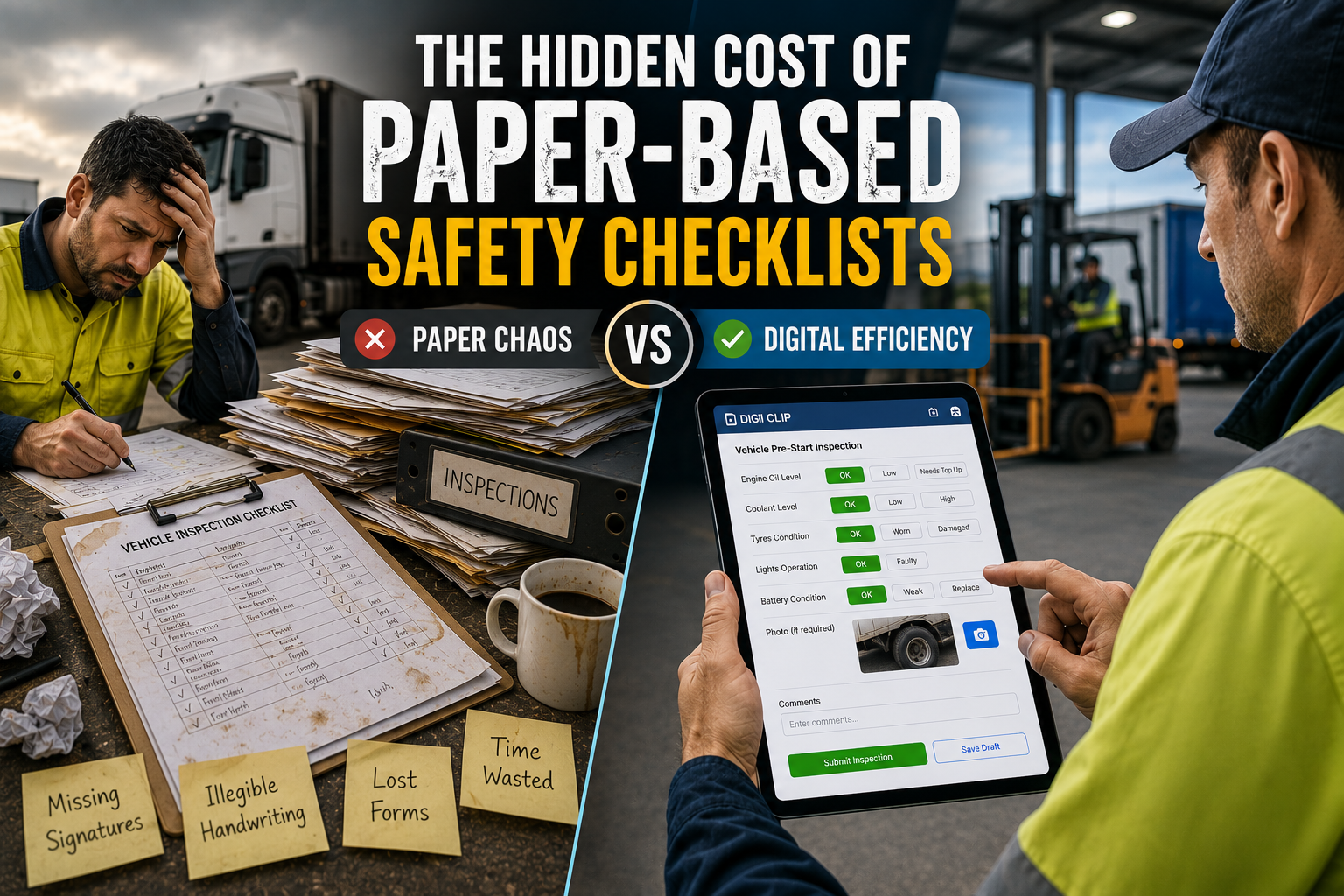
Paper-based safety checklists are manual inspection and compliance forms used to record safety, maintenance, and operational checks for vehicles, equipment, worksites, facilities, and field activities.
The Real Cost of Paper-Based Safety Checklists: Digital Forms ROI & Compliance Efficiency Explained
Many organisations still rely on paper-based safety checklists for vehicle inspections, equipment checks, hazard reporting, toolbox talks, maintenance records, and operational compliance.
At first glance, paper can feel simple and inexpensive. But the real cost is rarely the paper itself.
The bigger cost usually comes from labour, manual follow-up, lost information, delayed corrective actions, incomplete records, and the time managers spend chasing paperwork.
This article uses a realistic worked scenario to explain digital forms ROI, practical inspection software savings, and how digital checklists can support better compliance efficiency.
This example is illustrative only and is not a guaranteed outcome for every business.
Safe Work Australia highlights the broader economic value of reducing work-related injuries and illnesses, while WorkSafe Tasmania notes that WHS record keeping can apply to areas such as incident reports, inspections, risk assessments, training records, and plant-related records.
Key Takeaways
- Paper-based processes often create hidden labour and administration costs.
- Digital forms can reduce manual handling, scanning, filing, and follow-up.
- The worked example shows a potential labour saving of approximately A$73,710 per year.
- Actual ROI varies based on form volume, labour rates, users, and current inefficiencies.
- The biggest benefit is often operational confidence, not just cost reduction.
- The Hidden Cost of Paper-Based Safety Checklists
- A Realistic Operational ROI Example
- How Digital Forms Improve Compliance Efficiency
- Inspection Software Savings Explained
- Hidden Operational Costs Most Businesses Ignore
- Industries Seeing the Biggest Gains
- About DIGI CLIP Mobile Forms
- Frequently Asked Questions
The Hidden Cost of Paper-Based Safety Checklists
Paper systems often appear inexpensive because the visible cost is low. Printing, clipboards, folders, and filing cabinets do not look expensive on their own.
However, the true cost usually sits in the process around the paperwork.
- Forms need to be completed manually.
- Supervisors often need to chase missing paperwork.
- Completed forms may need to be scanned, filed, or entered into spreadsheets.
- Defects and hazards can be delayed before reaching the right person.
- Audit preparation can take longer because records are harder to find.
For businesses completing daily inspections across vehicles, equipment, sites, and teams, those small delays can add up quickly.
A Realistic Operational ROI Example
This worked example assumes 15 workers, 3 forms per worker per day, 5 working days per week, 52 weeks per year, and an average fully loaded labour rate of A$42 per hour.
Example Business Scenario
- 15 workers completing inspections and safety checklists.
- 3 forms completed per worker per day.
- 45 total forms completed per day.
- 5 working days per week.
- 52 weeks per year.
- Average labour rate: A$42/hour fully loaded.
Paper-Based Workflow
| Paper Process Task | Average Time |
|---|---|
| Completing paperwork | 8 minutes |
| Chasing, signing, scanning, and filing | 4 minutes |
| Manual data entry or follow-up | 3 minutes |
| Total per form | 15 minutes |
45 forms × 15 minutes = 675 minutes, or 11.25 labour hours per day.
11.25 hours × 5 days × 52 weeks = 2,925 hours per year.
2,925 hours × A$42/hour = A$122,850 per year.
How Digital Forms Improve Compliance Efficiency
With a digital checklist system like DIGI CLIP, many of the manual steps around paperwork can be reduced.
Digital workflows can support:
- Smart fields that reduce repetitive typing.
- Mandatory fields that improve form completion quality.
- Instant photo capture for defects, hazards, and evidence.
- Time-stamped digital records.
- Faster reporting to managers and supervisors.
- Digital corrective action tracking.
- Cloud-based storage for easier retrieval.
Using a conservative digital completion average of 6 minutes per form:
45 forms × 6 minutes = 270 minutes, or 4.5 labour hours per day.
4.5 hours × 5 days × 52 weeks = 1,170 hours per year.
1,170 hours × A$42/hour = A$49,140 per year.
Inspection Software Savings Explained
Inspection software savings are not limited to faster form completion. They can also come from reduced administration, fewer manual follow-ups, faster issue escalation, and better access to records.
| Cost Area | Estimated Annual Value |
|---|---|
| Paper-based labour cost | A$122,850/year |
| Digital workflow labour cost | A$49,140/year |
| Estimated labour saving | A$73,710/year |
| Printing and administration saving | A$2,000–A$6,000/year |
| DIGI CLIP Lite subscription | 15 users × A$3.50/month × 12 = A$630/year |
| Estimated net saving | A$74,000–A$78,000/year |
Subscription note: this example is based on DIGI CLIP Lite pricing at A$3.50 per user per month. View current pricing at DIGI CLIP pricing.
Actual ROI varies based on form volume, labour rates, number of users, selected plan, and current process inefficiencies.
Hidden Operational Costs Most Businesses Ignore
Some of the biggest costs are not always visible in a spreadsheet.
Paper-based systems can contribute to:
- Supervisors chasing incomplete forms.
- Delayed defect reporting.
- Lost or damaged records.
- Incomplete inspection evidence.
- Slower incident investigations.
- Repeated defects being missed.
- More time spent preparing for audits.
Digital systems can help reduce these issues by making records easier to complete, submit, review, retrieve, and action.
For many businesses, the biggest benefit is operational confidence: knowing inspections are being completed, issues are visible, and actions are being followed up.
Industries Seeing the Biggest Gains
Digital forms ROI is often strongest in businesses where inspections are frequent, mobile, or compliance-heavy.
Transport and Logistics
- Vehicle pre-start inspections.
- Driver compliance checks.
- Load restraint inspections.
- Maintenance and defect reporting.
Warehousing and Distribution
- Forklift checks.
- Pallet racking inspections.
- Cold storage inspections.
- Housekeeping and safety audits.
Agriculture and Field Operations
- Plant and machinery inspections.
- Food safety checks.
- Biosecurity records.
- Remote field reporting.
Local Councils and Multi-Site Teams
- Asset inspections.
- Facilities checks.
- Contractor reporting.
- Field maintenance inspections.
Ready to Simplify Compliance?
Replace paper forms with mobile checklists, digital records, photo evidence, and faster reporting.
Supported 14-day free trial. No credit card required. Set up in minutes.
About DIGI CLIP Mobile Forms
DIGI CLIP is a mobile checklist and inspection app designed to simplify safety, compliance, and operational reporting.
Designed for transport, warehousing, agriculture, construction, local government, and field operations, DIGI CLIP helps replace paper forms with real-time digital checklists.
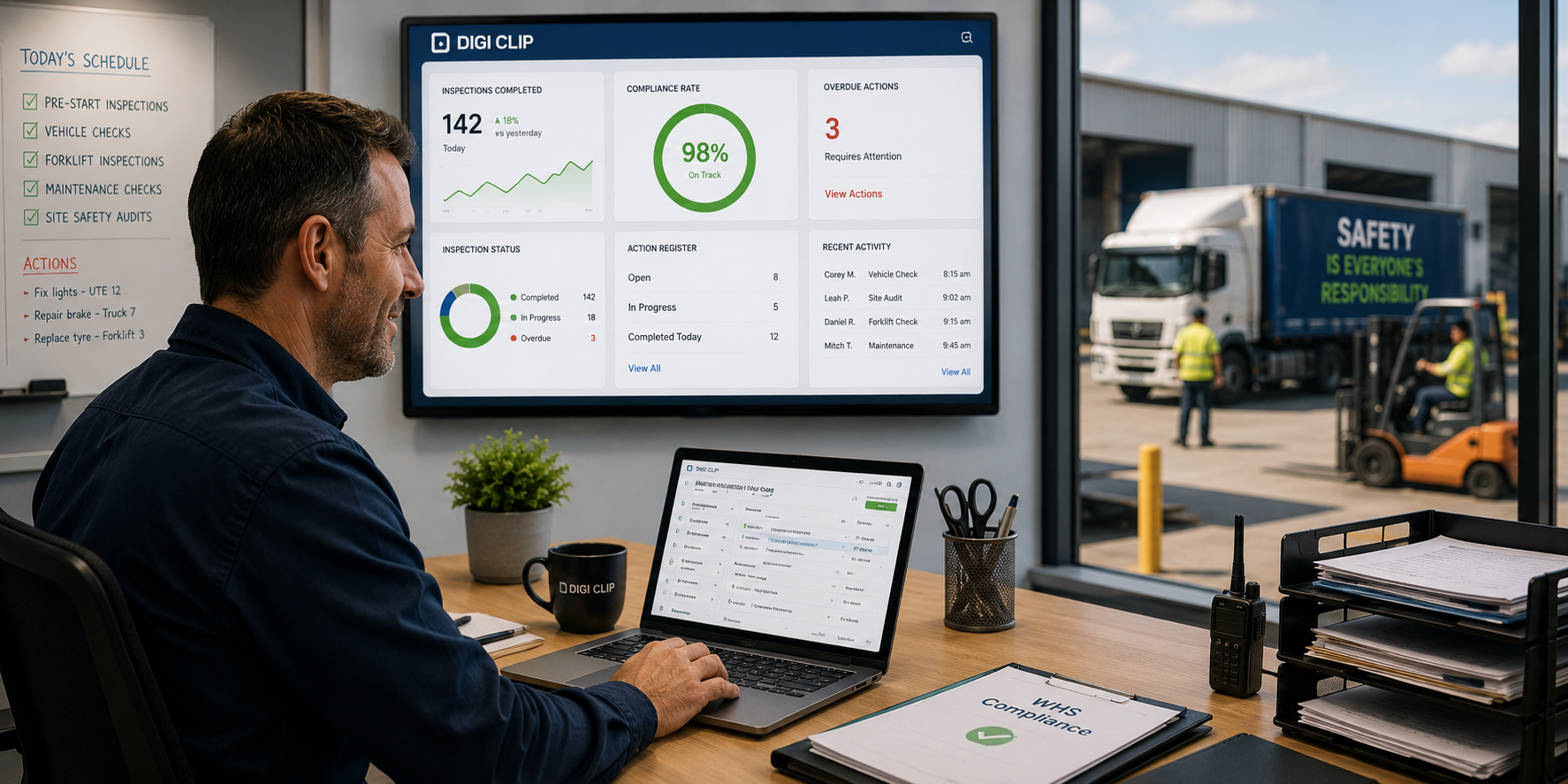
Features such as photo capture, automated alerts, geo-time stamping, and the Action Register help improve visibility, accountability, and compliance efficiency.
Frequently Asked Questions
What are paper-based safety checklists?
Paper-based safety checklists are manual forms used to record inspections, maintenance checks, hazard reporting, and workplace compliance activities using physical paperwork.
How do digital forms improve compliance efficiency?
Digital forms improve compliance efficiency by making inspections easier to complete, submit, review, store, and retrieve.
What are the biggest inspection software savings?
The biggest inspection software savings often come from reduced labour hours, less manual administration, faster reporting, and improved access to inspection records.
How much ROI can businesses expect from digital forms?
Digital forms ROI depends on the number of forms completed, labour rates, user numbers, selected subscription plan, and how inefficient the current paper process is.
Can digital checklists improve audit readiness?
Yes. Digital checklists can support audit readiness by creating searchable, time-stamped records that are easier to access when evidence is required.
Which industries benefit most from digital inspections?
Transport, warehousing, agriculture, construction, local government, manufacturing, and field service teams often benefit from digital inspections.
Conclusion
The true cost of paper-based safety checklists is rarely just paper.
For many organisations, the larger cost comes from labour, manual follow-up, delayed reporting, incomplete evidence, and time spent preparing records for audits or reviews.
Digital forms can improve compliance efficiency, reduce administrative friction, and create practical inspection software savings.
Most importantly, they help managers gain confidence that inspections are being completed, issues are visible, and corrective actions are being followed up.
DIGI CLIP was built for real-world operations that need simple, practical, mobile-first checklist and inspection software without unnecessary complexity.




Leave A Comment