Last updated:
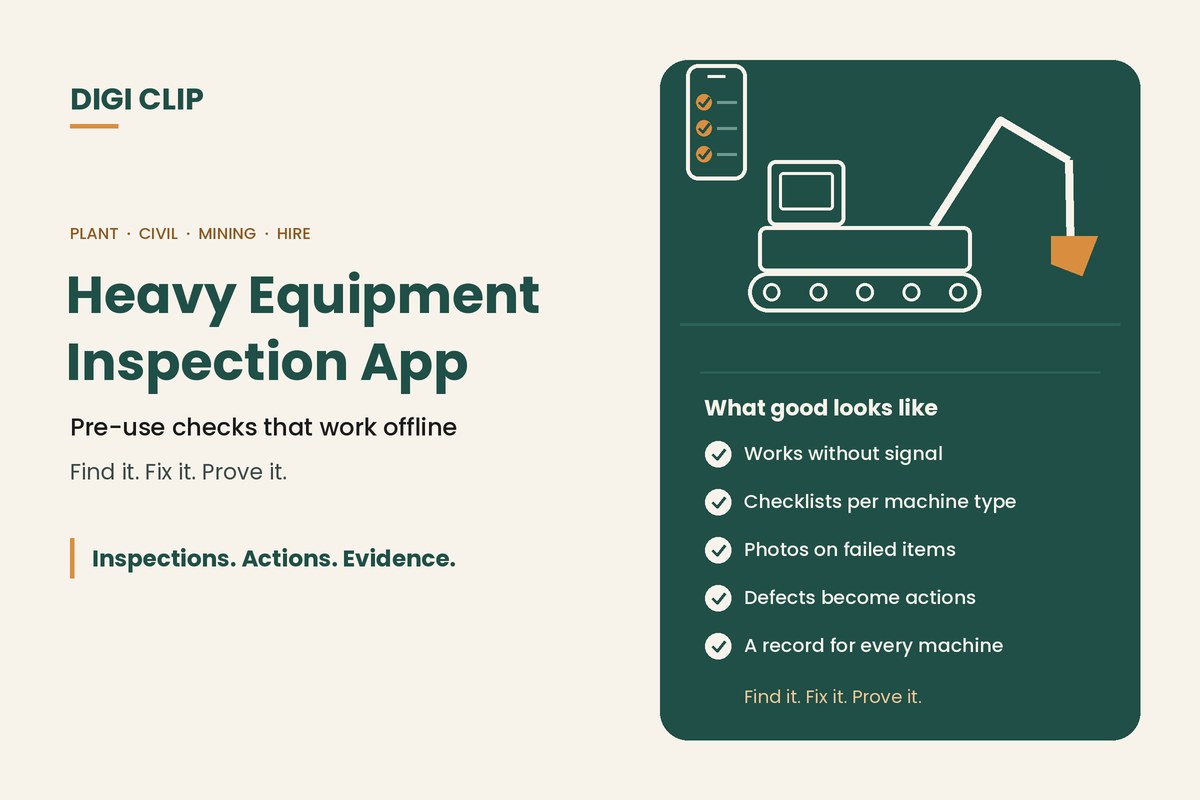
A heavy equipment inspection app lets operators complete pre-use checks and inspections on plant such as excavators, loaders, rollers and cranes using a phone or tablet. Failed items are captured with photos, turned into actions for the right person, and kept as a record for each machine.
Heavy Equipment Inspection App: Pre-Use Checks That Work Offline and Close the Loop
Paper pre-start books have kept plant moving for decades, but they are slow to report defects, hard to search and easy to tick without really checking. An inspection app puts the checklist on the operator’s phone, works where there’s no signal, and gets faults to the workshop while the machine is still on site. This guide covers what to look for in an app, what Australian WHS law expects for plant, and how to roll one out across your fleet.
Key points
- Look for offline use, checklists per machine type, photos on failed items and a clear path from defect to repair.
- Under WHS law, plant must be maintained and inspected by a competent person, and damaged plant should be taken out of service until the risk is controlled.
- Operator pre-use checks are the first line of defence between scheduled services.
- Keep a record for each machine, so you can show what was checked, what failed and how it was fixed.
- Start with one machine type, then roll out across the fleet.
Why move equipment inspections off paper
Plant works hard in dusty, remote and wet places, which is exactly where paper struggles. Common problems include:
- Defects reported late: a fault written in the pre-start book may not reach the workshop until the book comes back to the office.
- No evidence: “hydraulic leak” doesn’t show where the leak is or how bad it looks.
- Tick and flick: a column of ticks doesn’t show whether each item was actually checked.
- Hard to find: when you need a machine’s history after an incident or before a service, it’s spread across books and folders.
- Hired plant: machines move between sites and companies, and their paperwork doesn’t always follow them.
What to look for in a heavy equipment inspection app
Works offline
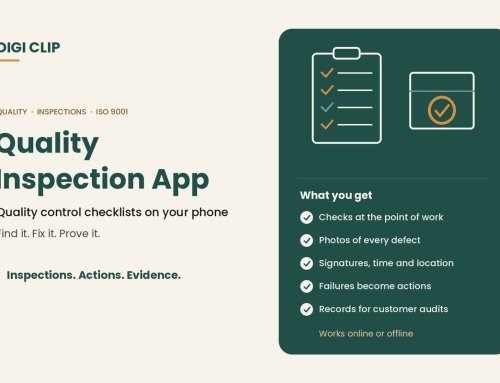
Many sites have patchy or no coverage. Operators should be able to complete a check without signal and submit it once the device is back online. In DIGI CLIP, completed checks are saved to the Offline Folder and submitted with a tap once you’re back in range.
Checklists for each machine type
An excavator, a roller and a telehandler need different checks. You should be able to build and edit checklists for each machine type yourself, based on the manufacturer’s instructions, without waiting on the vendor.
Photos and signatures
A photo of a cracked bucket tooth or a weeping hydraulic fitting tells the fitter far more than a note. Signatures show who completed and who reviewed the check.
Failed items become actions
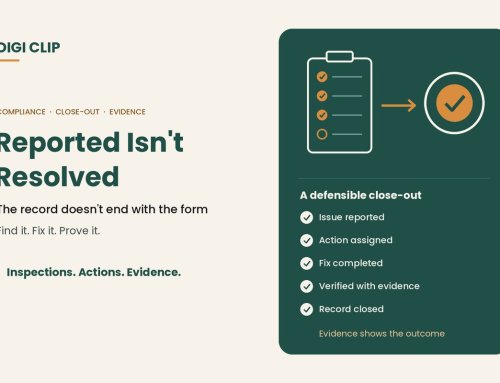
This is the part most apps get wrong. A failed item should create an action, assigned to someone, with a due date, and it should stay open until it is fixed and closed out with evidence. Reporting a defect isn’t the same as resolving it.
A record for each machine
Every check should record which machine was inspected, such as its plant number or rego, along with who completed it and when, so its checks, defects and repairs can be found and exported when you need them.
Simple for operators
If the app is slow or confusing, checks get skipped. Look for large buttons, clear pass and fail options, and a check that takes minutes, not a quarter of an hour.
An audit trail for every pre-use check
After an incident, the questions are always the same: was the machine checked, by whom, what did they find, and was it fixed before it went back to work? A pre-use inspection app should answer all of them without anyone digging through a ute full of pre-start books.
| Question | What DIGI CLIP records |
|---|---|
| Who did the check? | The operator who completed the form, with a digital signature where the form asks for one |
| When and where? | Each form is time-stamped and location-stamped |
| What was found? | Pass and fail answers, comments and photos |
| What happened next? | A “No”, “Not OK” or “At Risk” answer creates an action in the Action Log, and “View source” opens the original check |
| Was it fixed? | Actions are closed out with evidence, using one-step or two-step close-out, and overdue actions trigger escalation emails |
| Can you hand it over? | Records export to PDF, Excel and CSV, including bulk PDF |
What Australian WHS law expects for plant
The model Work Health and Safety Regulations and the Code of Practice for managing the risks of plant set out a business’s duties for plant. In summary:
- Manage the risks: identify hazards and control risks associated with plant, using the hierarchy of controls.
- Maintain and inspect: plant must be maintained, inspected and, where needed, tested by a competent person, following the manufacturer’s recommendations or, if there are none, a competent person’s recommendations.
- Take damaged plant out of service: the Code says plant with damage that poses a risk should be withdrawn from service until those risks have been controlled.
- Keep track of inspections: the Code recommends an up-to-date register of plant that needs regular inspection.
Operator pre-use checks aren’t a substitute for servicing and competent-person inspections, but they catch damage and faults between services. A record of those checks, and what was done about the faults they found, is practical evidence that plant risks are being managed.
Paper vs app: a quick comparison
| What matters | Paper pre-start book | Inspection app |
|---|---|---|
| Getting defects to the workshop | When the book is handed in | As soon as the check is submitted |
| Evidence | Handwritten notes | Photos, notes and signatures |
| Follow-up | Relies on someone reading the book | Failed items become assigned actions |
| Finding a machine’s history | Search through books | Search by machine or date |
| Changing the checklist | Reprint the books | Update the template once |
| No signal on site | Not a problem | Needs an app that works offline |
How to roll out an inspection app
- List your plant. Build a register of the machines you operate or hire, grouped by type, with any inspection and service intervals.
- Build the checklists. Create a pre-use checklist for each machine type from the manufacturer’s instructions and your current pre-start books, and mark the items that stop the machine being used.
- Set up the defect path. Decide who receives failed items, how quickly they are assessed and who signs off repairs.
- Pilot with one crew. Start with one machine type or site, get feedback from operators and fix anything that slows them down.
- Train operators and supervisors. Show operators how to complete a check and report a fault, and show supervisors how to review checks and close out actions.
- Roll out and review. Extend to the rest of the fleet, then review completed checks and recurring defects regularly and update the checklists as you learn.
Construction and earthmoving equipment
On construction and civil sites, the same app can cover every item of mobile plant, with a checklist for each machine type built from the manufacturer’s instructions. Common examples include:
- excavators, including quick hitch and attachment checks (see our excavator pre-start checklist)
- wheel loaders, skid steers, dozers and graders
- rollers, compactors and water carts
- telehandlers and forklifts (see our forklift pre-start checks)
- elevating work platforms, generators and compressors
- hired plant, checked on arrival and before return (see our equipment hire checklist)
For what to check on each machine, see our plant pre-start checklist and the ten most common heavy equipment failures.
Running inspections across sites and larger fleets
Once you have more than a handful of machines, or plant spread across several sites, the challenge shifts from doing checks to knowing they were done. Look for:
- Recurring checks with reminders, so daily and weekly inspections are prompted when they’re due.
- Dashboards, so managers can see completed checks and open actions without chasing paperwork.
- Escalation for overdue actions, so a defect doesn’t sit unresolved while the machine keeps working.
- Flexible users and billing. DIGI CLIP is billed monthly with no minimum users, and users can be added or removed at any time as crews change.
Incidents, hazards and investigations can be managed alongside inspections in Safety Tracker.
Comparing equipment inspection apps
If you’re weighing up options, our inspection checklist app guide sets out the criteria to check, and these comparisons cover specific tools: For cranes, utilities and other asset types, see our asset inspection checklist app guide.
- DIGI CLIP vs SafetyCulture for plant and machinery maintenance
- SafetyCulture (iAuditor) alternative
- Whip Around alternative for fleet inspections
Checklists to start with
You can adapt our free daily pre-start checklists for common plant:
- Excavator daily pre-start checklist (PDF)
- Roller compactor daily pre-start checklist (PDF)
- Grader daily pre-start checklist (PDF)
Or start from our plant pre-start checklist and equipment inspection checklist template pages. For what to check on specific machines, see our excavator pre-start guide and daily plant equipment safety checks.
Illustrative scenario: a cracked bucket tooth adapter
An excavator operator on a civil site with no mobile coverage completes his pre-use check in DIGI CLIP and fails the bucket item, adding a photo of a cracked tooth adapter. He submits the check when he drives back into coverage at lunch. The plant manager sees the action, sends a fitter with a replacement the next morning, and the fitter closes out the action with a photo, so the excavator’s record shows the defect, the repair and who signed it off.
This scenario is illustrative. It shows how a business could use DIGI CLIP and is not an account of a specific customer.
Comparing tools? See our inspection checklist app guide and our DIGI CLIP vs Mitti comparison for plant machinery checks.
Put Your Plant Checks on Every Operator’s Phone
Pre-use checks that work offline, with defects landing in the Action Log ready to fix and prove.
Start Your 14-Day Free TrialNo credit card required. Set up in minutes.
Frequently asked questions
What is a heavy equipment inspection app?
A heavy equipment inspection app lets operators complete pre-use checks and inspections on plant such as excavators, loaders, rollers and cranes using a phone or tablet. Failed items are captured with photos, turned into actions for the right person, and kept as a record for each machine.
Can equipment inspections be done offline?
Yes, if the app supports it. In DIGI CLIP, operators can complete checklists without coverage. Completed checks are saved to the Offline Folder and submitted with a tap once the device is back online.
What should a heavy equipment pre-use checklist include?
Typically a walk-around for damage and leaks, fluid levels, tyres or tracks, hydraulics, attachments and locking pins, guards, seatbelt and ROPS or FOPS, controls, brakes, emergency stops, and warning devices such as the horn, beacon and reversing alarm. Adjust it to the manufacturer’s instructions for each machine.
Do operator pre-use checks replace plant servicing and inspections?
No. WHS law requires plant to be maintained and inspected by a competent person, following the manufacturer’s recommendations. Operator checks catch damage and faults between those services.
What happens when a machine fails its check?
If the fault creates a risk, the machine should be taken out of service and tagged until it is repaired. In DIGI CLIP, the failed item becomes an action in the Action Log, assigned to someone and closed out with evidence once it is fixed.
Can we use our own checklists?
Yes. You can build checklists from your existing pre-start books and the manufacturer’s instructions, or start from templates in the DIGI CLIP Form Library and adapt them.
Does a heavy equipment inspection app keep an audit trail?
It should. In DIGI CLIP, each check is time- and location-stamped and records who completed it, what was found and any photos. Failed items become actions in the Action Log, linked back to the original check, and are closed out with evidence.
What construction equipment can be inspected with an app?
Any plant you can build a checklist for, including excavators, loaders, skid steers, dozers, rollers, telehandlers, forklifts, elevating work platforms and hired equipment.
Can DIGI CLIP be used across multiple sites?
Yes. Checks from every site come into one account, with dashboards, recurring checks with reminders, and escalation emails for overdue actions. Billing is monthly with no minimum users.
About DIGI CLIP Mobile Forms
DIGI CLIP is an Australian-built mobile checklist and inspection platform. Inspections. Actions. Evidence. Teams complete checks on a phone or tablet, turn defects into assigned actions, and keep the proof that each one was fixed and verified.
See our Form Library for ready-made templates.