
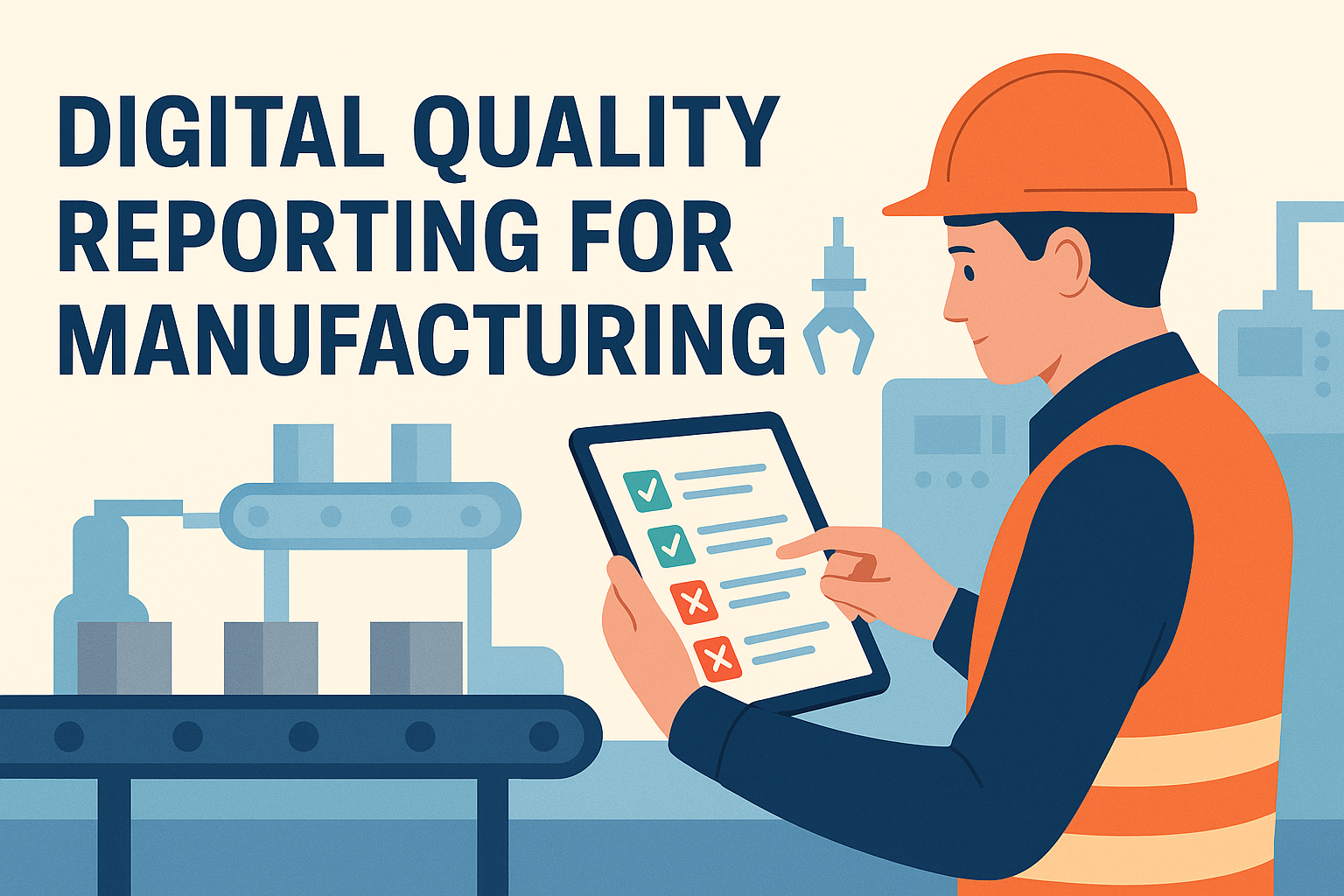
Modern Manufacturing Demands Better Digital Quality Reporting
Replace paper checklists with a unified, digital ecosystem for safety and QA.
Paper-based quality reporting hides defects, slows your lines, and makes every audit feel like a scramble. With DIGI CLIP, digital quality reporting for manufacturing becomes simple, traceable, and action-driven — all from one smart-device app used across the factory floor.
Start Your Free TrialFor many manufacturers, quality reporting still starts with a clipboard. Operators tick boxes on paper, supervisors sign the bottom, and forms are filed away “for audit purposes”. On the surface it looks fine — but underneath, paper-based systems quietly undermine quality, safety, and profitability.
In 2026, continuing to rely on paper for digital quality reporting for manufacturing is an operational risk. It slows down production, makes it harder to spot trends, and leaves you exposed when customers or regulators ask the most important question: “Can you prove what happened, and what you did about it?”
A modern manufacturer needs a single, digital source of truth for both safety and quality. That’s exactly where DIGI CLIP and the Safety Tracker add-on come in — turning your quality control checklists, safety inspections, and corrective actions into real-time, connected data instead of static paper.
Table of Contents
- Why Paper-Based Quality Reporting is Failing Modern Manufacturing
- The Hidden Costs of Paper Quality Control Checklists
- Beyond Quality: Why Safety and Quality Reporting Must Live Together
- How DIGI CLIP Delivers Digital Quality Reporting for Manufacturing
- Paper vs Digital Quality Reporting: Side-by-Side Comparison
- Mini Case Study: From Lost QA Sheets to Audit-Ready in Minutes
- How to Move from Paper QA to Digital Quality Reporting
- About DIGI CLIP Mobile Forms
- FAQs: Digital Quality Reporting in Manufacturing
- Conclusion: It’s Time to Retire the Clipboard
Quick Highlights
- Paper quality reports are slow, fragile, and difficult to trust in high-stakes manufacturing environments.
- Digital quality reporting for manufacturing improves traceability, speed, and audit readiness.
- Quality control checklists, safety inspections, and corrective actions can all live in one unified system.
- DIGI CLIP’s mobile forms, Safety Tracker add-on, and Action Register turn findings into trackable, accountable actions.
- Manufacturers gain a single view of safety and quality performance across lines, shifts, and sites.
Why Paper-Based Quality Reporting is Failing Modern Manufacturing
On the factory floor, speed and precision are everything. Yet many plants still rely on handwritten forms, spreadsheet uploads, and filing cabinets to manage quality control. It’s a workflow built for a different era — one that simply can’t keep up with today’s demand for real-time visibility and proof of compliance.
In practice, paper quality control checklists often become:
- Hard-to-read records with rushed handwriting and inconsistent terminology.
- Partially completed forms, skipped sections, or “tick and flick” behaviour during busy production runs.
- Static documents that are filed and forgotten, instead of actively reviewed and analysed.
- Missing, damaged, or misplaced when customers or auditors ask for evidence.
None of this means your team doesn’t care about quality. It simply means the system they’re using is working against them. Paper is fragile, slow to move, and makes trend analysis almost impossible. By the time an issue is discovered in a spreadsheet or folder, the defective product may already be in the market.
Modern manufacturing needs more than a “paper trail” — it needs a live, digital record of what was checked, what was found, and how quickly you responded.
The Hidden Costs of Paper Quality Control Checklists
The obvious cost of paper is ink and printing. The real cost sits in all the manual effort wrapped around it: chasing forms, re-keying data, clarifying illegible entries, and pulling reports together when something goes wrong.
Paper-based quality reporting quietly increases:
- Rework and scrap, because patterns of defects are only spotted after the fact – if at all.
- Administrative overhead, as supervisors manually collate checklists and enter data into spreadsheets.
- Compliance risk, when evidence is incomplete, missing, or open to interpretation.
- Conflict between teams, when operations and QA are working from different versions of the truth.
Research on digital safety and health tools has shown that moving from paper to digital significantly improves access to critical information, encourages consistent use of best-practice checklists, and makes it easier to act on the data you collect. Similar findings have been published by RMIT on digital technology and WHS knowledge and EU-OSHA on smart digital systems .
When you apply the same logic to manufacturing QA, the message is clear: a digital system for quality reporting isn’t a “nice to have” — it’s an enabler of consistent, reliable, and defendable quality performance.
Beyond Quality: Why Safety and Quality Reporting Must Live Together
In real factories, safety issues and quality issues rarely exist in separate worlds. The same underlying conditions often drive both. Examples include:
- Worn or poorly maintained equipment leading to both unsafe conditions and repeat defects.
- Poor housekeeping increasing trip hazards and the risk of product contamination or damage.
- Incorrect machine settings impacting operator safety as well as product specifications.
When safety checks live in one system and quality checks live in another — or worse, both live on paper — it’s almost impossible to see the full picture. You can’t easily answer questions like:
- “Are the same root causes sitting behind our incidents and our non-conformances?”
- “Do we have recurring problems on a particular line, shift, or with a particular product?”
- “Have we actually implemented and verified the corrective actions we agreed?”
A genuinely modern approach to digital quality reporting for manufacturing brings safety and quality data together. Inspections, hazards, near misses, incidents, product checks, and sign-offs all feed into the same ecosystem — with a shared action register ensuring that nothing is forgotten.
That’s the model DIGI CLIP is built for. The core mobile forms platform handles digital inspections, while the optional Safety Tracker module and central Action Register ensure every issue flows into a trackable action list.
How DIGI CLIP Delivers Digital Quality Reporting for Manufacturing
DIGI CLIP replaces paper forms with structured digital checklists that operators complete on a mobile device. For manufacturers, it becomes the backbone of a practical, real-world digital quality reporting for manufacturing solution that includes:
- Inward goods and supplier quality inspections.
- In-process and in-line checks at critical control points.
- End-of-line and pre-dispatch quality control checklists.
- Safety inspections, near-miss reports, and incident investigations.
Each digital checklist can be tailored to your processes, products, and customers. Mandatory fields prevent “half-finished” records. Photo capture enforces visual evidence at key steps. And all data flows into a central system instead of scattered across clipboards and spreadsheet tabs.
Digital Inspection Apps Purpose-Built for Manufacturing QA
Many generic apps allow basic note-taking or simple tick lists. DIGI CLIP supports rich, configurable digital inspection apps that are designed around manufacturing QA. You can design quality control checklists that include:
- Specific product attributes, tolerances, and test points.
- Pass/fail and numeric measurement fields for key criteria.
- Conditional logic that shows additional questions when a defect is recorded.
- Mandatory photos where visual evidence is required.
Because this data is captured digitally at the source, there’s no second step of re-keying it into spreadsheets. That means fewer errors, faster reporting, and a clear, timestamped record of every inspection for your manufacturing QA program.
Quality Assurance Software That Works Hand-in-Hand with Safety
Traditional quality assurance software often focuses on procedures, documents, and accreditation. DIGI CLIP and Safety Tracker focus on what happens on the floor: the checks you perform, the hazards you see, the incidents you record, and the actions you assign.
Safety Tracker captures incident and hazard information, while the Action Register brings safety and quality actions together in one central list. Supervisors can see every open action, filter by due date or status, and ensure nothing falls through the cracks.
To see how this integrated approach supports safety, quality, and maintenance together, explore: Digital Checklists for Manufacturing: Safety, Quality & Maintenance .
Paper vs Digital Quality Reporting: Side-by-Side Comparison
| Aspect | Paper-Based QA Reporting | Digital Quality Reporting with DIGI CLIP |
|---|---|---|
| Data capture | Handwritten forms, often incomplete, inconsistent, or hard to interpret. | Structured digital forms with required fields and clear response options. |
| Evidence | Photos are rare, stored separately, or get lost between devices and paper. | Photo capture embedded directly into checklists and attached to each record. |
| Action tracking | Actions scribbled in margins or passed verbally; easy to lose or forget. | Centralised Action Register with owners, due dates, and close-out status. |
| Reporting speed | Slow; relies on manual collation, spreadsheet updates, and ad hoc summaries. | Real-time dashboards and exports; issues and trends visible almost instantly. |
| Audit readiness | Requires searching through physical folders or network drives at short notice. | Filter and export digital records in minutes, with evidence attached. |
| Integration of safety & quality | Separate forms and systems for safety and quality, leading to siloed insights. | Safety, quality, and maintenance reporting on one platform with shared actions. |
Mini Case Study: From Lost QA Sheets to Audit-Ready in Minutes
A mid-sized manufacturer of packaged goods relied on paper forms for line checks, final inspections, and safety walk-arounds. On the surface, everything looked organised — each line had its own folder and colour-coded paperwork. But when a major customer asked for six months of quality evidence during an audit, the cracks showed.
- Some folders were missing key weeks of QA checks.
- Several forms were illegible or only half completed.
- There was no simple way to prove which corrective actions were actually closed out.
The team moved to DIGI CLIP mobile forms with the Safety Tracker add-on. They digitised their most critical quality control checklists and safety inspections first, then gradually expanded coverage. Within weeks:
- Operators were completing quality and safety inspections on tablets, with required photos at key steps.
- Non-conformances and hazards automatically generated actions in the Action Register.
- Supervisors could see open actions across lines and shifts in one real-time view.
At their next audit, the QA Manager was able to filter and export six months of digital quality reporting for manufacturing in minutes. Every record included a timestamp, the person who submitted it, and any linked actions. Instead of scrambling for paperwork, the team walked the auditor through a clear, digital trail — and passed with confidence.
How to Move from Paper QA to Digital Quality Reporting
Transitioning from paper doesn’t have to be disruptive. A phased, practical approach lets your teams adapt while you steadily build a stronger foundation for quality and safety.
-
Start with your highest-impact checklists.
Identify the quality control checklists that carry the most risk or administrative weight — for example, CCP checks, final release inspections, or safety-critical tasks. These are your first candidates for digital forms. -
Mirror your existing forms in a digital template.
Rebuild the paper form inside DIGI CLIP. Keep the structure familiar, then use digital advantages like mandatory fields, dropdowns, and photo capture to reduce ambiguity and incomplete records. -
Connect findings to actions.
Decide which responses should trigger automatic actions in the Action Register. This turns each digital inspection into an opportunity to improve, not just to record what went wrong. -
Pilot on one line or production area.
Roll out digital inspection apps to a single area first. Gather feedback, fine-tune the forms, and demonstrate early wins such as reduced rework or faster reporting. -
Extend to safety, maintenance, and compliance checks.
Once your team is comfortable with digital quality reporting, expand to safety inspections, near-miss reports, and basic maintenance checks. Over time, you build one ecosystem for operational risk and performance. For additional context on why SMBs move away from paper, see Top 10 Pain Points Driving SMBs from Paper to Digital Safety Checklists .
About DIGI CLIP Mobile Forms
DIGI CLIP is a mobile checklist and inspection app that simplifies safety, compliance, and operational reporting. Designed for industries including transport, warehousing, agriculture, construction, and manufacturing, DIGI CLIP replaces paper forms with real-time digital checklists that are easy to complete, share, and analyse.
With DIGI CLIP, you can:
- Standardise safety, quality, and maintenance inspections across sites and shifts.
- Capture photos, comments, and supporting evidence directly from the production floor.
- Trigger automated alerts and track close-out through the central Action Register.
- Use geo-time stamping to verify when and where inspections were completed.
Why Try DIGI CLIP?
Because safety and quality actions don’t count unless you can prove them. DIGI CLIP helps you show exactly
what was checked, what was found, and what you did next — with a clear digital trail that supports customers,
auditors, and regulators alike.
FAQs: Digital Quality Reporting for Manufacturing
What is digital quality reporting for manufacturing?
Digital quality reporting for manufacturing is the process of capturing, managing, and analysing quality data using digital tools instead of paper forms and standalone spreadsheets. It uses mobile checklists, structured fields, and evidence such as photos to create accurate, traceable, audit-ready records of inspections, tests, and non-conformances.
How does DIGI CLIP support manufacturing QA?
DIGI CLIP enables you to design and deploy digital inspection apps and quality control checklists tailored to your products and processes. Operators complete inspections on a mobile device, add comments and photos, and submit data instantly. Supervisors can review results in real time, monitor trends, and track corrective actions through the Action Register.
Can I track safety and quality in the same system?
Yes. With the Safety Tracker add-on module and the shared Action Register, DIGI CLIP lets you capture safety incidents, hazards, and quality issues in one ecosystem. This means you can manage all corrective actions — whether safety or quality related — from a single, central list.
Does digital quality reporting replace my existing QMS or ERP?
DIGI CLIP does not replace your ERP or your formal quality management system documentation. Instead, it provides the operational layer where inspections and checks are carried out. The digital records and reports from DIGI CLIP can then support your existing QMS and ERP by providing accurate, evidenced data.
How quickly can we move from paper to digital?
Many organisations start with one or two critical forms and can pilot digital quality reporting within days. Because DIGI CLIP forms are configurable, you can mirror your current paper forms initially, then gradually enhance them with mandatory fields, logic, and photo evidence as users become comfortable.
What types of manufacturing environments does DIGI CLIP suit?
DIGI CLIP is suited to a wide range of manufacturing environments, including food and beverage, fabricated metal, transport equipment, packaging, and more. If your operations rely on repeatable inspections, traceability, and robust safety and quality reporting, DIGI CLIP can help.
Where can I learn more about digital checklists for manufacturing?
You can learn more by visiting DIGI CLIP’s dedicated page on digital checklists for manufacturing safety, quality, and maintenance .
Conclusion: It’s Time to Retire the Clipboard
Paper served manufacturing well for decades, but it no longer matches the speed, complexity, and compliance pressures of today’s environment. Lost forms, incomplete records, and delayed insights are more than annoyances — they expose your organisation to quality failures, brand damage, and regulatory risk.
By embracing digital quality reporting for manufacturing, you move from fragile paperwork to reliable, actionable data. DIGI CLIP brings together manufacturing QA, safety inspections, and corrective actions in a single platform. Operators complete checklists on a mobile device, supervisors manage actions through the Action Register, and managers gain visibility across lines, shifts, and sites.
If you are ready to retire the clipboard, prove your safety and quality actions, and reduce audit stress, now is the perfect time to make the shift to digital.
If you liked this post, why not share it!





Leave A Comment