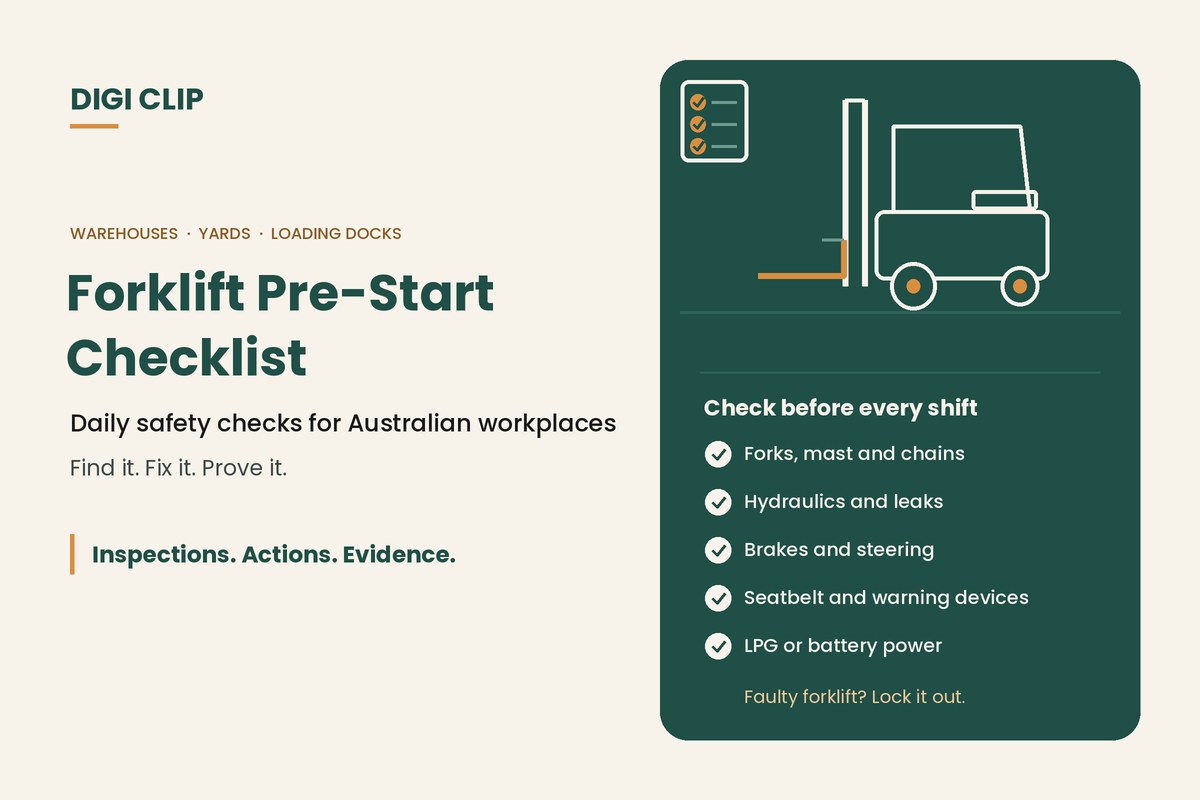
A forklift pre-start check is the short inspection an operator completes before using a forklift: at the start of each shift, and whenever a different operator or a different forklift is involved. It covers the forklift’s condition, controls, safety devices and attachments, so defects are found and the forklift is taken out of service before anyone is hurt.
Forklift Pre-Start Checklist: Daily Safety Checks for Australian Workplaces
Forklifts do the heavy lifting in Australian warehouses, yards and loading docks, and when something goes wrong the consequences can be serious, particularly for people on foot nearby. A good pre-start check takes a few minutes, follows the same order every time and catches the faults that turn a routine shift into an incident. This guide covers what to check, when to check it, what should take a forklift out of service, and the extra checks for LPG, electric and truck-mounted forklifts.
Key points
- Check the forklift at the start of each shift, before its first use for the day, and whenever the operator or the forklift changes.
- Work in a set order: walk-around, fluids and power source, seat and controls, then function tests.
- Any fault that makes the forklift unsafe means it is locked out and tagged until a competent person repairs it.
- Most forklifts need an operator with a high risk work licence, and the checks help show the plant is being kept safe to use.
- Digital checks get failed items, with photos, to the right person straight away.
Quick checklist: 12 forklift pre-start checks
- Tyres and wheels: no cuts, chunking or flat spots, wheel nuts secure, pneumatic tyres at the right pressure
- Forks: no cracks, bends or excessive heel wear, locking pins in place, forks level
- Mast and chains: chains evenly tensioned and lubricated, no damaged links, rollers and stops in place
- Hydraulics: no leaks from cylinders, hoses or fittings, hydraulic oil at the correct level
- Overhead guard and load backrest: in place, secure and undamaged
- Data plate and load chart: present, legible and matching any attachment fitted
- Attachments: correctly fitted, secured and rated for the job
- Power source: fuel or LPG cylinder secure with no leaks, or battery connectors and cables in good condition and charged
- Seat and seatbelt: seat secure, seatbelt or operator restraint working
- Brakes: service brake and park brake hold, inching pedal works
- Steering: smooth, with no excessive free play
- Warning devices: horn, lights, beacon, reversing alarm and any pedestrian warning lights working
Use this list as a starting point and adjust it to the manufacturer’s instructions for each forklift. Our equipment inspection checklist template and plant pre-start checklist pages show how to set this up for your whole fleet.
When to do a forklift pre-start check
WorkSafe Victoria’s forklift guidance says pre-operation inspections should happen at the start of each shift, before the forklift’s first use for the day, and when there is a change of operator, in line with the manufacturer’s recommendations. Safe Work Australia’s forklift information sheet also advises checking the forklift every time you use a different one.
In practice, that means:
- At the start of every shift, even if the forklift was used on the previous shift
- When a different operator takes over mid-shift
- When you jump on a different forklift, including a hire or loan unit
- After an attachment is fitted or changed
- After any bump, near miss or repair, before the forklift goes back into use
What Australian WHS law expects
Under the model Work Health and Safety laws, a business must manage the risks of plant, including keeping it maintained and safe to use. For forklifts, the regulators’ guidance points to a few practical expectations:
- Licensed operators: most forklifts need an operator with a high risk work licence. The LF class covers forklift trucks and the LO class covers order-picking forklifts. Pallet trucks and pedestrian-operated trucks are not covered by these classes. Check the rules with your state or territory regulator.
- Checks before use: the forklift and any attachment are checked before use and at the start of each shift.
- A lock-out system: WorkSafe Victoria says businesses should have a system to lock out a forklift or attachment from service when a defect makes it unsafe.
- Maintenance and records: keep records of what was inspected, maintenance carried out, and defects and their repairs, including items still waiting on follow-up.
A completed pre-start check with any defects and repairs recorded is practical evidence that these steps are being taken. It doesn’t replace scheduled servicing by a competent forklift technician.
Step-by-step forklift pre-start check
- Get ready. Make sure the forklift is parked on level ground away from traffic, with the forks lowered, the park brake on and the power off. Check the area around it is clear.
- Do the walk-around. Walk around the forklift and check the tyres, wheels, forks, mast, chains, hydraulic hoses, overhead guard, load backrest and any attachment. Look underneath for fresh leaks, and check the data plate and load chart are legible.
- Check fluids and the power source. Check engine oil, coolant and hydraulic oil where applicable. For LPG, check the cylinder is secure and the hoses and fittings aren’t damaged or leaking. For electric forklifts, check the battery connectors, cables and charge level.
- Check the seat and controls. Adjust the seat, fasten the seatbelt, start the forklift and check the gauges and warning lights. Make sure the controls are clearly labelled and return to neutral.
- Run the function tests. Test the service brake, park brake, inching pedal and steering. Test the horn, lights, beacon and reversing alarm. Raise, lower and tilt the mast through its full range, and operate any attachment.
- Record and report. Complete the checklist, photograph any defect and report it before you start work. If the forklift isn’t safe to use, lock it out and tag it.
LPG, diesel and electric forklifts
LPG forklifts
Check the cylinder is secured in its bracket and fitted as the manufacturer specifies, the valve and coupling aren’t damaged, and the hose isn’t cracked or perished. If you can smell gas, don’t start the forklift: close the valve, keep ignition sources away and report it. Change cylinders only in the designated area, following your site procedure.
Diesel forklifts
Check engine oil, coolant and fuel levels, look for leaks and damaged hoses, and check the exhaust system. Refuel only in the designated refuelling area with the engine off.
Electric forklifts
Check the battery is secure, the connectors and cables aren’t damaged, the charge level is enough for the shift, and the battery compartment is clean and dry. Only trained and authorised people should charge or change batteries. For the full set of electric-specific checks and charging controls, see our electric forklift safety guide.
Defects that take a forklift out of service
Your procedures should list the faults that stop a forklift being used, so operators don’t have to guess. Common examples include:
- Brakes or park brake that don’t hold
- Steering faults or excessive free play
- Cracked, bent or worn forks, or missing fork locking pins
- Damaged, stretched or unevenly tensioned mast chains
- Hydraulic leaks, or a mast that drifts, jerks or won’t hold a load
- A missing or damaged overhead guard or load backrest
- A seatbelt or operator restraint that doesn’t work
- A horn, reversing alarm or warning lights that don’t work
- LPG leaks, or damaged battery cables or connectors
- A missing or illegible data plate or load chart
If you find one, stop, remove the key, lock out and tag the forklift, record the defect with a photo and notify your supervisor or maintenance provider. The forklift should only return to service once the repair is done and recorded. See our guide to lock out, tag out for more on isolating plant.
Truck-mounted forklifts (Moffett-style)
Truck-mounted forklifts, often called Moffetts after one well-known brand, travel on the back of a truck or trailer and are unloaded at each delivery site. They need the normal forklift checks plus a few more, because the forklift becomes part of the load on the road.
- Mounting kit: check the mounting brackets, locking pins and hooks are in place, secure and undamaged, and that the kit suits both the forklift and the truck.
- Restraint: check the chains, straps and tensioners are in good condition, correctly rated and tensioned, and fitted as the manufacturer specifies. The Load Restraint Guide sets out the general performance standards for securing loads on heavy vehicles.
- Before travel: check the forks and mast are stowed, the forklift is locked in its travel position and nothing can move in transit. Do this before leaving the yard and after every delivery.
- Vehicle limits: remember the forklift adds to the vehicle’s mass, axle loads, width and rear overhang.
- Operator training: check with your state or territory regulator which licence and training apply to the model you use.
Add these items to the driver’s truck check so they aren’t missed. Our truck pre-start checklist app lets you combine both in one check.
Paper vs digital forklift checklists
Paper pre-start books are common, but they have well-known weaknesses: Comparing options? Our inspection app buyer's guide sets out the criteria that matter.
- Easy to tick and flick: a column of ticks doesn’t show the checks were actually done.
- Slow to report: a defect written on the morning shift may not reach maintenance until the book is collected.
- No photos: “mast chain damaged” doesn’t show the technician which link or how bad it is.
- Hard to find later: books fill up, get damaged or go missing, often when you most need them.
With DIGI CLIP, operators complete the forklift pre-start check on a phone or tablet, add photos to failed items and submit it on the spot. Checks can be completed without coverage and submitted with a tap once the device is back online. Failed items flow into the Action Log, where they are assigned, tracked and closed out with evidence.
Illustrative scenario: a stretched mast chain
At the start of the morning shift, a warehouse operator runs the mast through its full range as part of her DIGI CLIP forklift check. One chain looks slacker than the other. She fails the item, adds a photo, tags the forklift out and moves to a spare unit. The maintenance provider gets the action straight away, replaces the chain that afternoon and closes out the action with a photo and a note, so the forklift’s record shows the defect, the repair and who signed it off.
This scenario is illustrative. It shows how a business could use DIGI CLIP and is not an account of a specific customer.
Want a ready-made starting point? Our pre-start checklist template page shows how to build a forklift check in DIGI CLIP, and our guide to why pre-start checks matter covers how to close the loop on defects.
Take Your Forklift Checks Digital
Put your forklift pre-start check on every operator’s phone and see defects land in the Action Log, ready to fix and prove.
Start Your 14-Day Free TrialNo credit card required. Set up in minutes.
Frequently asked questions
What is a forklift pre-start check?
A forklift pre-start check is the short inspection an operator completes before using a forklift at the start of each shift, and whenever a different operator or forklift is involved. It covers the forklift’s condition, controls, safety devices and attachments, so defects are found and the forklift is taken out of service before anyone is hurt.
How often should a forklift pre-start check be done?
At the start of each shift and before the forklift’s first use for the day, and again when a different operator takes over or you use a different forklift. It’s also good practice to check after an attachment is changed or after any bump or repair.
Who should complete the forklift pre-start check?
Usually the operator who is about to use the forklift, because they need to know it is safe before they drive it. Scheduled servicing and repairs should be carried out by a competent forklift technician.
What happens if a forklift fails its pre-start check?
If the fault makes the forklift unsafe, don’t use it. Remove the key, lock out and tag the forklift, record the defect with a photo and report it. It should only return to service once a competent person has repaired it and the repair has been recorded.
Do you need a licence to operate a forklift in Australia?
Most forklifts need an operator with a high risk work licence. The LF class covers forklift trucks and the LO class covers order-picking forklifts, while pallet trucks and pedestrian-operated trucks are not covered by these classes. Check the rules for your situation with your state or territory regulator.
Can forklift pre-start checks be done on a phone?
Yes. Many businesses use digital checklists. The important thing is that records are accurate, secure and can be produced when asked. In DIGI CLIP, operators complete the check on a phone or tablet, attach photos and failed items flow to the Action Log.
About DIGI CLIP Mobile Forms
DIGI CLIP is an Australian-built mobile checklist and inspection platform. Inspections. Actions. Evidence. Teams complete checks on a phone or tablet, turn defects into assigned actions, and keep the proof that each one was fixed and verified.
See how it works for transport and logistics teams.